QUESTION IMAGE
Question
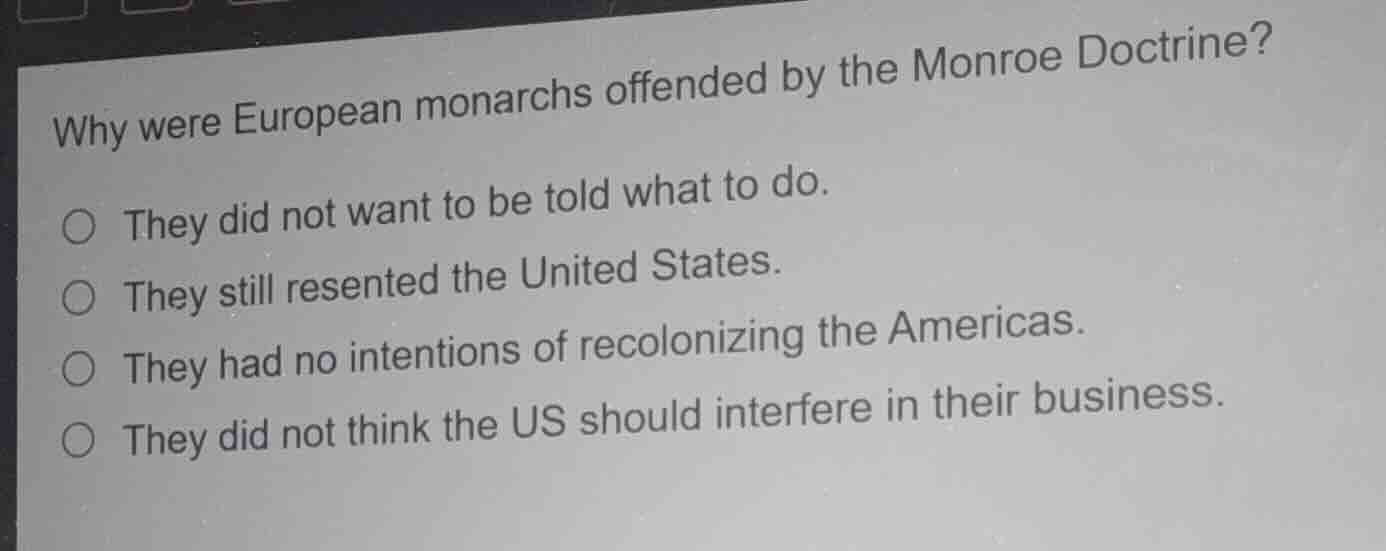
why were european monarchs offended by the monroe doctrine?
they did not want to be told what to do.
they still resented the united states.
they had no intentions of recolonizing the americas.
they did not think the us should interfere in their business.
Analyze the Monroe Doctrine's core message
Using the Monroe Doctrine and Monroe Doctrine Context knowledge points, we recall that in 1823, President James Monroe declared that the Western Hemisphere was closed to further European colonization and that any attempt by European powers to intervene in the Americas would be viewed as a hostile act toward the United States.
Evaluate European monarchs' perspective
European monarchs, particularly those of the Holy Alliance, viewed the United States as a young, relatively weak republic. They found it offensive and presumptuous that a minor global power would attempt to dictate where European empires could or could not establish influence or colonies.
Assess the given options
- "They did not want to be told what to do.": This directly captures the offense taken by powerful, established European monarchs at being lectured or restricted by a young republic.
- "They still resented the United States.": While some resentment existed (especially from Britain or Spain), this was not the primary reason they were specifically offended by this unilateral policy statement.
- "They had no intentions of recolonizing the Americas.": Many European powers, particularly Spain, did have desires or plans to reclaim lost colonies in Latin America.
- "They did not think the US should interfere in their business.": While true in a general sense, the primary offense of the doctrine itself was the unilateral declaration telling European empires what they could and could not do in the Western Hemisphere.

Snap & solve any problem in the app
Get step-by-step solutions on Sovi AI
Photo-based solutions with guided steps
Explore more problems and detailed explanations
- (A) They did not want to be told what to do. (Correct answer)
- (B) They still resented the United States.
- (C) They had no intentions of recolonizing the Americas.
- (D) They did not think the US should interfere in their business.