QUESTION IMAGE
Question
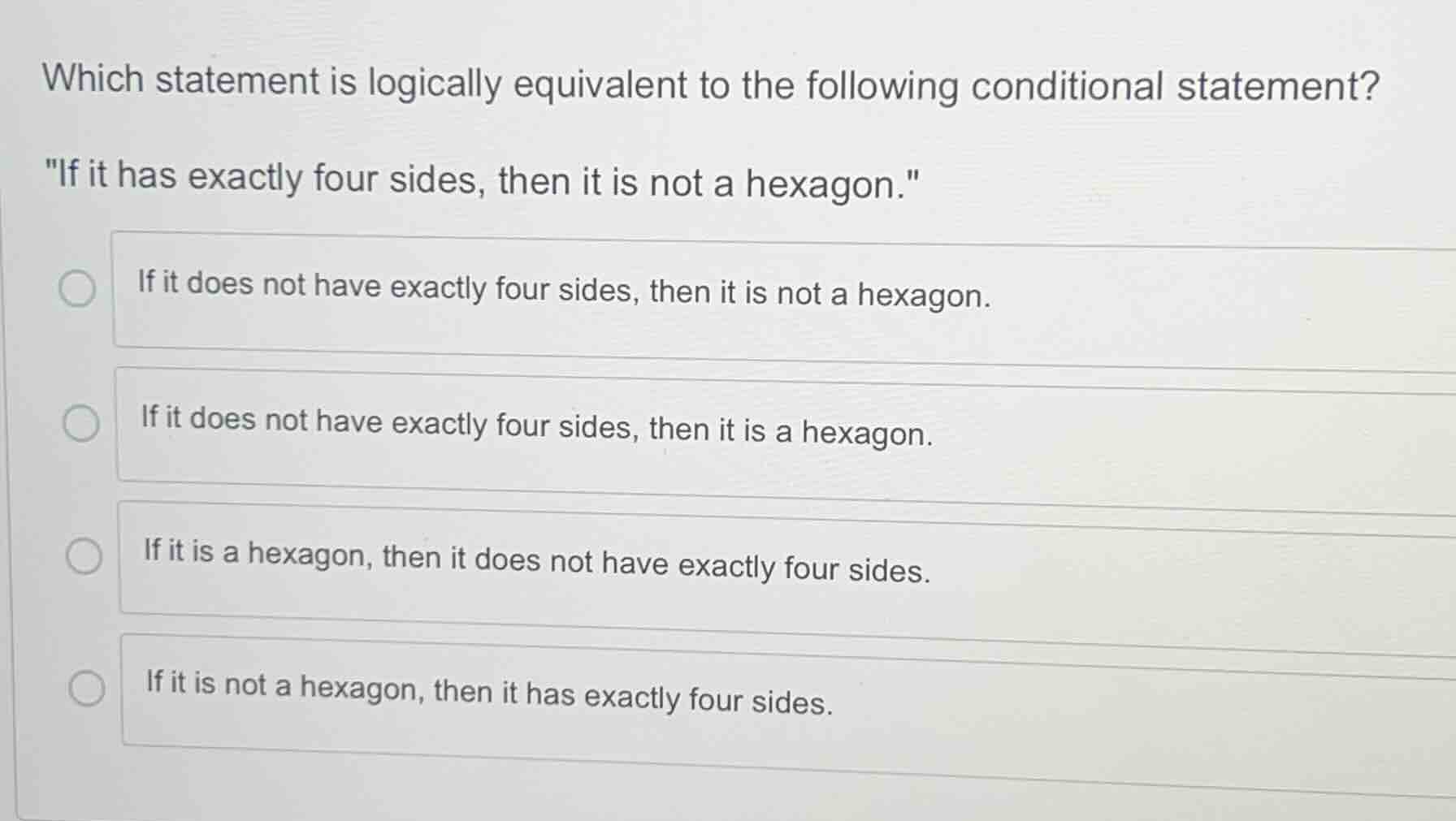
which statement is logically equivalent to the following conditional statement?
\if it has exactly four sides, then it is not a hexagon.\
- if it does not have exactly four sides, then it is not a hexagon.
- if it does not have exactly four sides, then it is a hexagon.
- if it is a hexagon, then it does not have exactly four sides.
- if it is not a hexagon, then it has exactly four sides.
Identify the conditional statement components
The given conditional statement is: "If it has exactly four sides, then it is not a hexagon."
Let \(p\) be "it has exactly four sides".
Let \(q\) be "it is not a hexagon".
The statement is represented symbolically as \(p
ightarrow q\).
Determine the logically equivalent form
A conditional statement \(p
ightarrow q\) is logically equivalent to its contrapositive, \(
eg q
ightarrow
eg p\).
The negation of \(q\) (\(
eg q\)) is: "it is a hexagon".
The negation of \(p\) (\(
eg p\)) is: "it does not have exactly four sides".
Therefore, the contrapositive is: "If it is a hexagon, then it does not have exactly four sides."
Match with the given options
Option 1: "If it does not have exactly four sides, then it is not a hexagon." (\(
eg p
ightarrow q\))
Option 2: "If it does not have exactly four sides, then it is a hexagon." (\(
eg p
ightarrow
eg q\))
Option 3: "If it is a hexagon, then it does not have exactly four sides." (\(
eg q
ightarrow
eg p\))
Option 4: "If it is not a hexagon, then it has exactly four sides." (\(q
ightarrow p\))
The third option matches the contrapositive.

Snap & solve any problem in the app
Get step-by-step solutions on Sovi AI
Photo-based solutions with guided steps
Explore more problems and detailed explanations
- (A) If it does not have exactly four sides, then it is not a hexagon.
- (B) If it does not have exactly four sides, then it is a hexagon.
- (C) If it is a hexagon, then it does not have exactly four sides. (Correct answer)
- (D) If it is not a hexagon, then it has exactly four sides.