QUESTION IMAGE
Question
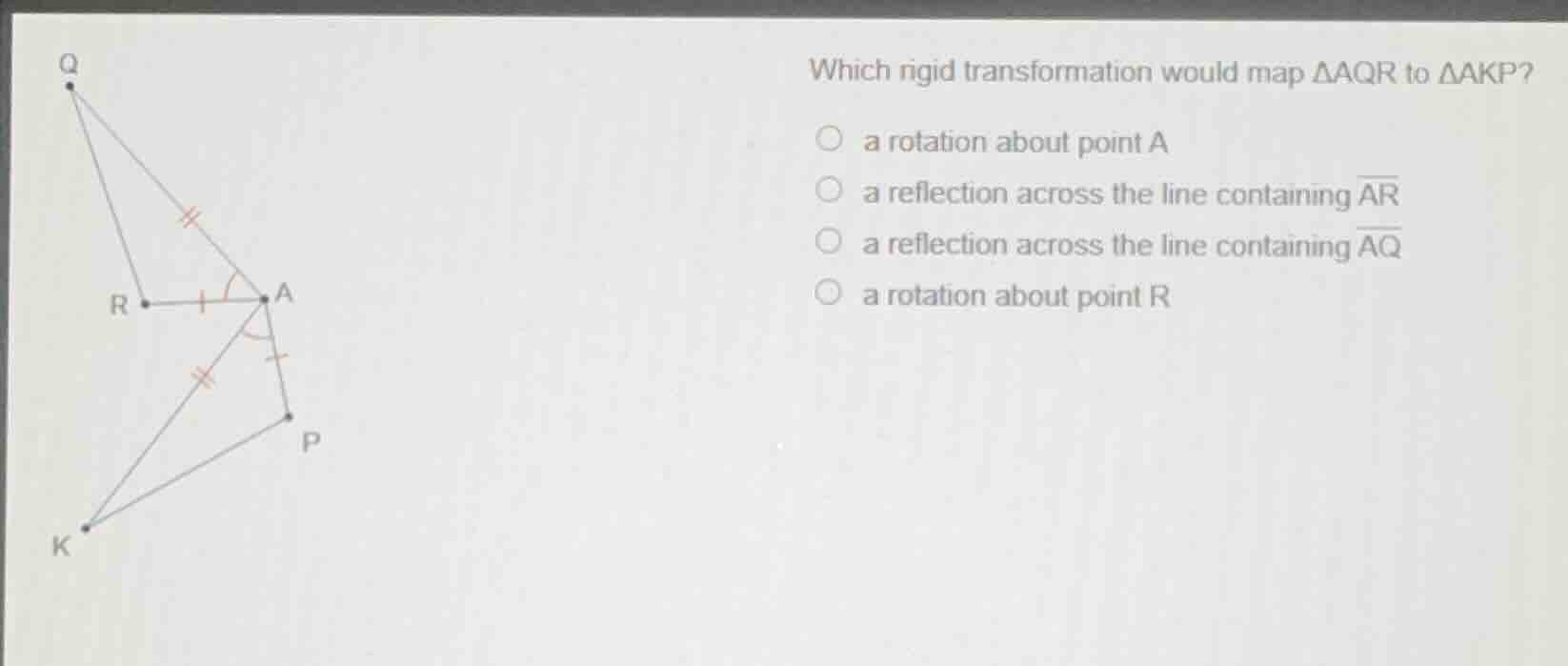
which rigid transformation would map \\(\delta aqr\\) to \\(\delta akp\\)?
a rotation about point a
a reflection across the line containing \\(\overline{ar}\\)
a reflection across the line containing \\(\overline{aq}\\)
a rotation about point r
Analyze corresponding parts of the triangles
Using the Congruence Mapping knowledge point
The mapping is \(\Delta AQR \to \Delta AKP\).
This means:
- Vertex \(A\) maps to vertex \(A\).
- Vertex \(Q\) maps to vertex \(K\).
- Vertex \(R\) maps to vertex \(P\).
Determine the type of transformation
Using the Rigid Transformations knowledge point
- Since vertex \(A\) maps to itself, point \(A\) is the center of the transformation.
- The orientation of the vertices \(A \to Q \to R\) is counterclockwise, while \(A \to K \to P\) is clockwise.
- A change in orientation indicates a reflection rather than a rotation.
- Thus, we reflect across a line passing through the fixed point \(A\).
Identify the line of reflection
Using the Rigid Transformations knowledge point
- The line of reflection must bisect the angle between corresponding points.
- Specifically, the line must bisect \(\angle QAK\) and \(\angle RAP\).
- From the diagram, the tick marks show \(AR = AP\) and \(AQ = AK\).
- The angle markings show \(\angle QAR \cong \angle KAP\).
- Reflecting across the line containing \(\overline{AR}\) maps \(\overline{AR}\) to itself (which is incorrect since \(R\) must map to \(P\)).
- Reflecting across the line containing \(\overline{AQ}\) maps \(\overline{AQ}\) to itself (which is incorrect since \(Q\) must map to \(K\)).
- Therefore, we must rotate about the fixed point \(A\) to map the segments: segment \(AQ\) rotates to segment \(AK\), and segment \(AR\) rotates to segment \(AP\).
- Let's re-verify the orientation: \(A \to Q \to R\) is counterclockwise. \(A \to K \to P\) is also counterclockwise.
- Since orientation is preserved, the transformation is a rotation about the common vertex \(A\).

Snap & solve any problem in the app
Get step-by-step solutions on Sovi AI
Photo-based solutions with guided steps
Explore more problems and detailed explanations
- (A) a rotation about point A (Correct answer)
- (B) a reflection across the line containing \(\overline{AR}\)
- (C) a reflection across the line containing \(\overline{AQ}\)
- (D) a rotation about point R