Sovi.AI - AI Math Tutor

Scan to solve math questions

QUESTION IMAGE

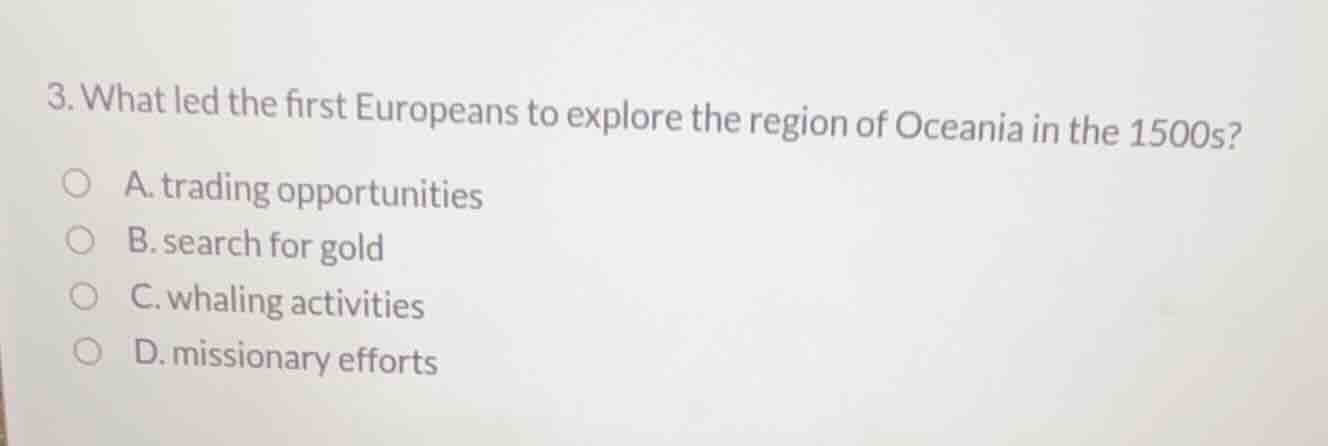
3. what led the first europeans to explore the region of oceania in the…

Question

  1. what led the first europeans to explore the region of oceania in the 1500s?

a. trading opportunities
b. search for gold
c. whaling activities
d. missionary efforts

Explanation:

Response

<pre_analysis>
{
"quality": "clear",
"question_count": 1,
"skills_matched": [
"direct_cot",
"multiple_choice_formatter",
"explain_then_answer",
"quick"
],
"needs_drawing": false,
"concepts_used": [],
"new_concepts": [
"European Exploration",
"Oceania History",
"Age of Discovery"
],
"current_concepts": [
"European Exploration",
"Oceania History",
"Age of Discovery"
]
}
</pre_analysis>

<reasoning>

Analyze the historical context of Oceania in the 1500s

During the early 1500s, the Age of Discovery was driven primarily by Spain and Portugal seeking new trade routes to the Spice Islands (Moluccas) in Asia. Ferdinand Magellan's expedition crossed the Pacific in 1521, initiating European contact with Oceania to find lucrative spice trading opportunities.

Evaluate the given options

  • Option A (trading opportunities): Aligns with the primary 16th-century European goal of finding spice trade routes and establishing commercial networks.
  • Option B (search for gold): While gold was a motivator in the Americas, it was not the primary driver for early Pacific exploration in the 1500s.
  • Option C (whaling activities): Whaling in Oceania did not become a major driver until the late 1700s and 1800s.
  • Option D (missionary efforts): Significant missionary activity in Oceania began much later, primarily in the late 18th and 19th centuries.

</reasoning>

<answer>
<mcq-correct>(A) trading opportunities</mcq-correct>
<mcq-option>(B) search for gold</mcq-option>
<mcq-option>(C) whaling activities</mcq-option>
<mcq-option>(D) missionary efforts</mcq-option>
</answer>

<post_analysis>
{
"subject": "Social Science",
"question_type": "Multiple Choice",
"knowledge_point": [
"Social Science",
"History",
"European Exploration"
]
}
</post_analysis>

Answer:

<pre_analysis>
{
"quality": "clear",
"question_count": 1,
"skills_matched": [
"direct_cot",
"multiple_choice_formatter",
"explain_then_answer",
"quick"
],
"needs_drawing": false,
"concepts_used": [],
"new_concepts": [
"European Exploration",
"Oceania History",
"Age of Discovery"
],
"current_concepts": [
"European Exploration",
"Oceania History",
"Age of Discovery"
]
}
</pre_analysis>

<reasoning>

Analyze the historical context of Oceania in the 1500s

During the early 1500s, the Age of Discovery was driven primarily by Spain and Portugal seeking new trade routes to the Spice Islands (Moluccas) in Asia. Ferdinand Magellan's expedition crossed the Pacific in 1521, initiating European contact with Oceania to find lucrative spice trading opportunities.

Evaluate the given options

  • Option A (trading opportunities): Aligns with the primary 16th-century European goal of finding spice trade routes and establishing commercial networks.
  • Option B (search for gold): While gold was a motivator in the Americas, it was not the primary driver for early Pacific exploration in the 1500s.
  • Option C (whaling activities): Whaling in Oceania did not become a major driver until the late 1700s and 1800s.
  • Option D (missionary efforts): Significant missionary activity in Oceania began much later, primarily in the late 18th and 19th centuries.

</reasoning>

<answer>
<mcq-correct>(A) trading opportunities</mcq-correct>
<mcq-option>(B) search for gold</mcq-option>
<mcq-option>(C) whaling activities</mcq-option>
<mcq-option>(D) missionary efforts</mcq-option>
</answer>

<post_analysis>
{
"subject": "Social Science",
"question_type": "Multiple Choice",
"knowledge_point": [
"Social Science",
"History",
"European Exploration"
]
}
</post_analysis>