QUESTION IMAGE
Question
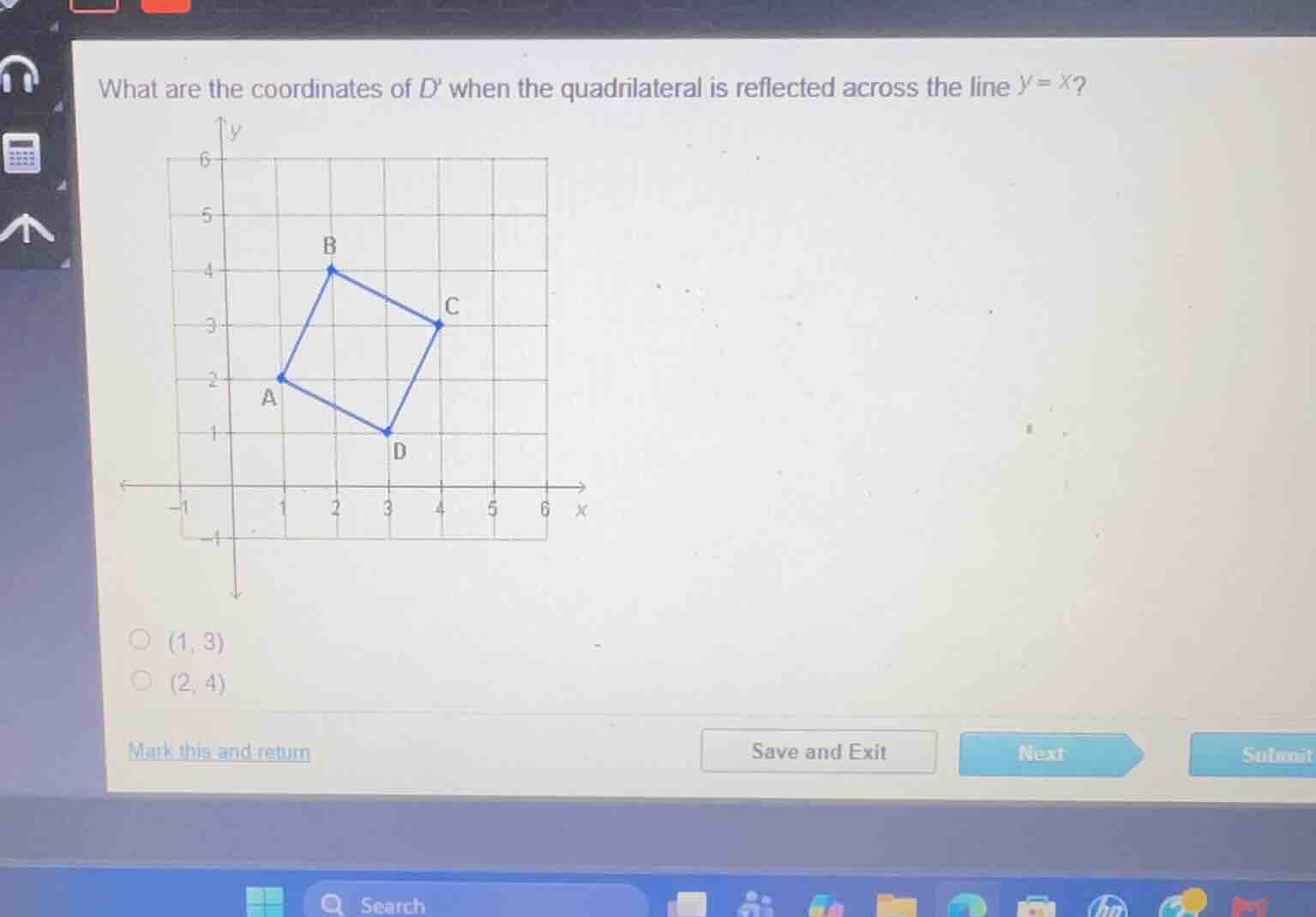
what are the coordinates of \\(d\\) when the quadrilateral is reflected across the line \\(y = x\\)?
(1, 3)
(2, 4)
<pre_analysis>
{
"quality": "clear",
"question_count": 1,
"skills_matched": [
"step_cot",
"multiple_choice_formatter",
"explain_then_answer",
"tutor"
],
"needs_drawing": true,
"concepts_used": [
"Coordinate Transformations"
],
"new_concepts": [
"Reflection Across Line y=x"
],
"current_concepts": [
"Coordinate Transformations",
"Reflection Across Line y=x"
]
}
</pre_analysis>
<reasoning>
Identify the coordinates of point D
Find the coordinates of vertex \(D\) from the given coordinate grid.
Looking at the graph, point \(D\) lies at \(x = 3\) and \(y = 1\).
Thus, the coordinates of \(D\) are \((3, 1)\).
Apply the reflection rule
Using the Coordinate Transformations knowledge point, we apply the reflection rule across the line \(y = x\).
The algebraic rule for reflecting a point \((x, y)\) across the line \(y = x\) is:
\[(x, y)
ightarrow (y, x)\]
Calculate the coordinates of D'
Substitute the coordinates of \(D(3, 1)\) into the reflection rule:
\[D(3, 1)
ightarrow D'(1, 3)\]
The coordinates of \(D'\) are \((1, 3)\).
</reasoning>
<answer>
<mcq-correct>(1, 3)</mcq-correct>
<mcq-option>(2, 4)</mcq-option>
</answer>
<plot>
{
"elements": [
{
"type": "point",
"params": [[1, 2]],
"properties": {
"name": "A",
"color": "#8C55F2",
"withLabel": true
}
},
{
"type": "point",
"params": [[2, 4]],
"properties": {
"name": "B",
"color": "#8C55F2",
"withLabel": true
}
},
{
"type": "point",
"params": [[4, 3]],
"properties": {
"name": "C",
"color": "#8C55F2",
"withLabel": true
}
},
{
"type": "point",
"params": [[3, 1]],
"properties": {
"name": "D",
"color": "#F2557F",
"withLabel": true
}
},
{
"type": "polygon",
"params": [[1, 2], [2, 4], [4, 3], [3, 1]],
"properties": {
"fillColor": "rgba(140, 85, 242, 0.15)",
"strokeColor": "#8C55F2",
"strokeWidth": 2
}
},
{
"type": "functiongraph",
"params": [{"js": "x", "latex": "y = x"}, -1, 6],
"properties": {
"strokeColor": "#5583F2",
"strokeWidth": 1.5,
"dash": 2,
"name": "y = x",
"withLabel": true
}
},
{
"type": "point",
"params": [[1, 3]],
"properties": {
"name": "D'",
"color": "#F2557F",
"withLabel": true
}
}
]
}
</plot>
<post_analysis>
{
"subject": "Mathematics",
"question_type": "Multiple Choice",
"knowledge_point": [
"Mathematics",
"Geometry",
"Coordinate Transformations"
]
}
</post_analysis>
Snap & solve any problem in the app
Get step-by-step solutions on Sovi AI
Photo-based solutions with guided steps
Explore more problems and detailed explanations
<pre_analysis>
{
"quality": "clear",
"question_count": 1,
"skills_matched": [
"step_cot",
"multiple_choice_formatter",
"explain_then_answer",
"tutor"
],
"needs_drawing": true,
"concepts_used": [
"Coordinate Transformations"
],
"new_concepts": [
"Reflection Across Line y=x"
],
"current_concepts": [
"Coordinate Transformations",
"Reflection Across Line y=x"
]
}
</pre_analysis>
<reasoning>
Identify the coordinates of point D
Find the coordinates of vertex \(D\) from the given coordinate grid.
Looking at the graph, point \(D\) lies at \(x = 3\) and \(y = 1\).
Thus, the coordinates of \(D\) are \((3, 1)\).
Apply the reflection rule
Using the Coordinate Transformations knowledge point, we apply the reflection rule across the line \(y = x\).
The algebraic rule for reflecting a point \((x, y)\) across the line \(y = x\) is:
\[(x, y)
ightarrow (y, x)\]
Calculate the coordinates of D'
Substitute the coordinates of \(D(3, 1)\) into the reflection rule:
\[D(3, 1)
ightarrow D'(1, 3)\]
The coordinates of \(D'\) are \((1, 3)\).
</reasoning>
<answer>
<mcq-correct>(1, 3)</mcq-correct>
<mcq-option>(2, 4)</mcq-option>
</answer>
<plot>
{
"elements": [
{
"type": "point",
"params": [[1, 2]],
"properties": {
"name": "A",
"color": "#8C55F2",
"withLabel": true
}
},
{
"type": "point",
"params": [[2, 4]],
"properties": {
"name": "B",
"color": "#8C55F2",
"withLabel": true
}
},
{
"type": "point",
"params": [[4, 3]],
"properties": {
"name": "C",
"color": "#8C55F2",
"withLabel": true
}
},
{
"type": "point",
"params": [[3, 1]],
"properties": {
"name": "D",
"color": "#F2557F",
"withLabel": true
}
},
{
"type": "polygon",
"params": [[1, 2], [2, 4], [4, 3], [3, 1]],
"properties": {
"fillColor": "rgba(140, 85, 242, 0.15)",
"strokeColor": "#8C55F2",
"strokeWidth": 2
}
},
{
"type": "functiongraph",
"params": [{"js": "x", "latex": "y = x"}, -1, 6],
"properties": {
"strokeColor": "#5583F2",
"strokeWidth": 1.5,
"dash": 2,
"name": "y = x",
"withLabel": true
}
},
{
"type": "point",
"params": [[1, 3]],
"properties": {
"name": "D'",
"color": "#F2557F",
"withLabel": true
}
}
]
}
</plot>
<post_analysis>
{
"subject": "Mathematics",
"question_type": "Multiple Choice",
"knowledge_point": [
"Mathematics",
"Geometry",
"Coordinate Transformations"
]
}
</post_analysis>