QUESTION IMAGE
Question
what additional information could be used to prove that the triangles are congruent using aas? select two options.
\\(\angle c \cong \angle q\\)
\\(\overline{cb} \cong \overline{qm}\\)
\\(ac = 3.9\text{cm}\\) and \\(rq = 3.9\text{cm}\\)
\\(m\angle c = 35^\circ\\) and \\(m\angle q = 35^\circ\\)
\\(ab = 2.5\text{cm}\\) and \\(mq = 2.5\text{cm}\\)
Identify the given corresponding parts
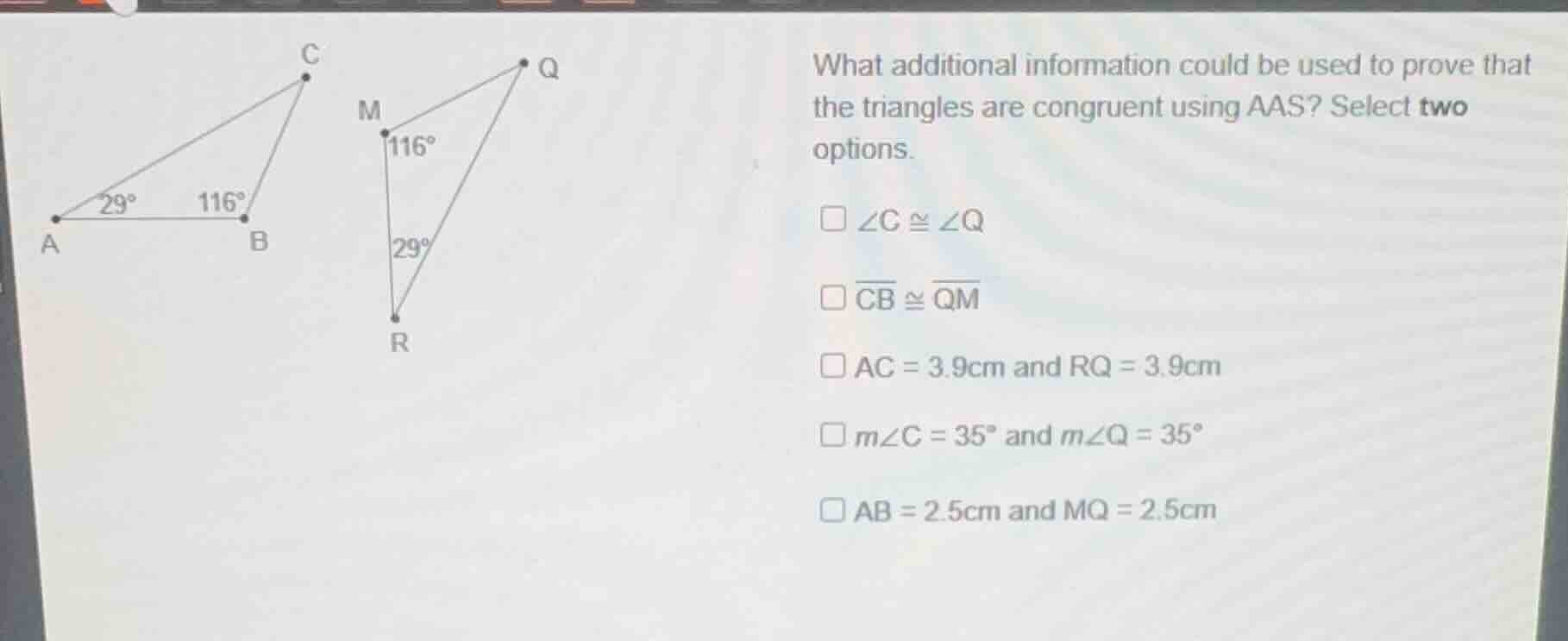
We are given two triangles, \(\triangle ABC\) and \(\triangle RMQ\).
From the diagram, we observe the following angle measures:
- In \(\triangle ABC\): \(m\angle A = 29^\circ\) and \(m\angle B = 116^\circ\).
- In \(\triangle RMQ\): \(m\angle R = 29^\circ\) and \(m\angle M = 116^\circ\).
Thus, we have two pairs of congruent angles:
- \(\angle A \cong \angle R\) (both measure \(29^\circ\))
- \(\angle B \cong \angle M\) (both measure \(116^\circ\))
Calculate the remaining angles
Using the Triangle Angle Sum Theorem, we can find the measures of the third angles:
- For \(\triangle ABC\):
- For \(\triangle RMQ\):
Therefore, \(\angle C \cong \angle Q\) is already established by calculation, so it does not provide new information to prove congruence.
Analyze the AAS Congruence Theorem requirements
The Angle-Angle-Side (AAS) Congruence Theorem states that if two angles and a non-included side of one triangle are congruent to two angles and the corresponding non-included side of another triangle, then the triangles are congruent.
Our known congruent angle pairs are:
- \(\angle A \cong \angle R\)
- \(\angle B \cong \angle M\)
The corresponding sides of these triangles are:
- Included sides (between the \(29^\circ\) and \(116^\circ\) angles): \(\overline{AB}\) and \(\overline{RM}\).
- Non-included sides opposite the \(116^\circ\) angles: \(\overline{AC}\) and \(\overline{RQ}\).
- Non-included sides opposite the \(29^\circ\) angles: \(\overline{BC}\) and \(\overline{MQ}\).
To use AAS, we need a pair of congruent corresponding non-included sides.
Evaluate the options
- Option 1: \(\angle C \cong \angle Q\)
This is already true by calculation and does not provide side length information to prove congruence.
- Option 2: \(\overline{CB} \cong \overline{QM}\)
These are corresponding non-included sides (both are opposite the \(29^\circ\) angles: \(\overline{BC}\) is opposite \(\angle A\), and \(\overline{MQ}\) is opposite \(\angle R\)). This satisfies AAS.
- Option 3: \(AC = 3.9\text{ cm}\) and \(RQ = 3.9\text{ cm}\)
These are corresponding non-included sides (both are opposite the \(116^\circ\) angles: \(\overline{AC}\) is opposite \(\angle B\), and \(\overline{RQ}\) is opposite \(\angle M\)). This means \(\overline{AC} \cong \overline{RQ}\), which satisfies AAS.
- Option 4: \(m\angle C = 35^\circ\) and \(m\angle Q = 35^\circ\)
This is already known and does not provide side length information.
- Option 5: \(AB = 2.5\text{ cm}\) and \(MQ = 2.5\text{ cm}\)
\(\overline{AB}\) is the included side between \(\angle A\) and \(\angle B\), whereas \(\overline{MQ}\) is a non-included side opposite \(\angle R\). These are not corresponding sides.

Snap & solve any problem in the app
Get step-by-step solutions on Sovi AI
Photo-based solutions with guided steps
Explore more problems and detailed explanations
- \(\angle C \cong \angle Q\)
- \(\overline{CB} \cong \overline{QM}\) (Correct answer)
- \(AC = 3.9\text{cm}\) and \(RQ = 3.9\text{cm}\) (Correct answer)
- \(m\angle C = 35^\circ\) and \(m\angle Q = 35^\circ\)
- \(AB = 2.5\text{cm}\) and \(MQ = 2.5\text{cm}\)