QUESTION IMAGE
Question
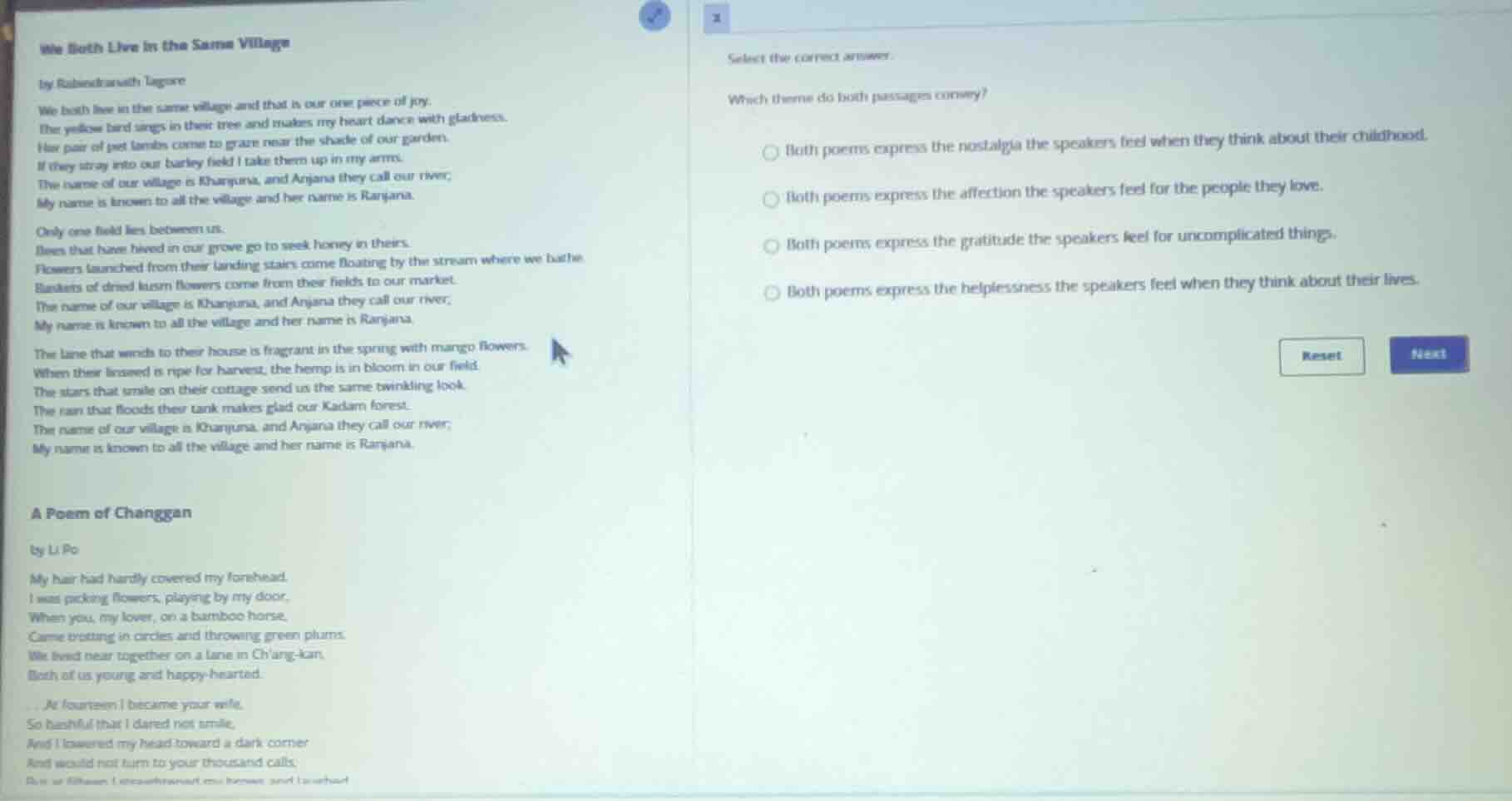
we both live in the same village
by rabindranath tagore
we both live in the same village and that is our one piece of joy.
the yellow bird sings in their tree and makes my heart dance with gladness.
her pair of pet lambs come to graze near the shade of our garden.
if they stray into our barley field i take them up in my arms.
the name of our village is khanjana, and anjana they call our river;
my name is known to all the village and her name is ranjana.
only one field lies between us.
bees that have hived in our grove go to seek honey in theirs.
flowers launched from their landing stairs come floating by the stream where we bathe.
baskets of dried kusm flowers come from their fields to our market.
the name of our village is khanjana, and anjana they call our river;
my name is known to all the village and her name is ranjana.
the lane that winds to their house is fragrant in the spring with mango flowers.
when their linseed is ripe for harvest, the hemp is in bloom in our field.
the stars that smile on their cottage send us the same twinkling look.
the rain that floods their tank makes glad our kadam forest.
the name of our village is khanjana, and anjana they call our river;
my name is known to all the village and her name is ranjana.
a poem of changgan
by li po
my hair had hardly covered my forehead.
i was picking flowers, playing by my door,
when you, my lover, on a bamboo horse,
came trotting in circles and throwing green plums.
we lived near together on a lane in chang-kan,
both of us young and happy-hearted.
at fourteen i became your wife,
so bashful that i dared not smile,
and i lowered my head toward a dark corner
and would not turn to your thousand calls.
select the correct answer.
which theme do both passages convey?
- both poems express the nostalgia the speakers feel when they think about their childhood.
- both poems express the affection the speakers feel for the people they love.
- both poems express the gratitude the speakers feel for uncomplicated things.
- both poems express the helplessness the speakers feel when they think about their lives.
Analyze the themes of both poems
The first poem, "We Both Live in the Same Village" by Rabindranath Tagore, describes simple, everyday joys of village life, such as a yellow bird singing, pet lambs grazing, bees seeking honey, and flowers floating down the stream. The speaker finds deep happiness and connection in these uncomplicated, natural elements of their shared environment.
The second poem, "A Poem of Changgan" by Li Po, begins by recalling simple childhood memories: playing by the gate, picking flowers, and riding a bamboo horse. Both poems focus heavily on finding joy, peace, and meaning in simple, everyday, and uncomplicated aspects of life and nature.
Evaluate the answer choices
- Option 1: "Both poems express the nostalgia..." is incorrect because Tagore's poem is set in the present village life, not looking back at childhood.
- Option 2: "Both poems express the affection..." is incorrect because Tagore's poem focuses more broadly on the village environment and simple daily occurrences rather than romantic or personal affection.
- Option 3: "Both poems express the gratitude the speakers feel for uncomplicated things." matches perfectly, as both speakers find joy and peace in simple, everyday details (village life, nature, childhood play).
- Option 4: "Both poems express the helplessness..." is incorrect as the tone of both poems is peaceful and appreciative, not helpless.

Snap & solve any problem in the app
Get step-by-step solutions on Sovi AI
Photo-based solutions with guided steps
Explore more problems and detailed explanations
- (A) Both poems express the nostalgia the speakers feel when they think about their childhood.
- (B) Both poems express the affection the speakers feel for the people they love.
- (C) Both poems express the gratitude the speakers feel for uncomplicated things. (Correct answer)
- (D) Both poems express the helplessness the speakers feel when they think about their lives.