QUESTION IMAGE
Question
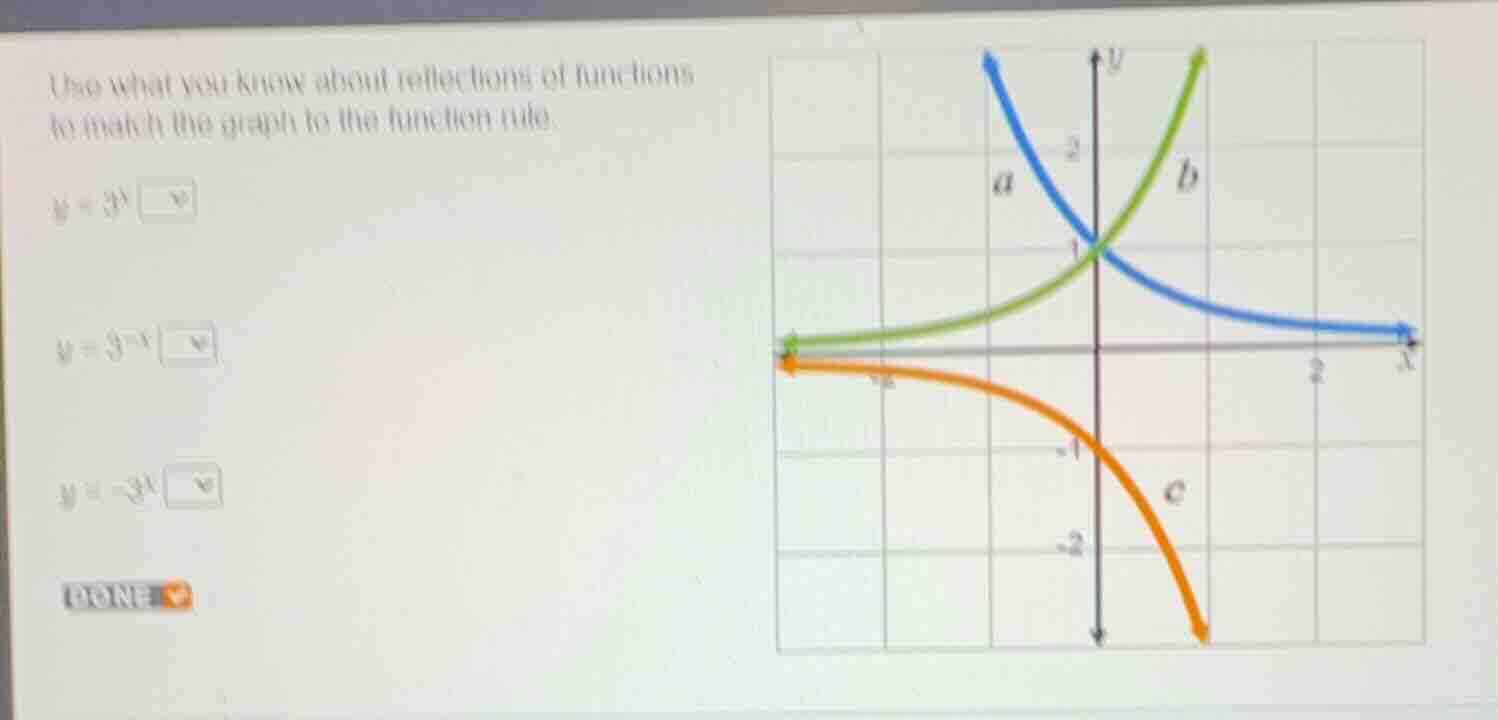
use what you know about reflections of functions to match the graph to the function rule.
\\(y = 3^x\\)
\\(y = 3^{-x}\\)
\\(y = -3^x\\)
<pre_analysis>
{
"quality": "clear",
"question_count": 1,
"skills_matched": [
"step_cot",
"explain_then_answer",
"tutor",
"mastery_adaptive_brevity"
],
"needs_drawing": false,
"concepts_used": [
"Exponential Function Graphs",
"Function Reflections"
],
"new_concepts": [],
"current_concepts": [
"Exponential Function Graphs",
"Function Reflections",
"Exponential Function Transformations"
]
}
</pre_analysis>
<reasoning>
Identify the base function
Using the Exponential Function Graphs knowledge point
\[
y = 3^x
\]
This is an exponential growth function because the base \(3 > 1\). As \(x \to \infty\), \(y \to \infty\), and as \(x \to -\infty\), \(y \to 0\). The graph passes through \((0, 1)\) and \((1, 3)\). This matches curve \(b\).
Analyze the horizontal reflection
Using the Function Reflections knowledge point
\[
y = 3^{-x}
\]
Replacing \(x\) with \(-x\) reflects the graph of \(y = 3^x\) horizontally across the \(y\)-axis. This results in an exponential decay curve that passes through \((0, 1)\) and \((-1, 3)\). This matches curve \(a\).
Analyze the vertical reflection
Using the Function Reflections knowledge point
\[
y = -3^{-x}
\]
Multiplying the function \(y = 3^{-x}\) by \(-1\) reflects its graph vertically across the \(x\)-axis. All \(y\)-values become negative, so the graph passes through \((0, -1)\) and \((1, -3)\). This matches curve \(c\).
</reasoning>
<answer>
Question 1
- \(y = 3^x\) matches graph <blank>b</blank>
- \(y = 3^{-x}\) matches graph <blank>a</blank>
- \(y = -3^{-x}\) matches graph <blank>c</blank>
</answer>
<post_analysis>
{
"subject": "Mathematics",
"question_type": "Fill-in-the-blank",
"knowledge_point": [
"Mathematics",
"Algebra",
"Exponential Function Transformations"
]
}
</post_analysis>
Snap & solve any problem in the app
Get step-by-step solutions on Sovi AI
Photo-based solutions with guided steps
Explore more problems and detailed explanations
<pre_analysis>
{
"quality": "clear",
"question_count": 1,
"skills_matched": [
"step_cot",
"explain_then_answer",
"tutor",
"mastery_adaptive_brevity"
],
"needs_drawing": false,
"concepts_used": [
"Exponential Function Graphs",
"Function Reflections"
],
"new_concepts": [],
"current_concepts": [
"Exponential Function Graphs",
"Function Reflections",
"Exponential Function Transformations"
]
}
</pre_analysis>
<reasoning>
Identify the base function
Using the Exponential Function Graphs knowledge point
\[
y = 3^x
\]
This is an exponential growth function because the base \(3 > 1\). As \(x \to \infty\), \(y \to \infty\), and as \(x \to -\infty\), \(y \to 0\). The graph passes through \((0, 1)\) and \((1, 3)\). This matches curve \(b\).
Analyze the horizontal reflection
Using the Function Reflections knowledge point
\[
y = 3^{-x}
\]
Replacing \(x\) with \(-x\) reflects the graph of \(y = 3^x\) horizontally across the \(y\)-axis. This results in an exponential decay curve that passes through \((0, 1)\) and \((-1, 3)\). This matches curve \(a\).
Analyze the vertical reflection
Using the Function Reflections knowledge point
\[
y = -3^{-x}
\]
Multiplying the function \(y = 3^{-x}\) by \(-1\) reflects its graph vertically across the \(x\)-axis. All \(y\)-values become negative, so the graph passes through \((0, -1)\) and \((1, -3)\). This matches curve \(c\).
</reasoning>
<answer>
Question 1
- \(y = 3^x\) matches graph <blank>b</blank>
- \(y = 3^{-x}\) matches graph <blank>a</blank>
- \(y = -3^{-x}\) matches graph <blank>c</blank>
</answer>
<post_analysis>
{
"subject": "Mathematics",
"question_type": "Fill-in-the-blank",
"knowledge_point": [
"Mathematics",
"Algebra",
"Exponential Function Transformations"
]
}
</post_analysis>