QUESTION IMAGE
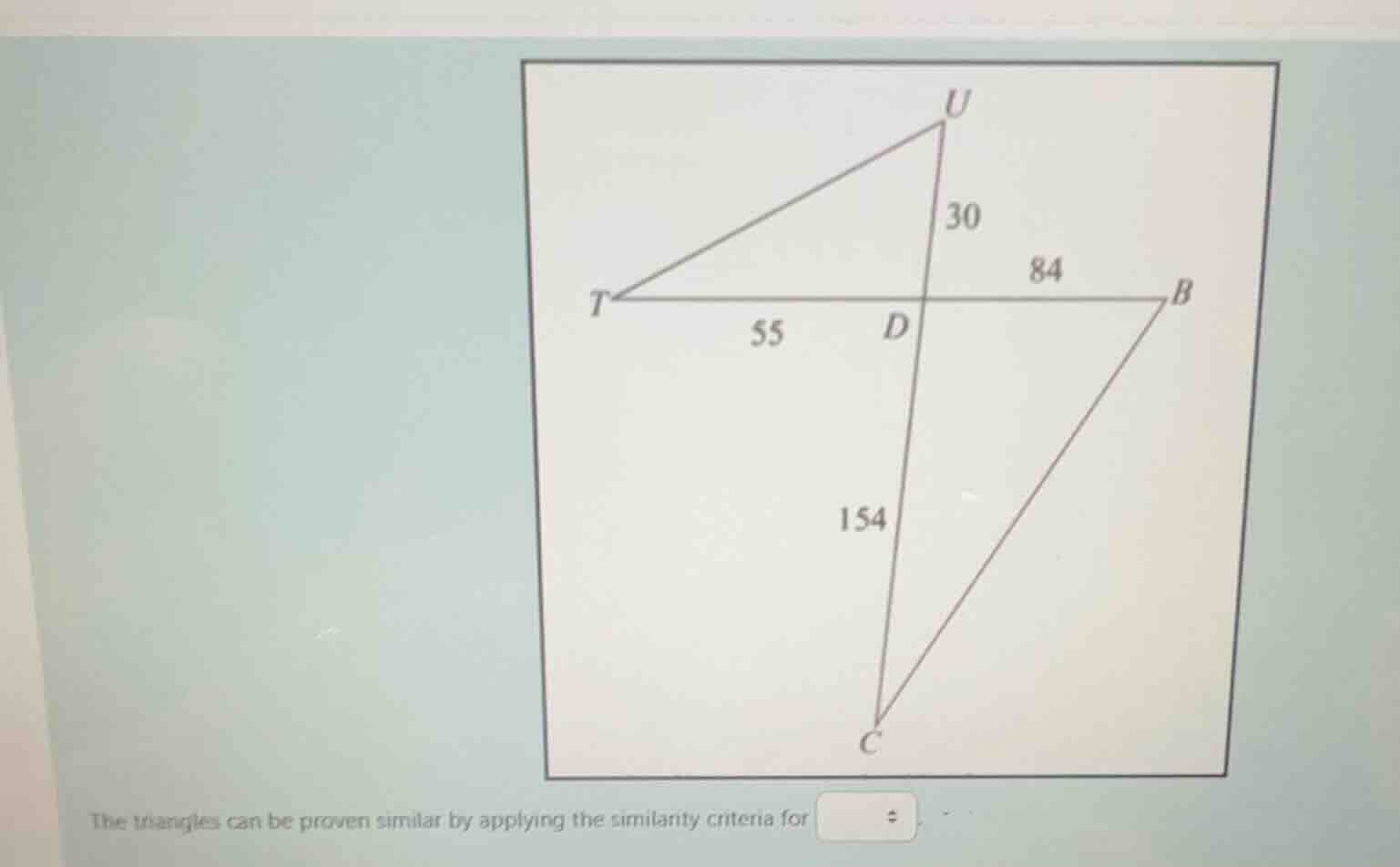
Question
the triangles can be proven similar by applying the similarity criteria for
⚡ Using what you learned: similarity criteria for triangles (aa, sss, sas)
Step 1: Identify vertical angles
The intersecting lines \(TB\) and \(UC\) intersect at point \(D\). This creates a pair of vertical angles:
Step 2: Compare ratios of corresponding sides
We check the ratios of the sides forming these angles in \(\triangle TDU\) and \(\triangle BDC\):
Since these do not match, we check the alternative pairing:
Since the ratios are equal:
Step 3: Apply similarity criterion
Two pairs of corresponding sides are proportional, and their included angles are congruent (\(\angle TDU \cong \angle BDC\)). Therefore, the triangles are similar by the Side-Angle-Side (SAS) similarity criterion.

Snap & solve any problem in the app
Get step-by-step solutions on Sovi AI
Photo-based solutions with guided steps
Explore more problems and detailed explanations
SAS