QUESTION IMAGE
Question
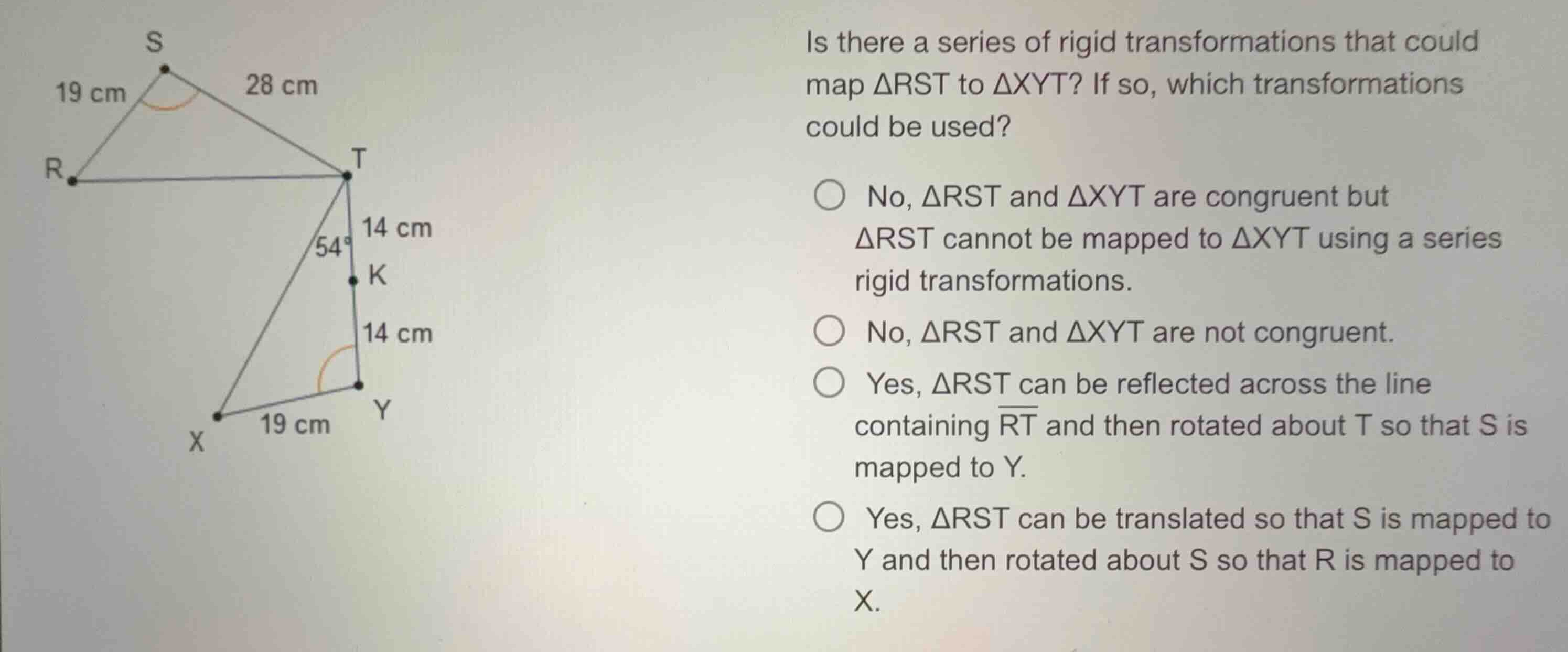
is there a series of rigid transformations that could map \\(\delta rst\\) to \\(\delta xyt\\)? if so, which transformations could be used?
no, \\(\delta rst\\) and \\(\delta xyt\\) are congruent but \\(\delta rst\\) cannot be mapped to \\(\delta xyt\\) using a series rigid transformations.
no, \\(\delta rst\\) and \\(\delta xyt\\) are not congruent.
yes, \\(\delta rst\\) can be reflected across the line containing \\(\overline{rt}\\) and then rotated about \\(t\\) so that \\(s\\) is mapped to \\(y\\).
yes, \\(\delta rst\\) can be translated so that \\(s\\) is mapped to \\(y\\) and then rotated about \\(s\\) so that \\(r\\) is mapped to \\(x\\).
Compare corresponding side lengths
Using the Triangle Congruence Theorems knowledge point
Determine the length of TY
Using the Segment Addition Postulate knowledge point
Analyze the included angles
Using the Triangle Congruence Theorems knowledge point
Determine congruence of the triangles
Using the Triangle Congruence Theorems knowledge point
Evaluate mapping via rigid transformations
Using the Rigid Transformations knowledge point

Snap & solve any problem in the app
Get step-by-step solutions on Sovi AI
Photo-based solutions with guided steps
Explore more problems and detailed explanations
- No, \(\Delta RST\) and \(\Delta XYT\) are congruent but \(\Delta RST\) cannot be mapped to \(\Delta XYT\) using a series rigid transformations.
- No, \(\Delta RST\) and \(\Delta XYT\) are not congruent.
- Yes, \(\Delta RST\) can be reflected across the line containing \(\overline{RT}\) and then rotated about \(T\) so that \(S\) is mapped to \(Y\). (Correct answer)
- Yes, \(\Delta RST\) can be translated so that \(S\) is mapped to \(Y\) and then rotated about \(S\) so that \(R\) is mapped to \(X\).