QUESTION IMAGE
Question
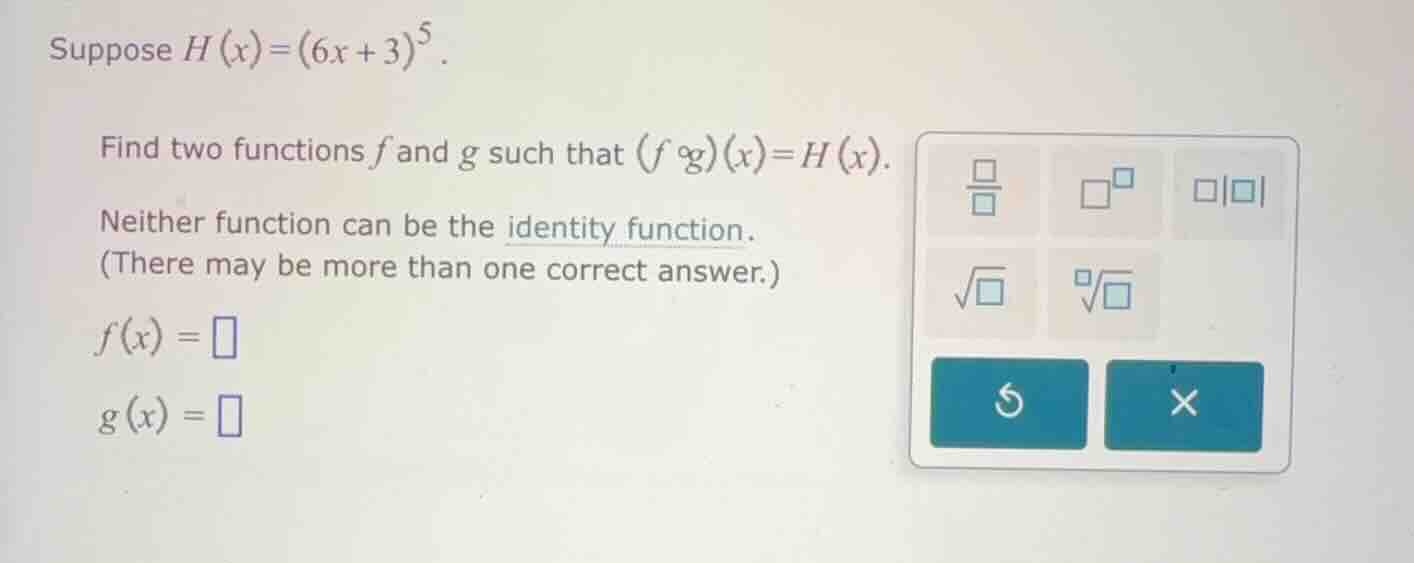
suppose \\(h(x) = (6x + 3)^5\\).
find two functions \\(f\\) and \\(g\\) such that \\((f \circ g)(x) = h(x)\\).
neither function can be the identity function.
(there may be more than one correct answer.)
\\(f(x) = \square\\)
\\(g(x) = \square\\)
<pre_analysis>
{
"quality": "clear",
"question_count": 1,
"skills_matched": [
"step_cot",
"blank_filling_formatter",
"explain_then_answer",
"quick"
],
"needs_drawing": false,
"concepts_used": [
"Definition of a Function"
],
"new_concepts": [
"Function Composition",
"Decomposing Functions"
],
"current_concepts": [
"Definition of a Function",
"Function Composition",
"Decomposing Functions"
]
}
</pre_analysis>
<reasoning>
Identify the inner and outer functions
\[
\]
Verify the non-identity condition
\[
\]
</reasoning>
<answer>
Suppose \(H(x) = (6x + 3)^5\).
Find two functions \(f\) and \(g\) such that \((f \circ g)(x) = H(x)\).
Neither function can be the identity function.
(There may be more than one correct answer.)
\(f(x) =\) <blank>\(x^5\)</blank>
\(g(x) =\) <blank>\(6x + 3\)</blank>
</answer>
<post_analysis>
{
"subject": "Mathematics",
"question_type": "Fill-in-the-blank",
"knowledge_point": [
"Mathematics",
"Algebra",
"Function Composition"
]
}
</post_analysis>
Snap & solve any problem in the app
Get step-by-step solutions on Sovi AI
Photo-based solutions with guided steps
Explore more problems and detailed explanations
<pre_analysis>
{
"quality": "clear",
"question_count": 1,
"skills_matched": [
"step_cot",
"blank_filling_formatter",
"explain_then_answer",
"quick"
],
"needs_drawing": false,
"concepts_used": [
"Definition of a Function"
],
"new_concepts": [
"Function Composition",
"Decomposing Functions"
],
"current_concepts": [
"Definition of a Function",
"Function Composition",
"Decomposing Functions"
]
}
</pre_analysis>
<reasoning>
Identify the inner and outer functions
\[
\]
Verify the non-identity condition
\[
\]
</reasoning>
<answer>
Suppose \(H(x) = (6x + 3)^5\).
Find two functions \(f\) and \(g\) such that \((f \circ g)(x) = H(x)\).
Neither function can be the identity function.
(There may be more than one correct answer.)
\(f(x) =\) <blank>\(x^5\)</blank>
\(g(x) =\) <blank>\(6x + 3\)</blank>
</answer>
<post_analysis>
{
"subject": "Mathematics",
"question_type": "Fill-in-the-blank",
"knowledge_point": [
"Mathematics",
"Algebra",
"Function Composition"
]
}
</post_analysis>