QUESTION IMAGE
Question
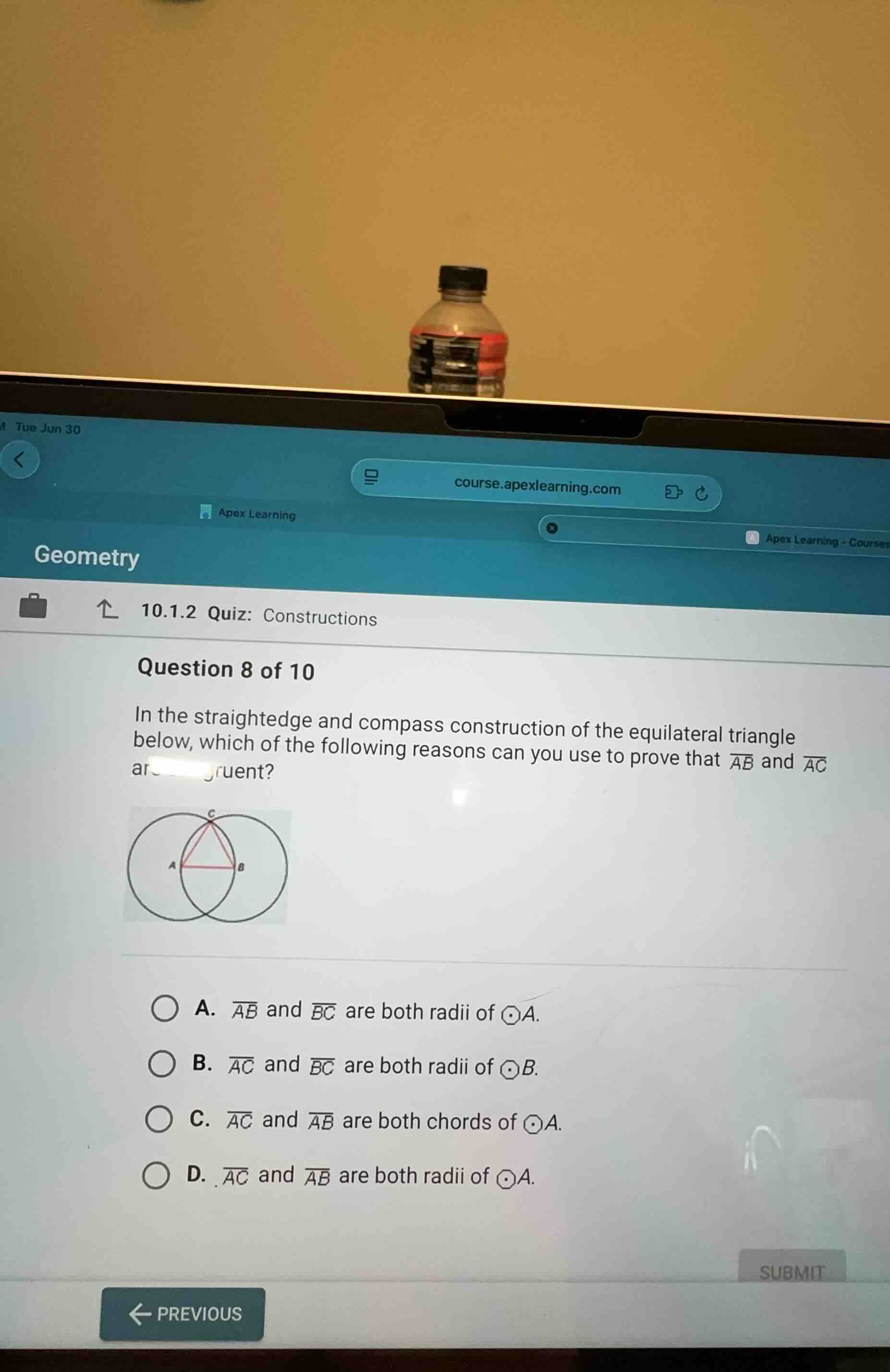
in the straightedge and compass construction of the equilateral triangle below, which of the following reasons can you use to prove that \\(\overline{ab}\\) and \\(\overline{ac}\\) are congruent?
a. \\(\overline{ab}\\) and \\(\overline{bc}\\) are both radii of \\(\odot a\\).
b. \\(\overline{ac}\\) and \\(\overline{bc}\\) are both radii of \\(\odot b\\).
c. \\(\overline{ac}\\) and \\(\overline{ab}\\) are both chords of \\(\odot a\\).
d. \\(\overline{ac}\\) and \\(\overline{ab}\\) are both radii of \\(\odot a\\).
Identify the geometric properties of the circles
Using the Circle Definition and Compass and Straightedge Construction knowledge points, we analyze the construction.
The construction shows two circles:
- Circle \(A\) (centered at point \(A\)) passes through point \(B\). Thus, the segment \(\overline{AB}\) is a radius of circle \(A\).
- Point \(C\) lies on the intersection of circle \(A\) and circle \(B\). Since \(C\) is on circle \(A\), the segment \(\overline{AC}\) is also a radius of circle \(A\).
Evaluate the relationship between the segments
Since both points \(B\) and \(C\) lie on circle \(A\), the segments connecting the center \(A\) to these points on the boundary are both radii of circle \(A\).
Therefore, \(\overline{AC}\) and \(\overline{AB}\) are both radii of circle \(A\).
By definition, all radii of the same circle are equal in length, which proves that \(\overline{AB}\) and \(\overline{AC}\) are congruent.
Match with the given options
We evaluate the multiple-choice options:
- Option A states \(\overline{AB}\) and \(\overline{BC}\) are both radii of circle \(A\). This is incorrect because \(C\) is on circle \(A\), but \(B\) is the center of the other circle, making \(\overline{BC}\) a radius of circle \(B\).
- Option B states \(\overline{AC}\) and \(\overline{BC}\) are both radii of circle \(B\). This is incorrect because \(A\) is not on circle \(B\).
- Option C states \(\overline{AC}\) and \(\overline{AB}\) are both chords of circle \(A\). While they are technically chords, this does not directly prove they are congruent since chords can have different lengths.
- Option D states \(\overline{AC}\) and \(\overline{AB}\) are both radii of circle \(A\). This is correct and directly proves their congruence.

Snap & solve any problem in the app
Get step-by-step solutions on Sovi AI
Photo-based solutions with guided steps
Explore more problems and detailed explanations
- A. \(\overline{AB}\) and \(\overline{BC}\) are both radii of \(\odot A\).
- B. \(\overline{AC}\) and \(\overline{BC}\) are both radii of \(\odot B\).
- C. \(\overline{AC}\) and \(\overline{AB}\) are both chords of \(\odot A\).
- D. \(\overline{AC}\) and \(\overline{AB}\) are both radii of \(\odot A\). (Correct answer)