QUESTION IMAGE
Question
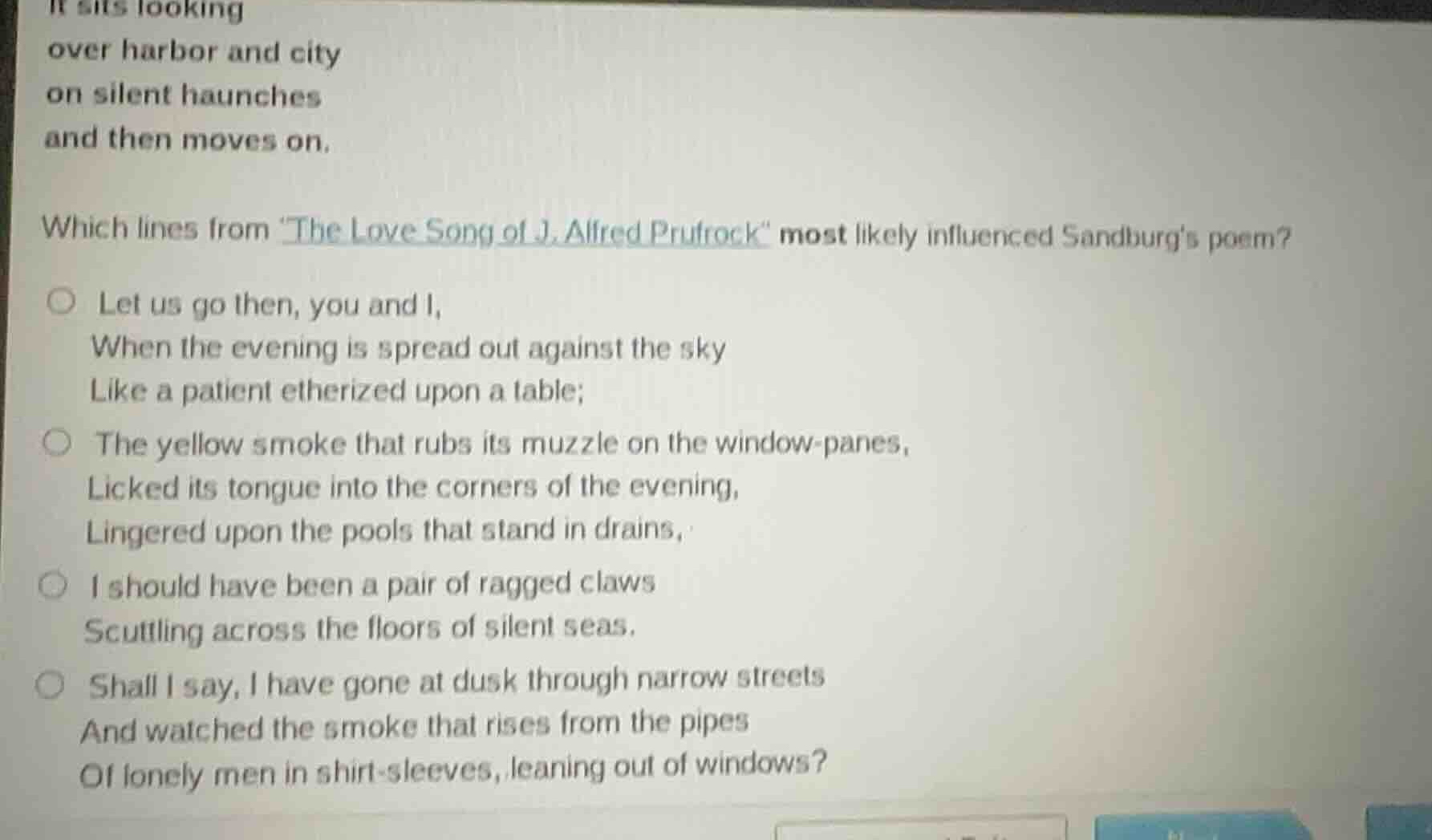
it sits looking
over harbor and city
on silent haunches
and then moves on.
which lines from \the love song of j. alfred prufrock\ most likely influenced sandburgs poem?
let us go then, you and i,
when the evening is spread out against the sky
like a patient etherized upon a table;
the yellow smoke that rubs its muzzle on the window-panes,
licked its tongue into the corners of the evening,
lingered upon the pools that stand in drains,
i should have been a pair of ragged claws
scuttling across the floors of silent seas.
shall i say, i have gone at dusk through narrow streets
and watched the smoke that rises from the pipes
of lonely men in shirt-sleeves, leaning out of windows?
<pre_analysis>
{
"quality": "clear",
"question_count": 1,
"skills_matched": [
"direct_cot",
"multiple_choice_formatter",
"explain_then_answer",
"tutor"
],
"needs_drawing": false,
"concepts_used": [
"Modernist Poetry",
"Prufrock Analysis",
"Poetic Imagery"
],
"new_concepts": [
"Intertextuality",
"Poetic Influence"
],
"current_concepts": [
"Modernist Poetry",
"Prufrock Analysis",
"Poetic Imagery",
"Intertextuality",
"Poetic Influence"
]
}
</pre_analysis>
<reasoning>
Analyze Sandburg's poem excerpt
The excerpt shown at the top of the image is from Carl Sandburg's famous poem "Fog":
"It sits looking
over harbor and city
on silent haunches
and then moves on."
This excerpt uses animal imagery (specifically comparing fog to a cat sitting on its "silent haunches") to describe a natural phenomenon.
Compare with Eliot's "Prufrock" imagery
We need to find which lines from T.S. Eliot's "The Love Song of J. Alfred Prufrock" share this specific cat-like animal imagery of fog or smoke. Let's evaluate the options:
- Option 1: "Let us go then, you and I..." uses medical imagery ("etherized upon a table").
- Option 2: "The yellow smoke that rubs its muzzle on the window-panes, / Licked its tongue into the corners of the evening..." uses explicit feline/cat-like imagery ("muzzle", "licked its tongue") to describe the yellow smoke/fog. This directly matches Sandburg's cat-like depiction of fog sitting on "silent haunches."
- Option 3: "I should have been a pair of ragged claws..." uses crab-like imagery to express isolation.
- Option 4: "Shall I say, I have gone at dusk..." describes lonely men in the city, lacking feline metaphor.
Therefore, the second option is the correct match. We apply Modernist Poetry and Poetic Imagery to connect these two famous depictions of urban fog.
</reasoning>
<answer>
<mcq-option>(A) Let us go then, you and I, When the evening is spread against the sky Like a patient etherized upon a table;</mcq-option>
<mcq-correct>(B) The yellow smoke that rubs its muzzle on the window-panes, Licked its tongue into the corners of the evening, Lingered upon the pools that stand in drains,</mcq-correct>
<mcq-option>(C) I should have been a pair of ragged claws Scuttling across the floors of silent seas.</mcq-option>
<mcq-option>(D) Shall I say, I have gone at dusk through narrow streets And watched the smoke that rises from the pipes Of lonely men in shirt-sleeves, leaning out of windows?</mcq-option>
</answer>
<post_analysis>
{
"subject": "Arts",
"question_type": "Multiple Choice",
"knowledge_point": [
"Arts",
"Literature",
"Poetry Analysis"
]
}
</post_analysis>
Snap & solve any problem in the app
Get step-by-step solutions on Sovi AI
Photo-based solutions with guided steps
Explore more problems and detailed explanations
<pre_analysis>
{
"quality": "clear",
"question_count": 1,
"skills_matched": [
"direct_cot",
"multiple_choice_formatter",
"explain_then_answer",
"tutor"
],
"needs_drawing": false,
"concepts_used": [
"Modernist Poetry",
"Prufrock Analysis",
"Poetic Imagery"
],
"new_concepts": [
"Intertextuality",
"Poetic Influence"
],
"current_concepts": [
"Modernist Poetry",
"Prufrock Analysis",
"Poetic Imagery",
"Intertextuality",
"Poetic Influence"
]
}
</pre_analysis>
<reasoning>
Analyze Sandburg's poem excerpt
The excerpt shown at the top of the image is from Carl Sandburg's famous poem "Fog":
"It sits looking
over harbor and city
on silent haunches
and then moves on."
This excerpt uses animal imagery (specifically comparing fog to a cat sitting on its "silent haunches") to describe a natural phenomenon.
Compare with Eliot's "Prufrock" imagery
We need to find which lines from T.S. Eliot's "The Love Song of J. Alfred Prufrock" share this specific cat-like animal imagery of fog or smoke. Let's evaluate the options:
- Option 1: "Let us go then, you and I..." uses medical imagery ("etherized upon a table").
- Option 2: "The yellow smoke that rubs its muzzle on the window-panes, / Licked its tongue into the corners of the evening..." uses explicit feline/cat-like imagery ("muzzle", "licked its tongue") to describe the yellow smoke/fog. This directly matches Sandburg's cat-like depiction of fog sitting on "silent haunches."
- Option 3: "I should have been a pair of ragged claws..." uses crab-like imagery to express isolation.
- Option 4: "Shall I say, I have gone at dusk..." describes lonely men in the city, lacking feline metaphor.
Therefore, the second option is the correct match. We apply Modernist Poetry and Poetic Imagery to connect these two famous depictions of urban fog.
</reasoning>
<answer>
<mcq-option>(A) Let us go then, you and I, When the evening is spread against the sky Like a patient etherized upon a table;</mcq-option>
<mcq-correct>(B) The yellow smoke that rubs its muzzle on the window-panes, Licked its tongue into the corners of the evening, Lingered upon the pools that stand in drains,</mcq-correct>
<mcq-option>(C) I should have been a pair of ragged claws Scuttling across the floors of silent seas.</mcq-option>
<mcq-option>(D) Shall I say, I have gone at dusk through narrow streets And watched the smoke that rises from the pipes Of lonely men in shirt-sleeves, leaning out of windows?</mcq-option>
</answer>
<post_analysis>
{
"subject": "Arts",
"question_type": "Multiple Choice",
"knowledge_point": [
"Arts",
"Literature",
"Poetry Analysis"
]
}
</post_analysis>