Sovi.AI - AI Math Tutor

Scan to solve math questions

QUESTION IMAGE

in the short-run, the fight-or-flight response and the release of corti…

Question

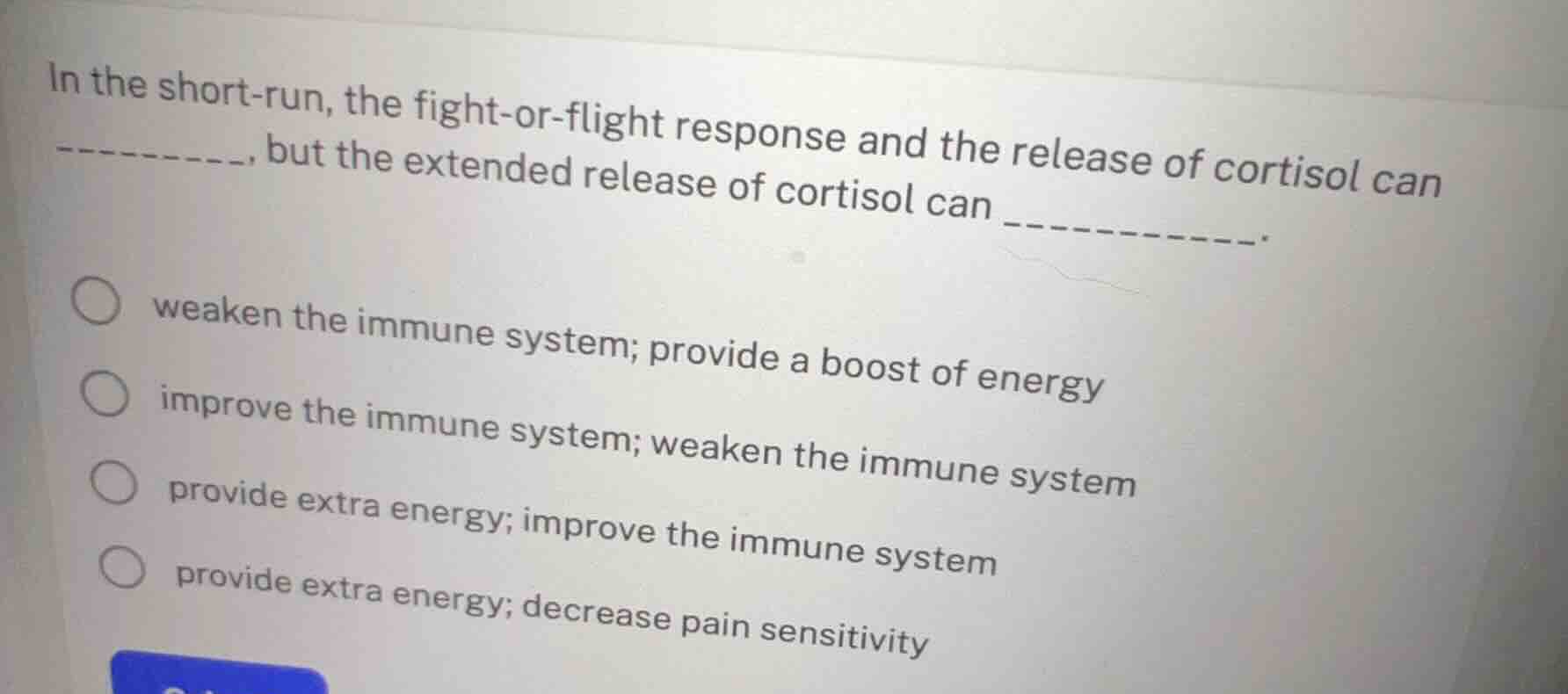
in the short-run, the fight-or-flight response and the release of cortisol can ______, but the extended release of cortisol can ______.

weaken the immune system; provide a boost of energy
improve the immune system; weaken the immune system
provide extra energy; improve the immune system
provide extra energy; decrease pain sensitivity

Explanation:

Response

<pre_analysis>
{
"quality": "clear",
"question_count": 1,
"skills_matched": [
"direct_cot",
"multiple_choice_formatter",
"explain_then_answer",
"tutor"
],
"needs_drawing": false,
"concepts_used": [
"General Adaptation Syndrome",
"Selye Stress Definition"
],
"new_concepts": [
"Cortisol Effects",
"Fight-or-Flight Response"
],
"current_concepts": [
"General Adaptation Syndrome",
"Selye Stress Definition",
"Cortisol Effects",
"Fight-or-Flight Response"
]
}
</pre_analysis>

<reasoning>

Analyze short-term stress response

In the short-run, the fight-or-flight response and the initial release of cortisol prepare the body for immediate physical action. This adaptive response mobilizes glucose reserves to provide extra energy (or improve immediate physiological functioning/immune response temporarily, though energy mobilization is the primary hallmark).

Analyze long-term stress response

When stress becomes chronic, the extended release of cortisol remains high. Over time, elevated cortisol levels suppress white blood cell production and overall immune function, which can weaken the immune system.

Evaluate the given options

Let's match our findings with the provided choices:

  • Option 1: "weaken the immune system; provide a boost of energy" (Reversed order)
  • Option 2: "improve the immune system; weaken the immune system" (While cortisol has complex immune-modulating effects, the primary adaptive short-term benefit is energy mobilization rather than "improving" the immune system in standard introductory psychology contexts, though some models discuss temporary enhancement. Let's look at Option 3 and 4).
  • Option 3: "provide extra energy; improve the immune system" (Incorrect, long-term cortisol weakens the immune system).
  • Option 4: "provide extra energy; decrease pain sensitivity" (Cortisol does decrease pain sensitivity in the short term, but the second blank is for the extended/long-term release, which weakens the immune system).
  • Let's re-evaluate Option 2: "improve the immune system; weaken the immune system". In many standard psychology curricula (such as AP Psychology or introductory college courses discussing General Adaptation Syndrome), the short-term release of cortisol can temporarily enhance or "improve" immune system functioning to protect against immediate infection/injury, whereas chronic, extended release of cortisol suppresses and "weakens the immune system".
  • Let's compare Option 2 and Option 3/4. If the first blank is "provide extra energy", the second blank must be "weaken the immune system" to be correct, but no option has "provide extra energy; weaken the immune system". The only option with "weaken the immune system" as the second blank is Option 2: "improve the immune system; weaken the immune system". Therefore, Option 2 is the intended correct answer.

</reasoning>

<answer>
<mcq-option>(A) weaken the immune system; provide a boost of energy</mcq-option>
<mcq-correct>(B) improve the immune system; weaken the immune system</mcq-correct>
<mcq-option>(C) provide extra energy; improve the immune system</mcq-option>
<mcq-option>(D) provide extra energy; decrease pain sensitivity</mcq-option>
</answer>

<post_analysis>
{
"subject": "Natural Science",
"question_type": "Multiple Choice",
"knowledge_point": [
"Natural Science",
"Biology",
"Endocrine System and Stress Response"
]
}
</post_analysis>

Answer:

<pre_analysis>
{
"quality": "clear",
"question_count": 1,
"skills_matched": [
"direct_cot",
"multiple_choice_formatter",
"explain_then_answer",
"tutor"
],
"needs_drawing": false,
"concepts_used": [
"General Adaptation Syndrome",
"Selye Stress Definition"
],
"new_concepts": [
"Cortisol Effects",
"Fight-or-Flight Response"
],
"current_concepts": [
"General Adaptation Syndrome",
"Selye Stress Definition",
"Cortisol Effects",
"Fight-or-Flight Response"
]
}
</pre_analysis>

<reasoning>

Analyze short-term stress response

In the short-run, the fight-or-flight response and the initial release of cortisol prepare the body for immediate physical action. This adaptive response mobilizes glucose reserves to provide extra energy (or improve immediate physiological functioning/immune response temporarily, though energy mobilization is the primary hallmark).

Analyze long-term stress response

When stress becomes chronic, the extended release of cortisol remains high. Over time, elevated cortisol levels suppress white blood cell production and overall immune function, which can weaken the immune system.

Evaluate the given options

Let's match our findings with the provided choices:

  • Option 1: "weaken the immune system; provide a boost of energy" (Reversed order)
  • Option 2: "improve the immune system; weaken the immune system" (While cortisol has complex immune-modulating effects, the primary adaptive short-term benefit is energy mobilization rather than "improving" the immune system in standard introductory psychology contexts, though some models discuss temporary enhancement. Let's look at Option 3 and 4).
  • Option 3: "provide extra energy; improve the immune system" (Incorrect, long-term cortisol weakens the immune system).
  • Option 4: "provide extra energy; decrease pain sensitivity" (Cortisol does decrease pain sensitivity in the short term, but the second blank is for the extended/long-term release, which weakens the immune system).
  • Let's re-evaluate Option 2: "improve the immune system; weaken the immune system". In many standard psychology curricula (such as AP Psychology or introductory college courses discussing General Adaptation Syndrome), the short-term release of cortisol can temporarily enhance or "improve" immune system functioning to protect against immediate infection/injury, whereas chronic, extended release of cortisol suppresses and "weakens the immune system".
  • Let's compare Option 2 and Option 3/4. If the first blank is "provide extra energy", the second blank must be "weaken the immune system" to be correct, but no option has "provide extra energy; weaken the immune system". The only option with "weaken the immune system" as the second blank is Option 2: "improve the immune system; weaken the immune system". Therefore, Option 2 is the intended correct answer.

</reasoning>

<answer>
<mcq-option>(A) weaken the immune system; provide a boost of energy</mcq-option>
<mcq-correct>(B) improve the immune system; weaken the immune system</mcq-correct>
<mcq-option>(C) provide extra energy; improve the immune system</mcq-option>
<mcq-option>(D) provide extra energy; decrease pain sensitivity</mcq-option>
</answer>

<post_analysis>
{
"subject": "Natural Science",
"question_type": "Multiple Choice",
"knowledge_point": [
"Natural Science",
"Biology",
"Endocrine System and Stress Response"
]
}
</post_analysis>