QUESTION IMAGE
Question
select the correct answer.
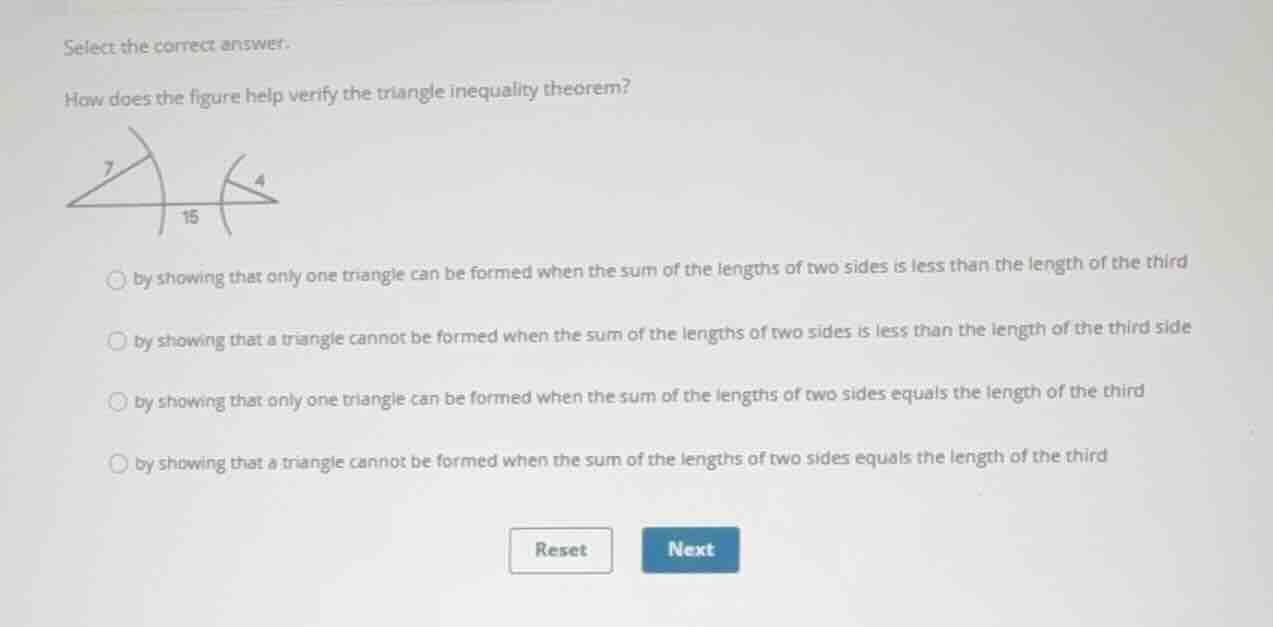
how does the figure help verify the triangle inequality theorem?
by showing that only one triangle can be formed when the sum of the lengths of two sides is less than the length of the third
by showing that a triangle cannot be formed when the sum of the lengths of two sides is less than the length of the third side
by showing that only one triangle can be formed when the sum of the lengths of two sides equals the length of the third
by showing that a triangle cannot be formed when the sum of the lengths of two sides equals the length of the third
Identify the given values
Using the Triangle Inequality Theorem knowledge point
Compare the side lengths
Using the Triangle Inequality Theorem knowledge point
Interpret the geometric representation
Using the Triangle Inequality Theorem knowledge point
- The arcs represent all possible locations for the free endpoints of the sides of lengths \(7\) and \(4\).
- Since the sum of their lengths (\(11\)) is less than the base length (\(15\)), the arcs do not intersect.
- This demonstrates that a triangle cannot be formed because the sum of the lengths of two sides is less than the length of the third side.

Snap & solve any problem in the app
Get step-by-step solutions on Sovi AI
Photo-based solutions with guided steps
Explore more problems and detailed explanations
- by showing that only one triangle can be formed when the sum of the lengths of two sides is less than the length of the third
- by showing that a triangle cannot be formed when the sum of the lengths of two sides is less than the length of the third side (Correct answer)
- by showing that only one triangle can be formed when the sum of the lengths of two sides equals the length of the third
- by showing that a triangle cannot be formed when the sum of the lengths of two sides equals the length of the third