QUESTION IMAGE
Question
secondary one mathematics exam papers g3
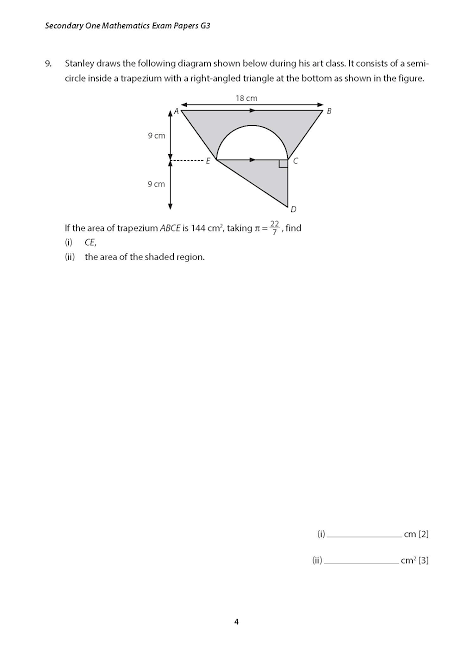
- stanley draws the following diagram shown below during his art class. it consists of a semi-circle inside a trapezium with a right-angled triangle at the bottom as shown in the figure.
if the area of trapezium \\(abce\\) is \\(144\text{ cm}^2\\), taking \\(\pi = \frac{22}{7}\\), find
(i) \\(ce\\),
(ii) the area of the shaded region.
🆕 New Concept Discovered: Area of Composite Figures
Finding areas by combining or subtracting basic shapes.
Step 1: Find the length of \( CE \)
The area of a trapezium is given by the formula:
For trapezium \( ABCE \):
- Parallel sides are \( AB = 18\text{ cm} \) and \( CE \).
- Height \( h = 9\text{ cm} \).
- Area is given as \( 144\text{ cm}^2 \).
Substitute these values into the formula to solve for \( CE \):
---
Step 2: Calculate the area of the unshaded semi-circle
The semi-circle sits on the line segment \( CE \), which means its diameter is equal to the length of \( CE \).
- Diameter \( d = 14\text{ cm} \)
- Radius \( r = \frac{14}{2} = 7\text{ cm} \)
Using \( \pi = \frac{22}{7} \), the area of the semi-circle is:
---
Step 3: Calculate the shaded region in the trapezium
The shaded area in the upper section is the area of trapezium \( ABCE \) minus the area of the semi-circle:
---
Step 4: Calculate the shaded area of the right-angled triangle
The bottom section is a right-angled triangle \( ECD \) with:
- Base \( CE = 14\text{ cm} \)
- Height \( CD = 9\text{ cm} \)
The area of this triangle is:
---
Step 5: Calculate the total shaded area
Sum the shaded areas from both sections:

Snap & solve any problem in the app
Get step-by-step solutions on Sovi AI
Photo-based solutions with guided steps
Explore more problems and detailed explanations
(i) \( 14\text{ cm} \)
(ii) \( 130\text{ cm}^2 \)