Sovi.AI - AI Math Tutor

Scan to solve math questions

QUESTION IMAGE

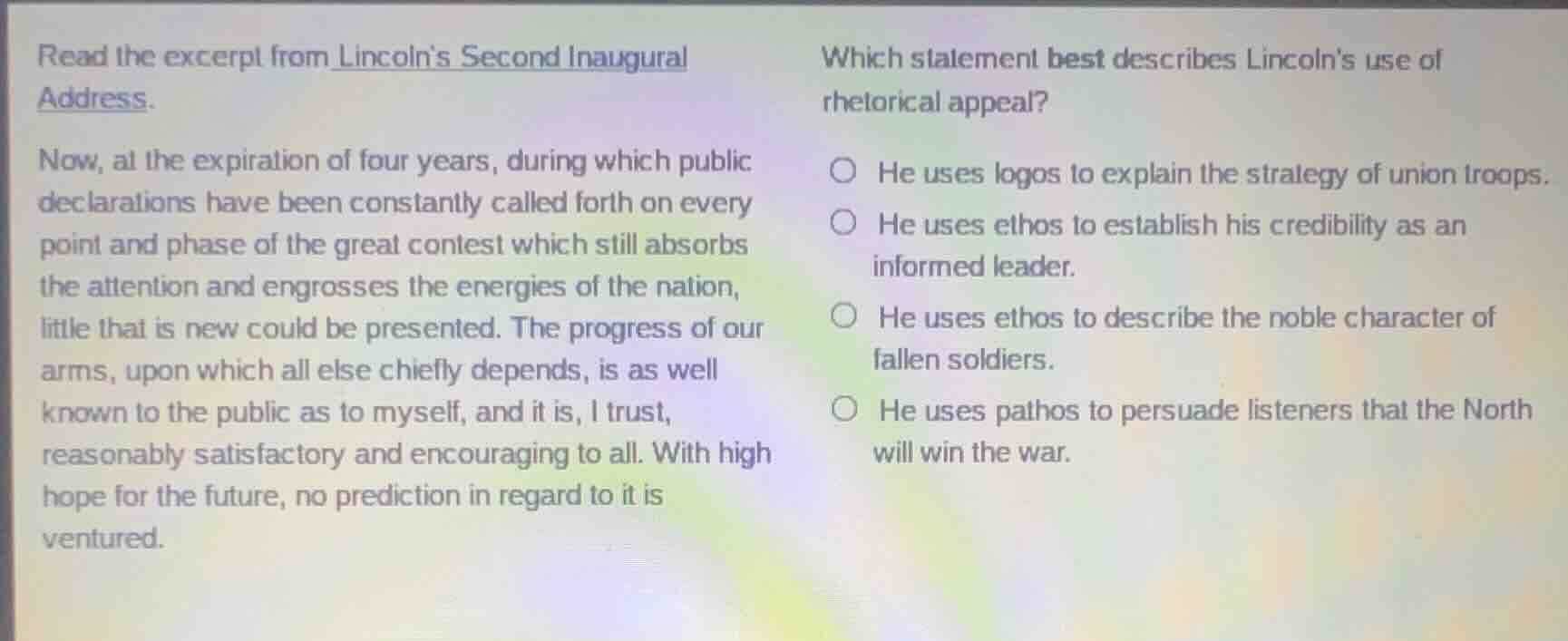
read the excerpt from lincolns second inaugural address. now, at the ex…

Question

read the excerpt from lincolns second inaugural address.

now, at the expiration of four years, during which public declarations have been constantly called forth on every point and phase of the great contest which still absorbs the attention and engrosses the energies of the nation, little that is new could be presented. the progress of our arms, upon which all else chiefly depends, is as well known to the public as to myself, and it is, i trust, reasonably satisfactory and encouraging to all. with high hope for the future, no prediction in regard to it is ventured.

which statement best describes lincolns use of rhetorical appeal?

he uses logos to explain the strategy of union troops.
he uses ethos to establish his credibility as an informed leader.
he uses ethos to describe the noble character of fallen soldiers.
he uses pathos to persuade listeners that the north will win the war.

Explanation:

Response

<pre_analysis>
{
"quality": "clear",
"question_count": 1,
"skills_matched": [
"direct_cot",
"multiple_choice_formatter",
"explain_then_answer",
"quick"
],
"needs_drawing": false,
"concepts_used": [
"Author's Purpose"
],
"new_concepts": [
"Rhetorical Appeals",
"Ethos Pathos Logos"
],
"current_concepts": [
"Author's Purpose",
"Rhetorical Appeals",
"Ethos Pathos Logos"
]
}
</pre_analysis>

<reasoning>

Analyze the excerpt for rhetorical appeals

In the excerpt, Lincoln states that the progress of the war is "as well known to the public as to myself." By acknowledging that the public is just as informed as he is, and by expressing his trust that the progress is "reasonably satisfactory and encouraging to all," he establishes a shared understanding and builds his credibility (ethos) as an honest, informed, and trustworthy leader who does not need to make false predictions.

Evaluate the given options

  • Option 1: The text does not explain military strategies of Union troops (incorrect use of logos).
  • Option 2: By stating that the progress of the war is well known to both the public and himself, Lincoln establishes a mutual understanding, reinforcing his ethos as an informed and reliable leader (correct).
  • Option 3: The excerpt does not mention or describe the character of fallen soldiers (incorrect).
  • Option 4: Lincoln explicitly declines to make predictions about winning the war ("no prediction in regard to it is ventured"), so he is not using pathos to persuade listeners of an assured victory (incorrect).

</reasoning>

<answer>
<mcq-option>He uses logos to explain the strategy of union troops.</mcq-option>
<mcq-correct>He uses ethos to establish his credibility as an informed leader.</mcq-correct>
<mcq-option>He uses ethos to describe the noble character of fallen soldiers.</mcq-option>
<mcq-option>He uses pathos to persuade listeners that the North will win the war.</mcq-option>
</answer>

<post_analysis>
{
"subject": "Social Science",
"question_type": "Multiple Choice",
"knowledge_point": [
"Social Science",
"History",
"Rhetorical Analysis of Historical Texts"
]
}
</post_analysis>

Answer:

<pre_analysis>
{
"quality": "clear",
"question_count": 1,
"skills_matched": [
"direct_cot",
"multiple_choice_formatter",
"explain_then_answer",
"quick"
],
"needs_drawing": false,
"concepts_used": [
"Author's Purpose"
],
"new_concepts": [
"Rhetorical Appeals",
"Ethos Pathos Logos"
],
"current_concepts": [
"Author's Purpose",
"Rhetorical Appeals",
"Ethos Pathos Logos"
]
}
</pre_analysis>

<reasoning>

Analyze the excerpt for rhetorical appeals

In the excerpt, Lincoln states that the progress of the war is "as well known to the public as to myself." By acknowledging that the public is just as informed as he is, and by expressing his trust that the progress is "reasonably satisfactory and encouraging to all," he establishes a shared understanding and builds his credibility (ethos) as an honest, informed, and trustworthy leader who does not need to make false predictions.

Evaluate the given options

  • Option 1: The text does not explain military strategies of Union troops (incorrect use of logos).
  • Option 2: By stating that the progress of the war is well known to both the public and himself, Lincoln establishes a mutual understanding, reinforcing his ethos as an informed and reliable leader (correct).
  • Option 3: The excerpt does not mention or describe the character of fallen soldiers (incorrect).
  • Option 4: Lincoln explicitly declines to make predictions about winning the war ("no prediction in regard to it is ventured"), so he is not using pathos to persuade listeners of an assured victory (incorrect).

</reasoning>

<answer>
<mcq-option>He uses logos to explain the strategy of union troops.</mcq-option>
<mcq-correct>He uses ethos to establish his credibility as an informed leader.</mcq-correct>
<mcq-option>He uses ethos to describe the noble character of fallen soldiers.</mcq-option>
<mcq-option>He uses pathos to persuade listeners that the North will win the war.</mcq-option>
</answer>

<post_analysis>
{
"subject": "Social Science",
"question_type": "Multiple Choice",
"knowledge_point": [
"Social Science",
"History",
"Rhetorical Analysis of Historical Texts"
]
}
</post_analysis>