QUESTION IMAGE
Question
this question has two parts. first, answer part a. then, answer part b.
part a
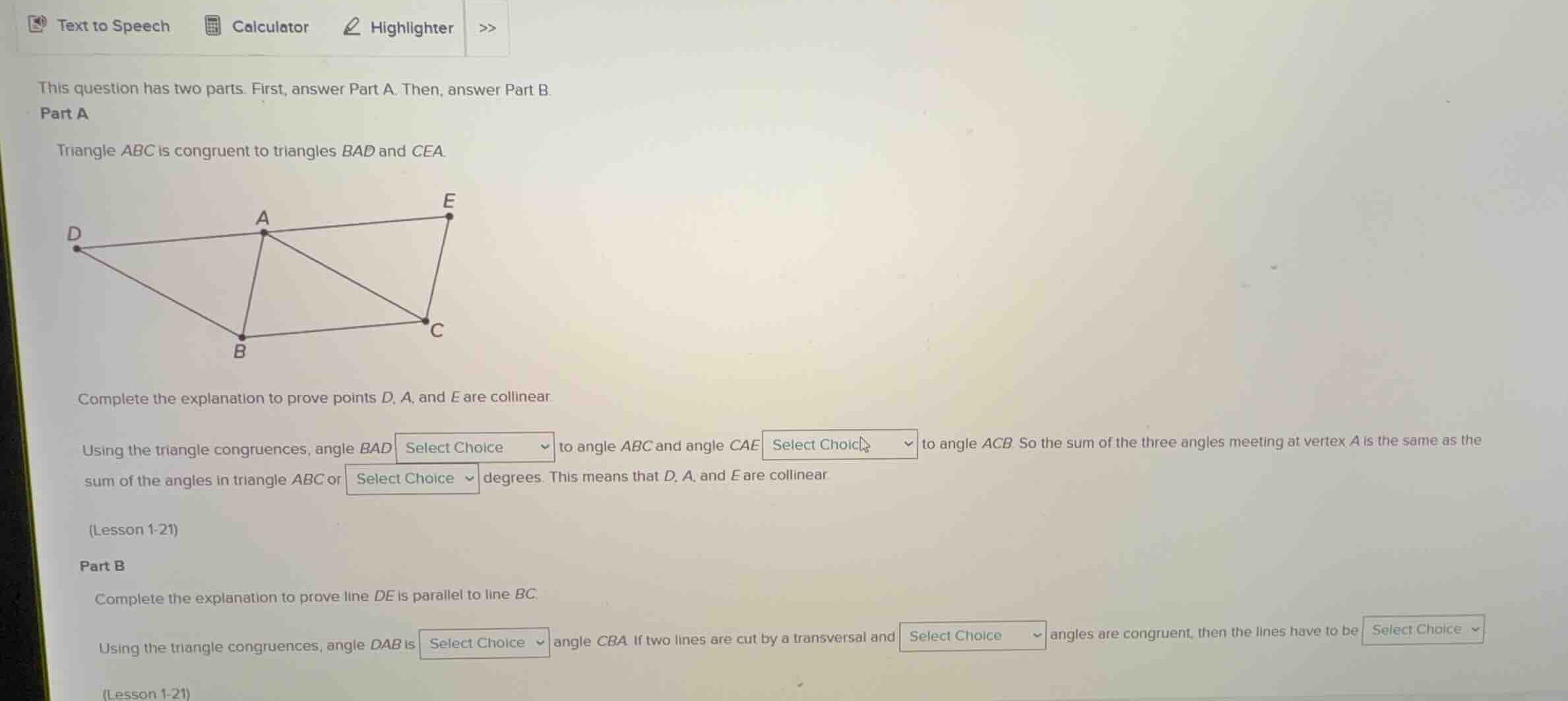
triangle \\(abc\\) is congruent to triangles \\(bad\\) and \\(cea\\).
complete the explanation to prove points \\(d\\), \\(a\\), and \\(e\\) are collinear.
using the triangle congruences, angle \\(bad\\) select choice to angle \\(abc\\) and angle \\(cae\\) select choice to angle \\(acb\\). so the sum of the three angles meeting at vertex \\(a\\) is the same as the sum of the angles in triangle \\(abc\\) or select choice degrees. this means that \\(d\\), \\(a\\), and \\(e\\) are collinear.
(lesson 1-21)
part b
complete the explanation to prove line \\(de\\) is parallel to line \\(bc\\).
using the triangle congruences, angle \\(dab\\) is select choice angle \\(cba\\). if two lines are cut by a transversal and select choice angles are congruent, then the lines have to be select choice.
(lesson 1-21)
Analyze given congruences
We are given that \(\triangle ABC \cong \triangle BAD\) and \(\triangle ABC \cong \triangle CEA\).
Corresponding parts of congruent triangles are congruent (CPCTC).
Thus, corresponding angles are equal:
- From \(\triangle ABC \cong \triangle BAD\), we have \(\angle BAD \cong \angle ABC\).
- From \(\triangle ABC \cong \triangle CEA\), we have \(\angle CAE \cong \angle ACB\).
Prove collinearity (Part A)
The three angles meeting at vertex \(A\) along the line-like structure are \(\angle DAB\), \(\angle BAC\), and \(\angle CAE\).
Note that \(\angle BAD\) is the same as \(\angle DAB\).
Using the congruences:
- \(\angle DAB \cong \angle ABC\)
- \(\angle CAE \cong \angle ACB\)
The sum of these three angles is:
Since the sum of the angles in \(\triangle ABC\) is \(180^\circ\), the sum of the three angles meeting at vertex \(A\) is \(180^\circ\).
Therefore, \(D\), \(A\), and \(E\) form a straight line, meaning they are collinear.
Analyze parallel lines (Part B)
We want to prove line \(DE\) is parallel to line \(BC\).
From the congruence \(\triangle ABC \cong \triangle BAD\):
- The corresponding angles are \(\angle DAB\) and \(\angle CBA\).
- Therefore, \(\angle DAB \cong \angle CBA\).
Looking at lines \(DE\) and \(BC\) cut by the transversal line \(AB\):
- \(\angle DAB\) and \(\angle CBA\) are alternate interior angles.
- Since these alternate interior angles are congruent, the lines \(DE\) and \(BC\) must be parallel.

Snap & solve any problem in the app
Get step-by-step solutions on Sovi AI
Photo-based solutions with guided steps
Explore more problems and detailed explanations
Question 1 (Part A)
Using the triangle congruences, angle \(BAD\) is <blank>is congruent</blank> to angle \(ABC\) and angle \(CAE\) is <blank>is congruent</blank> to angle \(ACB\). So the sum of the three angles meeting at vertex \(A\) is the same as the sum of the angles in triangle \(ABC\) or <blank>180</blank> degrees. This means that \(D\), \(A\), and \(E\) are collinear.
Question 2 (Part B)
Using the triangle congruences, angle \(DAB\) is <blank>congruent to</blank> angle \(CBA\). If two lines are cut by a transversal and <blank>alternate interior</blank> angles are congruent, then the lines have to be <blank>parallel</blank>.