QUESTION IMAGE
Question
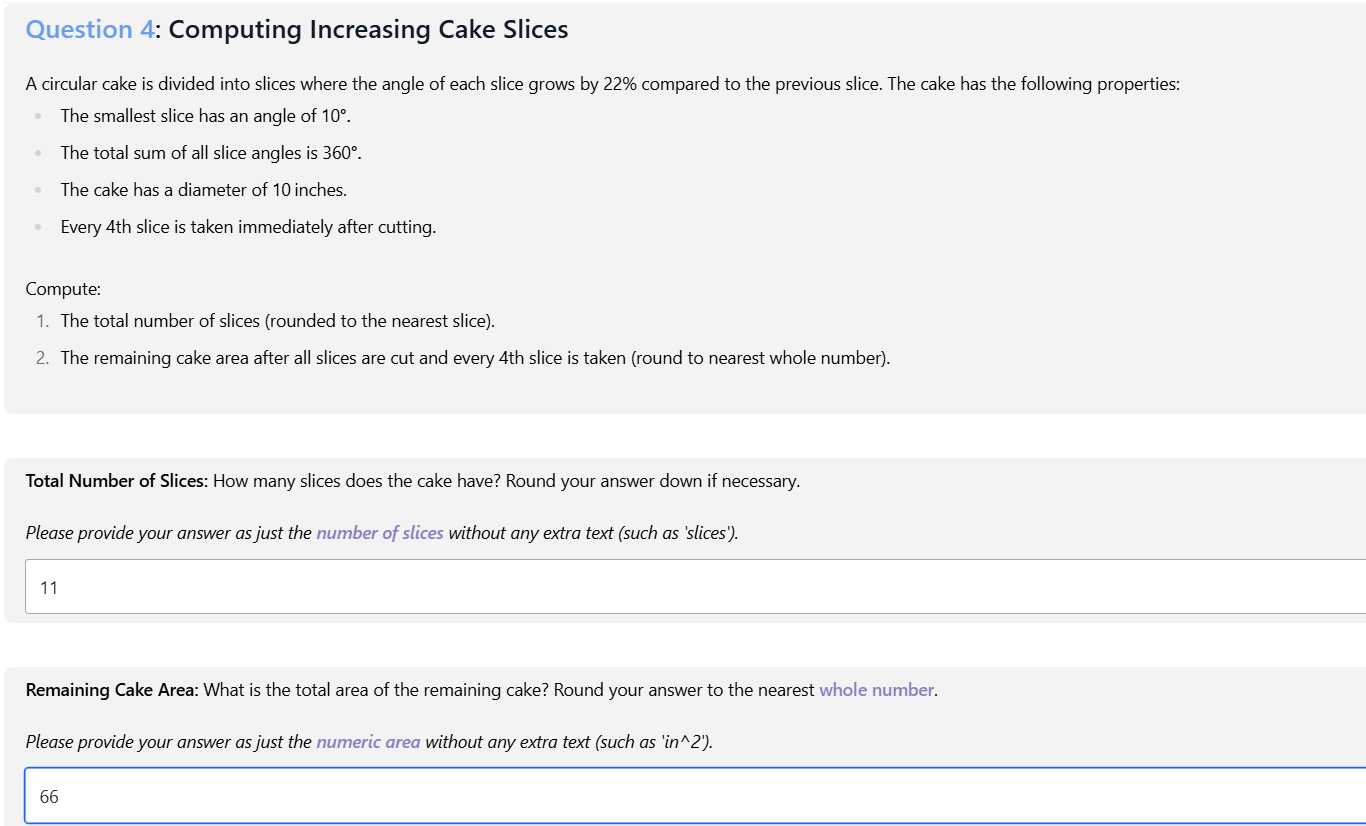
question 4: computing increasing cake slices
a circular cake is divided into slices where the angle of each slice grows by 22% compared to the previous slice. the cake has the following properties:
- the smallest slice has an angle of 10\\(^{\circ}\\).
- the total sum of all slice angles is 360\\(^{\circ}\\).
- the cake has a diameter of 10 inches.
- every 4th slice is taken immediately after cutting.
compute:
- the total number of slices (rounded to the nearest slice).
- the remaining cake area after all slices are cut and every 4th slice is taken (round to nearest whole number).
total number of slices: how many slices does the cake have? round your answer down if necessary.
please provide your answer as just the number of slices without any extra text (such as slices).
11
remaining cake area: what is the total area of the remaining cake? round your answer to the nearest whole number.
please provide your answer as just the numeric area without any extra text (such as in^2).
66
🆕 New Concept Discovered: Geometric Series
Summing terms that grow by a constant percentage.
Step 1: Model the slice angles as a geometric progression
The angle of each slice grows by \(22\%\) compared to the previous slice. This forms a geometric sequence where:
- First term (smallest slice): \(a = 10^\circ\)
- Common ratio: \(r = 1 + 0.22 = 1.22\)
- Sum of all \(n\) slices: \(S_n = 360^\circ\)
The formula for the sum of a geometric series is:
Substitute the known values to solve for \(n\):
Solve for \(n\) using logarithms:
Rounding to the nearest whole number (or rounding down as specified in the prompt):
Step 2: Identify the taken slices
There are \(11\) slices in total, ordered from smallest (\(1\)st) to largest (\(11\)th).
Every 4th slice is taken immediately after cutting:
- Slices taken: \(4\)th and \(8\)th slices.
- Slices remaining: \(1\)st, \(2\)nd, \(3\)rd, \(5\)th, \(6\)th, \(7\)th, \(9\)th, \(10\)th, and \(11\)th slices.
Step 3: Calculate the total angle of the taken slices
First, calculate the angles of the \(4\)th and \(8\)th slices using the term formula \(a_k = a \cdot r^{k-1}\):
- \(4\)th slice angle:
- \(8\)th slice angle:
Sum of the angles of the taken slices:
Step 4: Calculate the total angle of the remaining slices
Subtract the taken angles from the total \(360^\circ\):
Step 5: Calculate the remaining cake area
The cake has a diameter of \(10\) inches, so its radius is:
The total area of a circle is \(\pi R^2\). The area of the remaining sector is proportional to the remaining angle:
Rounding to the nearest whole number:

Snap & solve any problem in the app
Get step-by-step solutions on Sovi AI
Photo-based solutions with guided steps
Explore more problems and detailed explanations
- Total Number of Slices: 11
- Remaining Cake Area: 66