QUESTION IMAGE
Question
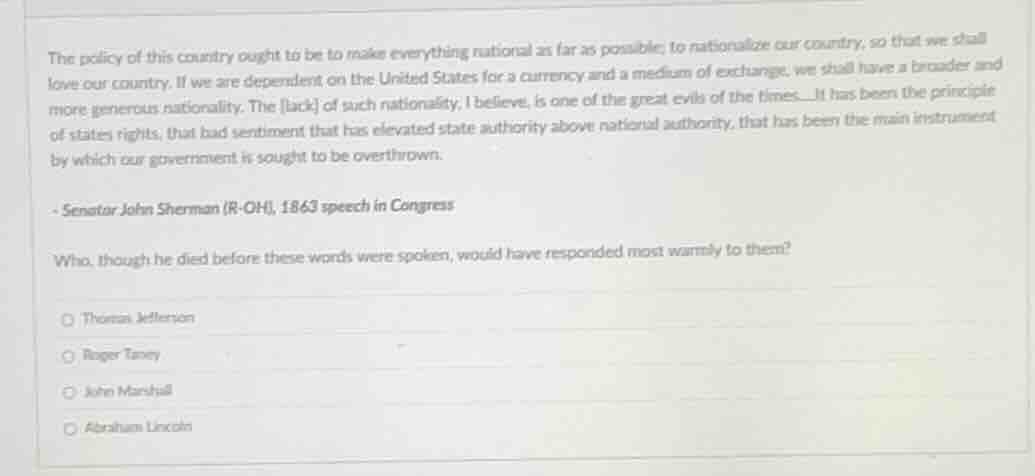
the policy of this country ought to be to make everything national as far as possible; to nationalize our country, so that we shall love our country. if we are dependent on the united states for a currency and a medium of exchange, we shall have a broader and more generous nationality. the lack of such nationality, i believe, is one of the great evils of the times... it has been the principle of states rights, that bad sentiment that has elevated state authority above national authority, that has been the main instrument by which our government is sought to be overthrown.
- senator john sherman (r-oh), 1863 speech in congress
who, though he died before these words were spoken, would have responded most warmly to them?
thomas jefferson
roger taney
john marshall
abraham lincoln
<pre_analysis>
{
"quality": "clear",
"question_count": 1,
"skills_matched": [
"direct_cot",
"multiple_choice_formatter",
"explain_then_answer",
"tutor"
],
"needs_drawing": false,
"concepts_used": [
"Civil War Congress",
"Republican Legislation"
],
"new_concepts": [
"National Banking Acts",
"Federalist Jurisprudence",
"Nationalism vs States Rights"
],
"current_concepts": [
"Civil War Congress",
"Republican Legislation",
"National Banking Acts",
"Federalist Jurisprudence",
"Nationalism vs States Rights"
]
}
</pre_analysis>
<reasoning>
Analyze the source text
The excerpt is from a speech by Senator John Sherman (R-OH) in 1863. He argues that the country should "make everything national as far as possible" and "nationalize our country." He specifically highlights the importance of a national currency and a unified medium of exchange to foster a broader nationality. He strongly criticizes the principle of "states' rights" as a "bad sentiment" that elevates state authority above national authority and serves as the instrument used to try to overthrow the federal government.
Evaluate the historical context
During the Civil War, the Civil War Congress passed major Republican Legislation to centralize and strengthen the federal government and the national economy. This included the National Banking Acts, which created a unified national currency to replace a chaotic system of state-bank notes. Sherman's speech directly reflects this effort to consolidate federal power over the economy and suppress the Southern states' rights ideology that led to secession.
Assess the historical figures
We need to identify which of the listed figures would have responded most warmly to these nationalist, anti-states'-rights, and pro-national-currency sentiments, keeping in mind the clue that this person "died before these words were spoken" (before 1863):
- Thomas Jefferson: Died in 1826. He was a champion of states' rights, strict constructionism, and decentralized agrarianism. He would have strongly opposed this level of federal centralization.
- Roger Taney: Died in 1864 (after the speech was given). As Chief Justice, his ruling in the Dred Scott case supported states' rights and limited federal power.
- John Marshall: Died in 1835 (before 1863). As Chief Justice, Marshall was a staunch Federalist who consistently ruled to expand federal power over the states, promote national economic development, and establish the supremacy of national authority. He would have warmly embraced Sherman's nationalist vision.
- Abraham Lincoln: Died in 1865 (after the speech was given). He was alive when these words were spoken in 1863.
Confirm the correct option
John Marshall died in 1835, satisfying the condition of dying before 1863. His judicial legacy was defined by strengthening national authority and federal supremacy over state governments, aligning perfectly with Sherman's call to "nationalize our country" and subordinate state authority.
</reasoning>
<answer>
<mcq-option>Thomas Jefferson</mcq-option>
<mcq-option>Roger Taney</mcq-option>
<mcq-correct>John Marshall</mcq-correct>
<mcq-option>Abraham Lincoln</mcq-option>
</answer>
<post_analysis>
{
"subject": "Social Science",
"question_type": "Multiple Choice",
"knowledge_point": [
"Social Science",
"US History",
"Federal Supremacy and Nationalism"
]
}
</post_analysis>
Snap & solve any problem in the app
Get step-by-step solutions on Sovi AI
Photo-based solutions with guided steps
Explore more problems and detailed explanations
<pre_analysis>
{
"quality": "clear",
"question_count": 1,
"skills_matched": [
"direct_cot",
"multiple_choice_formatter",
"explain_then_answer",
"tutor"
],
"needs_drawing": false,
"concepts_used": [
"Civil War Congress",
"Republican Legislation"
],
"new_concepts": [
"National Banking Acts",
"Federalist Jurisprudence",
"Nationalism vs States Rights"
],
"current_concepts": [
"Civil War Congress",
"Republican Legislation",
"National Banking Acts",
"Federalist Jurisprudence",
"Nationalism vs States Rights"
]
}
</pre_analysis>
<reasoning>
Analyze the source text
The excerpt is from a speech by Senator John Sherman (R-OH) in 1863. He argues that the country should "make everything national as far as possible" and "nationalize our country." He specifically highlights the importance of a national currency and a unified medium of exchange to foster a broader nationality. He strongly criticizes the principle of "states' rights" as a "bad sentiment" that elevates state authority above national authority and serves as the instrument used to try to overthrow the federal government.
Evaluate the historical context
During the Civil War, the Civil War Congress passed major Republican Legislation to centralize and strengthen the federal government and the national economy. This included the National Banking Acts, which created a unified national currency to replace a chaotic system of state-bank notes. Sherman's speech directly reflects this effort to consolidate federal power over the economy and suppress the Southern states' rights ideology that led to secession.
Assess the historical figures
We need to identify which of the listed figures would have responded most warmly to these nationalist, anti-states'-rights, and pro-national-currency sentiments, keeping in mind the clue that this person "died before these words were spoken" (before 1863):
- Thomas Jefferson: Died in 1826. He was a champion of states' rights, strict constructionism, and decentralized agrarianism. He would have strongly opposed this level of federal centralization.
- Roger Taney: Died in 1864 (after the speech was given). As Chief Justice, his ruling in the Dred Scott case supported states' rights and limited federal power.
- John Marshall: Died in 1835 (before 1863). As Chief Justice, Marshall was a staunch Federalist who consistently ruled to expand federal power over the states, promote national economic development, and establish the supremacy of national authority. He would have warmly embraced Sherman's nationalist vision.
- Abraham Lincoln: Died in 1865 (after the speech was given). He was alive when these words were spoken in 1863.
Confirm the correct option
John Marshall died in 1835, satisfying the condition of dying before 1863. His judicial legacy was defined by strengthening national authority and federal supremacy over state governments, aligning perfectly with Sherman's call to "nationalize our country" and subordinate state authority.
</reasoning>
<answer>
<mcq-option>Thomas Jefferson</mcq-option>
<mcq-option>Roger Taney</mcq-option>
<mcq-correct>John Marshall</mcq-correct>
<mcq-option>Abraham Lincoln</mcq-option>
</answer>
<post_analysis>
{
"subject": "Social Science",
"question_type": "Multiple Choice",
"knowledge_point": [
"Social Science",
"US History",
"Federal Supremacy and Nationalism"
]
}
</post_analysis>