QUESTION IMAGE
Question
no, because they are non-coplanar
no, because they are parallel
yes, because they are perpendicular
yes, because they are coplanar
Analyze the geometric configuration of lines \(m\) and \(n\)
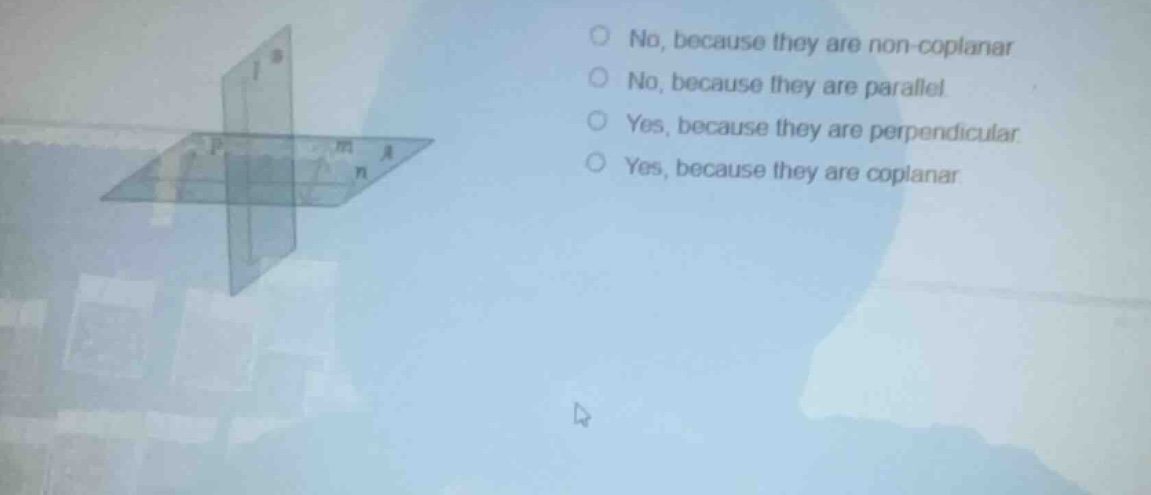
The diagram shows two planes intersecting. Plane \(A\) is the horizontal plane containing lines \(m\) and \(n\). Since both lines \(m\) and \(n\) lie entirely within the same plane \(A\), they are coplanar by definition.
Determine if the lines intersect
In plane \(A\), lines \(m\) and \(n\) are drawn with parallel markings (arrows on the lines) indicating they are parallel. Parallel lines in the same plane do not intersect.
Evaluate the multiple-choice options
- "No, because they are non-coplanar": Incorrect, they lie in the same plane \(A\).
- "No, because they are parallel": Correct, parallel lines in the same plane never intersect.
- "Yes, because they are perpendicular": Incorrect, they are parallel.
- "Yes, because they are coplanar": Incorrect, being coplanar does not guarantee intersection (they can be parallel).

Snap & solve any problem in the app
Get step-by-step solutions on Sovi AI
Photo-based solutions with guided steps
Explore more problems and detailed explanations
- No, because they are non-coplanar
- No, because they are parallel (Correct answer)
- Yes, because they are perpendicular
- Yes, because they are coplanar