Sovi.AI - AI Math Tutor

Scan to solve math questions

QUESTION IMAGE

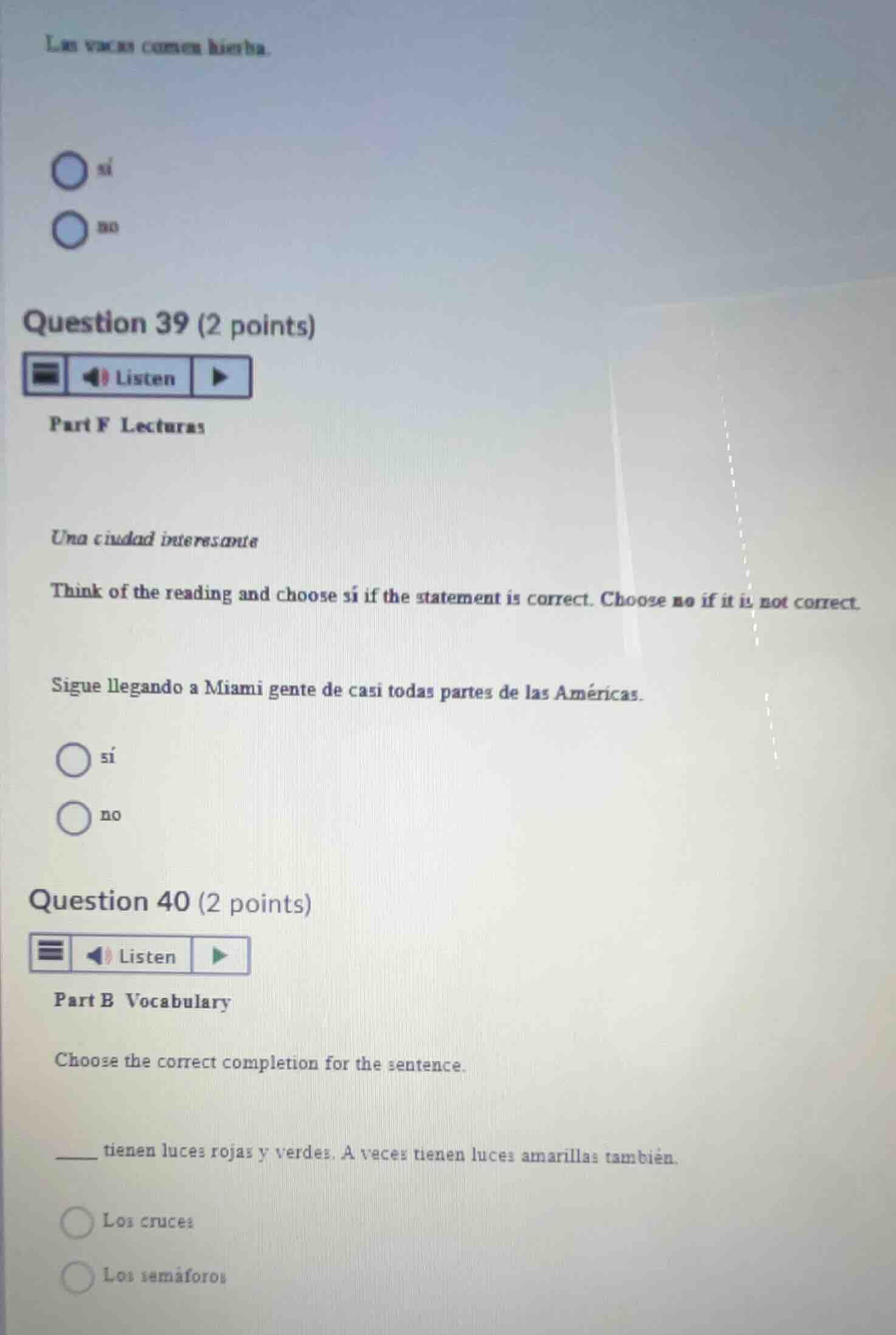
las vacas comen hierba. sí no question 39 (2 points) part f lecturas un…

Question

las vacas comen hierba.


no

question 39 (2 points)
part f lecturas

una ciudad interesante
think of the reading and choose sí if the statement is correct. choose no if it is not correct.

sigue llegando a miami gente de casi todas partes de las américas.


no

question 40 (2 points)
part b vocabulary

choose the correct completion for the sentence.

_____ tienen luces rojas y verdes. a veces tienen luces amarillas también.

los cruces
los semáforos

Explanation:

Response

<pre_analysis>
{
"quality": "clear",
"question_count": 3,
"skills_matched": [
"direct_cot",
"multiple_choice_formatter",
"explain_then_answer",
"tutor",
"mastery_adaptive_brevity"
],
"needs_drawing": false,
"concepts_used": [
"Spanish Vocabulary",
"Spanish Subject Verb Agreement"
],
"new_concepts": [
"Spanish Reading Comprehension"
],
"current_concepts": [
"Spanish Vocabulary",
"Spanish Subject Verb Agreement",
"Spanish Reading Comprehension"
]
}
</pre_analysis>

<reasoning>

Analyze the first statement

Using the Spanish Vocabulary knowledge point

The statement is: "Las vacas comen hierba."

  • "Las vacas" means "The cows".
  • "comen" means "eat" (from the verb comer).
  • "hierba" means "grass".

The statement translates to "Cows eat grass," which is a factually correct statement. Therefore, the correct option is "sí".

Analyze Question 39

Using the Spanish Vocabulary knowledge point

The prompt asks to think of a reading and choose "sí" if the statement is correct, or "no" if it is not correct.
The statement is: "Sigue llegando a Miami gente de casi todas partes de las Américas."

  • "Sigue llegando a Miami" means "People continue to arrive in Miami".
  • "gente de casi todas partes de las Américas" means "people from almost all parts of the Americas".

Historically and culturally, Miami is a major hub that continuously receives immigrants and visitors from all over Latin America and North America (the Americas). Without the specific textbook passage, this general reading comprehension statement is factually correct regarding the demographics of Miami. Therefore, the correct option is "sí".

Analyze Question 40

Using the Spanish Vocabulary and Spanish Subject Verb Agreement knowledge points

The sentence is: "____ tienen luces rojas y verdes. A veces tienen luces amarillas también."

  • "tienen luces rojas y verdes" means "[They] have red and green lights."
  • "A veces tienen luces amarillas también" means "Sometimes they have yellow lights too."

Now we evaluate the vocabulary options:

  1. "Los cruces" means "The intersections/crossings". Intersections themselves do not have colored lights; rather, the traffic signals at them do.
  2. "Los semáforos" means "The traffic lights". Traffic lights have red, green, and sometimes yellow lights.

Thus, "Los semáforos" is the correct vocabulary word to complete the sentence.
</reasoning>

<answer>

Question 1

<mcq-correct>sí</mcq-correct>
<mcq-option>no</mcq-option>

Question 39

<mcq-correct>sí</mcq-correct>
<mcq-option>no</mcq-option>

Question 40

<mcq-option>Los cruces</mcq-option>
<mcq-correct>Los semáforos</mcq-correct>
</answer>

<post_analysis>
{
"subject": "Others",
"question_type": "Multiple Choice",
"knowledge_point": [
"Others",
"Spanish",
"Spanish Vocabulary"
]
}
</post_analysis>

Answer:

<pre_analysis>
{
"quality": "clear",
"question_count": 3,
"skills_matched": [
"direct_cot",
"multiple_choice_formatter",
"explain_then_answer",
"tutor",
"mastery_adaptive_brevity"
],
"needs_drawing": false,
"concepts_used": [
"Spanish Vocabulary",
"Spanish Subject Verb Agreement"
],
"new_concepts": [
"Spanish Reading Comprehension"
],
"current_concepts": [
"Spanish Vocabulary",
"Spanish Subject Verb Agreement",
"Spanish Reading Comprehension"
]
}
</pre_analysis>

<reasoning>

Analyze the first statement

Using the Spanish Vocabulary knowledge point

The statement is: "Las vacas comen hierba."

  • "Las vacas" means "The cows".
  • "comen" means "eat" (from the verb comer).
  • "hierba" means "grass".

The statement translates to "Cows eat grass," which is a factually correct statement. Therefore, the correct option is "sí".

Analyze Question 39

Using the Spanish Vocabulary knowledge point

The prompt asks to think of a reading and choose "sí" if the statement is correct, or "no" if it is not correct.
The statement is: "Sigue llegando a Miami gente de casi todas partes de las Américas."

  • "Sigue llegando a Miami" means "People continue to arrive in Miami".
  • "gente de casi todas partes de las Américas" means "people from almost all parts of the Americas".

Historically and culturally, Miami is a major hub that continuously receives immigrants and visitors from all over Latin America and North America (the Americas). Without the specific textbook passage, this general reading comprehension statement is factually correct regarding the demographics of Miami. Therefore, the correct option is "sí".

Analyze Question 40

Using the Spanish Vocabulary and Spanish Subject Verb Agreement knowledge points

The sentence is: "____ tienen luces rojas y verdes. A veces tienen luces amarillas también."

  • "tienen luces rojas y verdes" means "[They] have red and green lights."
  • "A veces tienen luces amarillas también" means "Sometimes they have yellow lights too."

Now we evaluate the vocabulary options:

  1. "Los cruces" means "The intersections/crossings". Intersections themselves do not have colored lights; rather, the traffic signals at them do.
  2. "Los semáforos" means "The traffic lights". Traffic lights have red, green, and sometimes yellow lights.

Thus, "Los semáforos" is the correct vocabulary word to complete the sentence.
</reasoning>

<answer>

Question 1

<mcq-correct>sí</mcq-correct>
<mcq-option>no</mcq-option>

Question 39

<mcq-correct>sí</mcq-correct>
<mcq-option>no</mcq-option>

Question 40

<mcq-option>Los cruces</mcq-option>
<mcq-correct>Los semáforos</mcq-correct>
</answer>

<post_analysis>
{
"subject": "Others",
"question_type": "Multiple Choice",
"knowledge_point": [
"Others",
"Spanish",
"Spanish Vocabulary"
]
}
</post_analysis>