Sovi.AI - AI Math Tutor

Scan to solve math questions

QUESTION IMAGE

katie earns \\$125 babysitting monday through friday and \\$5 per hour …

Question

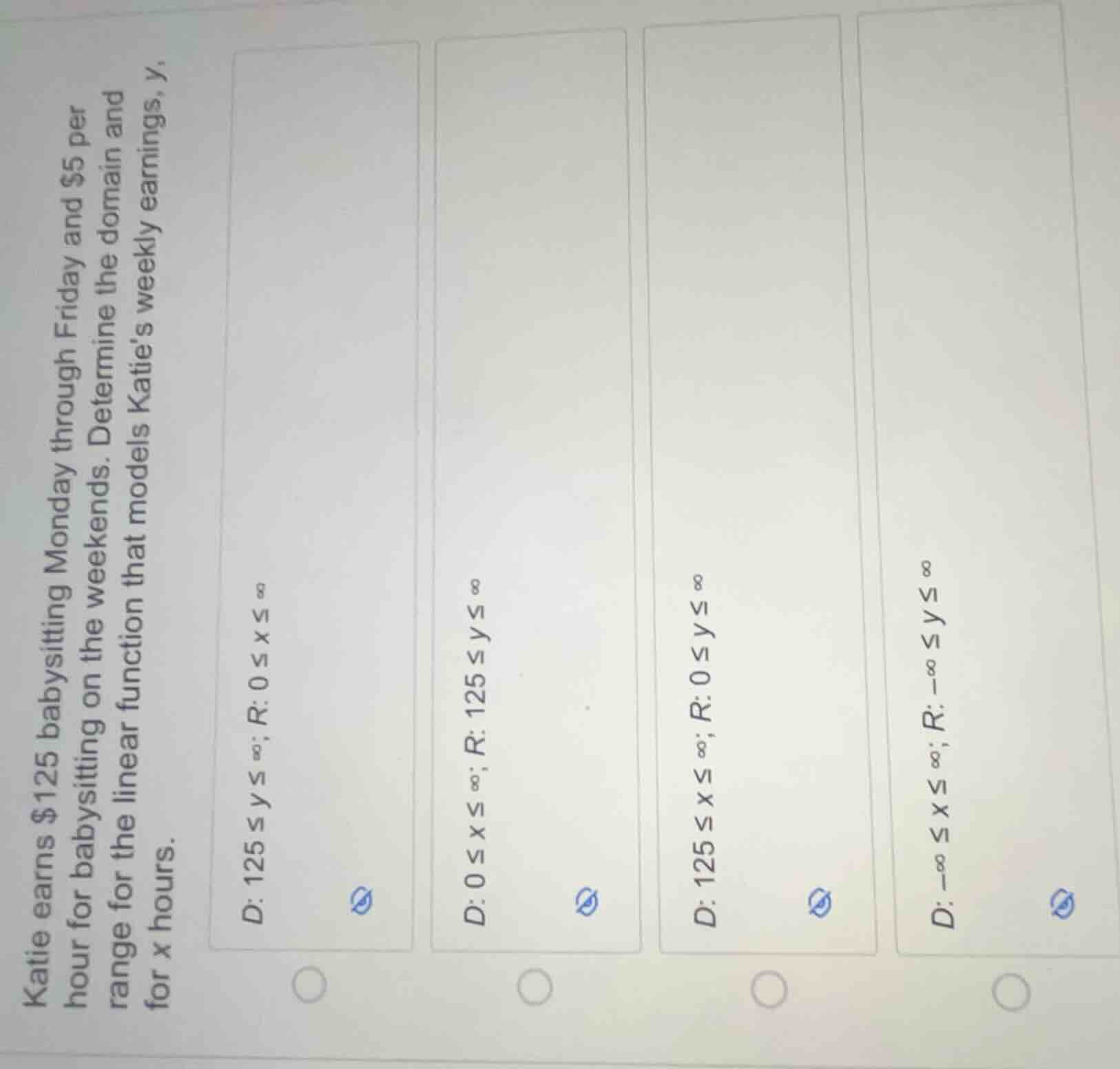
katie earns \\$125 babysitting monday through friday and \\$5 per hour for babysitting on the weekends. determine the domain and range for the linear function that models katies weekly earnings, y, for x hours.

option 1: d: \\(125 \le y \le \infty\\); r: \\(0 \le x \le \infty\\)
option 2: d: \\(0 \le x \le \infty\\); r: \\(125 \le y \le \infty\\)
option 3: d: \\(125 \le x \le \infty\\); r: \\(0 \le y \le \infty\\)
option 4: d: \\(-\infty \le x \le \infty\\); r: \\(-\infty \le y \le \infty\\)

Explanation:

Response

<pre_analysis>
{
"quality": "clear",
"question_count": 1,
"skills_matched": [
"step_cot",
"multiple_choice_formatter",
"explain_then_answer",
"tutor"
],
"needs_drawing": false,
"concepts_used": [
"Rate of Change"
],
"new_concepts": [
"Domain and Range",
"Linear Functions"
],
"current_concepts": [
"Rate of Change",
"Domain and Range",
"Linear Functions"
]
}
</pre_analysis>

<reasoning>

Identify the variables and function

The problem describes Katie's weekly earnings, \(y\), based on the number of hours she works babysitting on weekends, \(x\).
Katie earns a flat rate of \$125 from Monday through Friday.
On weekends, she earns an additional \$5 per hour.
Using the Rate of Change concept, the hourly rate is \$5 per hour.
The linear function modeling her weekly earnings is:
\[y = 5x + 125\]

Determine the domain

The domain represents all possible values for the independent variable, \(x\) (weekend hours worked).
Since hours worked cannot be negative, the minimum value for \(x\) is 0.
There is no specified maximum limit on the hours she can work in the problem statement.
Therefore, the domain is:
\[D: 0 \le x < \infty\]

Determine the range

The range represents all possible values for the dependent variable, \(y\) (weekly earnings).
When Katie works 0 hours on the weekend (\(x = 0\)):
\[y = 5(0) + 125 = 125\]
As the number of hours \(x\) increases, her earnings \(y\) increase.
Therefore, the minimum weekly earnings are \$125, and there is no upper limit.
The range is:
\[R: 125 \le y < \infty\]

Match with the options

We look for the option that states:
\[D: 0 \le x < \infty;\ R: 125 \le y < \infty\]
This matches the second option.
</reasoning>

<answer>
<mcq-option>(A) \(D: 125 \le y < \infty;\ R: 0 \le x < \infty\)</mcq-option>
<mcq-correct>(B) \(D: 0 \le x < \infty;\ R: 125 \le y < \infty\)</mcq-correct>
<mcq-option>(C) \(D: 125 \le x < \infty;\ R: 0 \le y < \infty\)</mcq-option>
<mcq-option>(D) \(D: -\infty < x < \infty;\ R: -\infty \le y < \infty\)</mcq-option>
</answer>

<post_analysis>
{
"subject": "Mathematics",
"question_type": "Multiple Choice",
"knowledge_point": [
"Mathematics",
"Algebra",
"Domain and Range"
]
}
</post_analysis>

Answer:

<pre_analysis>
{
"quality": "clear",
"question_count": 1,
"skills_matched": [
"step_cot",
"multiple_choice_formatter",
"explain_then_answer",
"tutor"
],
"needs_drawing": false,
"concepts_used": [
"Rate of Change"
],
"new_concepts": [
"Domain and Range",
"Linear Functions"
],
"current_concepts": [
"Rate of Change",
"Domain and Range",
"Linear Functions"
]
}
</pre_analysis>

<reasoning>

Identify the variables and function

The problem describes Katie's weekly earnings, \(y\), based on the number of hours she works babysitting on weekends, \(x\).
Katie earns a flat rate of \$125 from Monday through Friday.
On weekends, she earns an additional \$5 per hour.
Using the Rate of Change concept, the hourly rate is \$5 per hour.
The linear function modeling her weekly earnings is:
\[y = 5x + 125\]

Determine the domain

The domain represents all possible values for the independent variable, \(x\) (weekend hours worked).
Since hours worked cannot be negative, the minimum value for \(x\) is 0.
There is no specified maximum limit on the hours she can work in the problem statement.
Therefore, the domain is:
\[D: 0 \le x < \infty\]

Determine the range

The range represents all possible values for the dependent variable, \(y\) (weekly earnings).
When Katie works 0 hours on the weekend (\(x = 0\)):
\[y = 5(0) + 125 = 125\]
As the number of hours \(x\) increases, her earnings \(y\) increase.
Therefore, the minimum weekly earnings are \$125, and there is no upper limit.
The range is:
\[R: 125 \le y < \infty\]

Match with the options

We look for the option that states:
\[D: 0 \le x < \infty;\ R: 125 \le y < \infty\]
This matches the second option.
</reasoning>

<answer>
<mcq-option>(A) \(D: 125 \le y < \infty;\ R: 0 \le x < \infty\)</mcq-option>
<mcq-correct>(B) \(D: 0 \le x < \infty;\ R: 125 \le y < \infty\)</mcq-correct>
<mcq-option>(C) \(D: 125 \le x < \infty;\ R: 0 \le y < \infty\)</mcq-option>
<mcq-option>(D) \(D: -\infty < x < \infty;\ R: -\infty \le y < \infty\)</mcq-option>
</answer>

<post_analysis>
{
"subject": "Mathematics",
"question_type": "Multiple Choice",
"knowledge_point": [
"Mathematics",
"Algebra",
"Domain and Range"
]
}
</post_analysis>