QUESTION IMAGE
Question
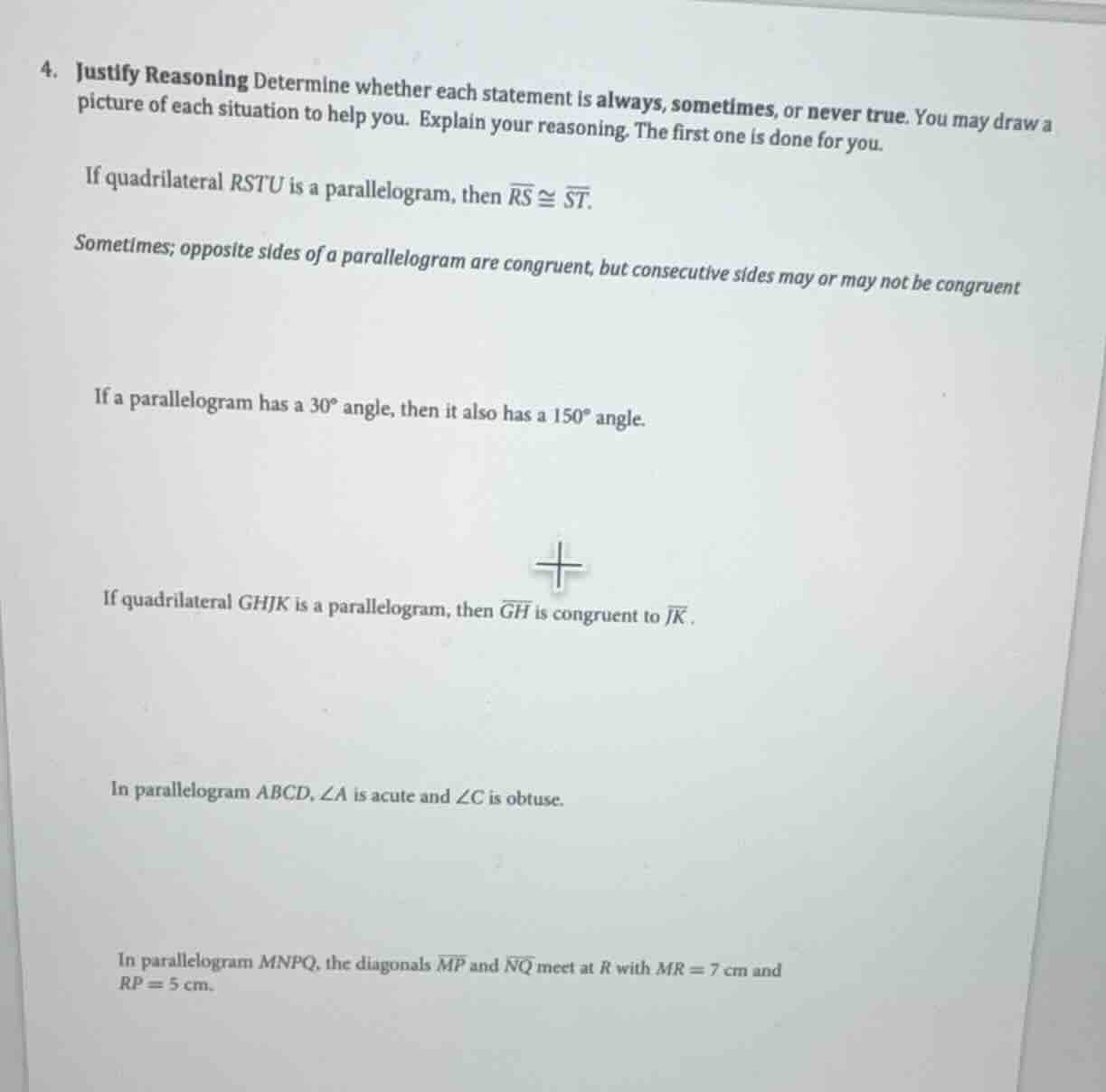
- justify reasoning determine whether each statement is always, sometimes, or never true. you may draw a picture of each situation to help you. explain your reasoning. the first one is done for you.
if quadrilateral \\(rstu\\) is a parallelogram, then \\(\overline{rs} \cong \overline{st}\\).
sometimes; opposite sides of a parallelogram are congruent, but consecutive sides may or may not be congruent
if a parallelogram has a \\(30^\circ\\) angle, then it also has a \\(150^\circ\\) angle.
if quadrilateral \\(ghjk\\) is a parallelogram, then \\(\overline{gh}\\) is congruent to \\(\overline{jk}\\).
in parallelogram \\(abcd\\), \\(\angle a\\) is acute and \\(\angle c\\) is obtuse.
in parallelogram \\(mnpq\\), the diagonals \\(\overline{mp}\\) and \\(\overline{nq}\\) meet at \\(r\\) with \\(mr = 7\text{ cm}\\) and \\(rp = 5\text{ cm}\\).
Analyze the first statement
Using the Parallelogram Theorems and Quadrilateral Properties knowledge points
- Statement: "If a parallelogram has a \(30^\circ\) angle, then it also has a \(150^\circ\) angle."
- Consecutive angles in any parallelogram are supplementary.
- If one angle is \(30^\circ\), the consecutive angle must be \(180^\circ - 30^\circ = 150^\circ\).
- Therefore, this statement is always true.
Analyze the second statement
Using the Parallelogram Theorems and Quadrilateral Properties knowledge points
- Statement: "If quadrilateral \(GHJK\) is a parallelogram, then \(\overline{GH}\) is congruent to \(\overline{JK}\)."
- In a parallelogram named in order \(G-H-J-K\), the opposite sides are \(\overline{GH}\) and \(\overline{JK}\).
- Opposite sides of a parallelogram are always congruent.
- Therefore, this statement is always true.
Analyze the third statement
Using the Parallelogram Theorems and Quadrilateral Properties knowledge points
- Statement: "In parallelogram \(ABCD\), \(\angle A\) is acute and \(\angle C\) is obtuse."
- In parallelogram \(ABCD\), \(\angle A\) and \(\angle C\) are opposite angles.
- Opposite angles of a parallelogram must be congruent.
- An angle cannot be both acute (less than \(90^\circ\)) and obtuse (greater than \(90^\circ\)) while remaining congruent.
- Therefore, this statement is never true.
Analyze the fourth statement
Using the Parallelogram Theorems and Quadrilateral Properties knowledge points
- Statement: "In parallelogram \(MNPQ\), the diagonals \(\overline{MP}\) and \(\overline{NQ}\) meet at \(R\) with \(MR = 7\text{ cm}\) and \(RP = 5\text{ cm}\)."
- The diagonals of a parallelogram bisect each other.
- The intersection point \(R\) must divide diagonal \(\overline{MP}\) into two equal segments, meaning \(MR\) must equal \(RP\).
- Since \(7\text{ cm}
eq 5\text{ cm}\), this configuration is impossible.
- Therefore, this statement is never true.

Snap & solve any problem in the app
Get step-by-step solutions on Sovi AI
Photo-based solutions with guided steps
Explore more problems and detailed explanations
Question 1
- Statement: If a parallelogram has a \(30^\circ\) angle, then it also has a \(150^\circ\) angle.
- Answer: Always; consecutive angles of a parallelogram are supplementary, so \(180^\circ - 30^\circ = 150^\circ\).
Question 2
- Statement: If quadrilateral \(GHJK\) is a parallelogram, then \(\overline{GH}\) is congruent to \(\overline{JK}\).
- Answer: Always; opposite sides of a parallelogram are always congruent.
Question 3
- Statement: In parallelogram \(ABCD\), \(\angle A\) is acute and \(\angle C\) is obtuse.
- Answer: Never; opposite angles of a parallelogram must be congruent, so one cannot be acute while the other is obtuse.
Question 4
- Statement: In parallelogram \(MNPQ\), the diagonals \(\overline{MP}\) and \(\overline{NQ}\) meet at \(R\) with \(MR = 7\text{ cm}\) and \(RP = 5\text{ cm}\).
- Answer: Never; the diagonals of a parallelogram bisect each other, which requires \(MR = RP\).