QUESTION IMAGE
Question
introductory phrases & clauses
quotations within quotations
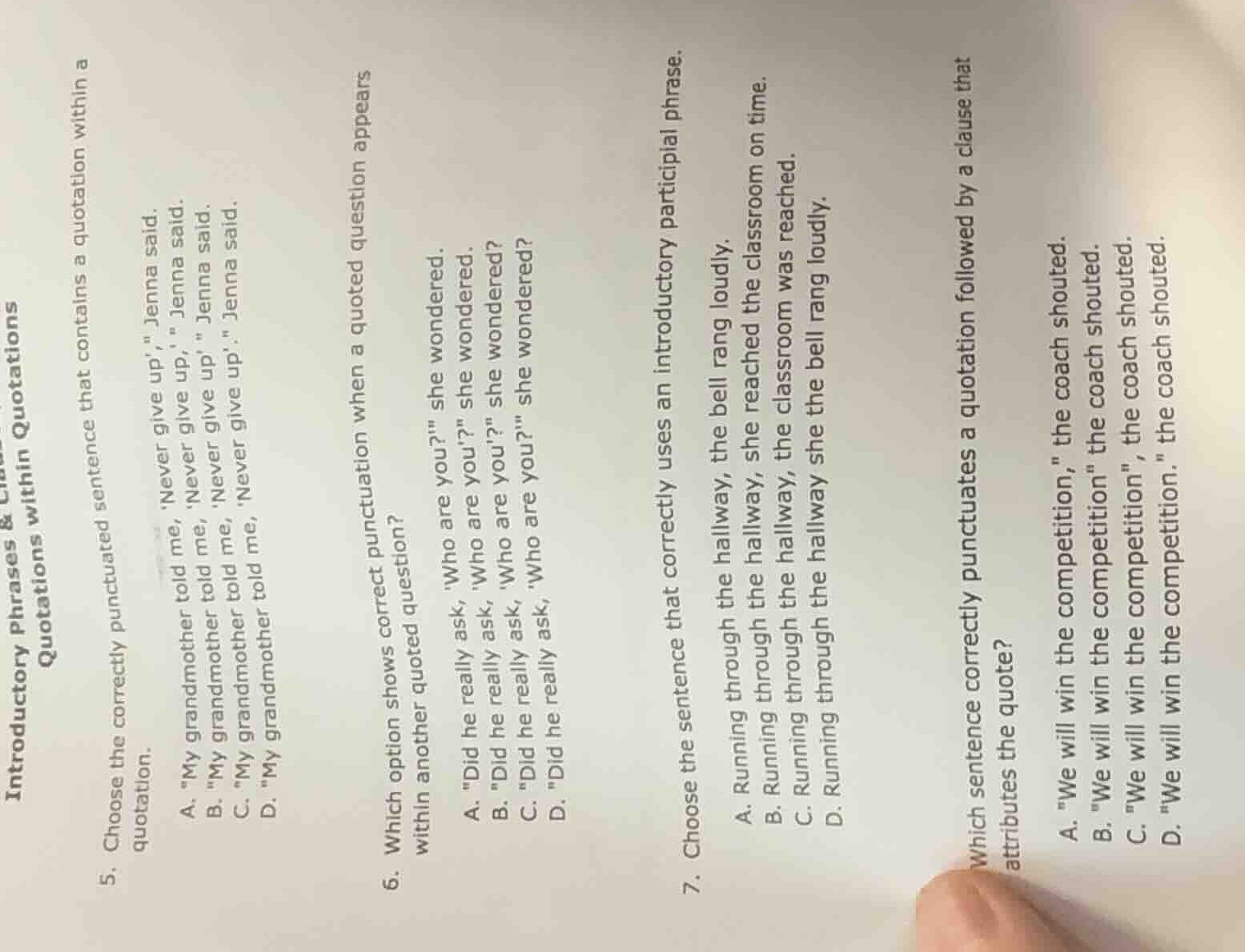
- choose the correctly punctuated sentence that contains a quotation within a quotation.
a. \my grandmother told me, never give up,\ jenna said.
b. \my grandmother told me, never give up,\ jenna said.
c. \my grandmother told me, never give up\ jenna said.
d. \my grandmother told me, never give up.\ jenna said.
- which option shows correct punctuation when a quoted question appears within another quoted question?
a. \did he really ask, who are you?\ she wondered.
b. \did he really ask, who are you?\ she wondered.
c. \did he really ask, who are you??\ she wondered.
d. \did he really ask, who are you?\ she wondered?
- choose the sentence that correctly uses an introductory participial phrase.
a. running through the hallway, the bell rang loudly.
b. running through the hallway, she reached the classroom on time.
c. running through the hallway, the classroom was reached.
d. running through the hallway she the bell rang loudly.
which sentence correctly punctuates a quotation followed by a clause that attributes the quote?
a. \we will win the competition,\ the coach shouted.
b. \we will win the competition\ the coach shouted.
c. \we will win the competition\, the coach shouted.
d. \we will win the competition.\ the coach shouted.
Analyze quotations within quotations
Using the Quotation Punctuation knowledge point, we evaluate Question 5. When a quotation is nested inside another quotation, single quotation marks are used for the inner quote, and double quotation marks are used for the outer quote. Commas separating the speaker attribution from the quote must be placed correctly. In option A: "My grandmother told me, 'Never give up,'" Jenna said. The comma after "me" is outside the single quote, and the comma after "up" is inside both the single and double quotation marks, which is correct.
Evaluate nested question punctuation
For Question 6, we analyze a question nested inside another question. The outer sentence is a question: "Did he really ask...?" and the inner quotation is also a question: "Who are you?". When both the outer sentence and the nested quotation are questions, a single question mark is placed inside the single quotation marks, and no additional question mark is needed at the very end of the double quotation marks. Thus, the correct punctuation is: Did he really ask, "Who are you?" which corresponds to option C.
Identify correct participial phrase usage
Using the Introductory Clauses and Comma Usage knowledge points, we evaluate Question 7. An introductory participial phrase must modify the subject that immediately follows the comma. In "Running through the hallway...", the action of running must be performed by the subject. In option B, "she" is the subject who is running: Running through the hallway, she reached the classroom on time. In other options, "the bell" or "the classroom" is the subject, creating a dangling modifier.
Analyze quotation followed by an attributing clause
We evaluate the final question. When a quotation is followed by a clause that attributes the quote (e.g., "the coach shouted"), a comma is used inside the closing quotation mark to separate the quote from the attribution, unless the quote ends with a question mark or exclamation point. In option A: "We will win the competition," the coach shouted. The comma is correctly placed inside the quotation marks, and the attributing clause starts with a lowercase letter.

Snap & solve any problem in the app
Get step-by-step solutions on Sovi AI
Photo-based solutions with guided steps
Explore more problems and detailed explanations
Question 5
- A. "My grandmother told me, 'Never give up,'" Jenna said. (Correct answer)
- B. "My grandmother told me, 'Never give up,' " Jenna said.
- C. "My grandmother told me, 'Never give up' " Jenna said.
- D. "My grandmother told me, 'Never give up'." Jenna said.
Question 6
- A. "Did he really ask, 'Who are you?'" she wondered.
- B. "Did he really ask, 'Who are you'?" she wondered.
- C. "Did he really ask, 'Who are you?'" she wondered? (Correct answer)
- D. "Did he really ask, 'Who are you'?" she wondered?
Question 7
- A. Running through the hallway, the bell rang loudly.
- B. Running through the hallway, she reached the classroom on time. (Correct answer)
- C. Running through the hallway, the classroom was reached.
- D. Running through the hallway she the bell rang loudly.
Question 8
- A. "We will win the competition," the coach shouted. (Correct answer)
- B. "We will win the competition" the coach shouted.
- C. "We will win the competition" , the coach shouted.
- D. "We will win the competition. " the coach shouted.