QUESTION IMAGE
Question
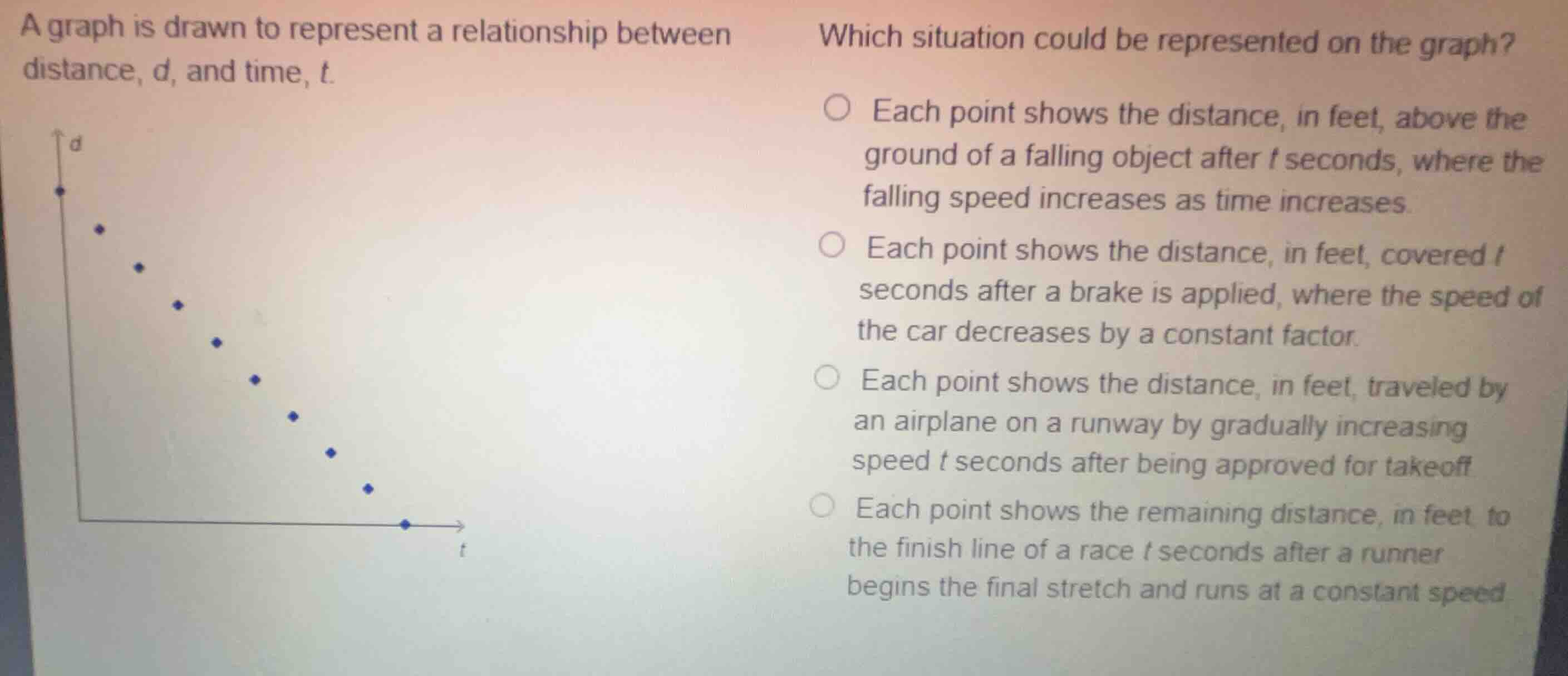
a graph is drawn to represent a relationship between distance, \\(d\\), and time, \\(t\\).
which situation could be represented on the graph?
each point shows the distance, in feet, above the ground of a falling object after \\(t\\) seconds, where the falling speed increases as time increases.
each point shows the distance, in feet, covered \\(t\\) seconds after a brake is applied, where the speed of the car decreases by a constant factor.
each point shows the distance, in feet, traveled by an airplane on a runway by gradually increasing speed \\(t\\) seconds after being approved for takeoff.
each point shows the remaining distance, in feet, to the finish line of a race \\(t\\) seconds after a runner begins the final stretch and runs at a constant speed.
<pre_analysis>
{
"quality": "clear",
"question_count": 1,
"skills_matched": [
"direct_cot",
"multiple_choice_formatter",
"explain_then_answer",
"tutor"
],
"needs_drawing": false,
"concepts_used": [
"Linear Rate of Change",
"Slope Interpretation"
],
"new_concepts": [
"Linear Modeling",
"Graph Interpretation"
],
"current_concepts": [
"Linear Rate of Change",
"Slope Interpretation",
"Linear Modeling",
"Graph Interpretation"
]
}
</pre_analysis>
<reasoning>
Analyze the graph's shape
The graph shows discrete points representing distance \(d\) versus time \(t\). These points lie along a straight line that slopes downward from left to right, indicating a constant negative rate of change.
Interpret the constant rate
Using the Linear Rate of Change knowledge point, a straight line represents a constant rate of change. Since the slope is negative, the distance \(d\) decreases by a constant amount for each unit increase in time \(t\).
Evaluate the options
Using the Slope Interpretation knowledge point, we analyze each scenario:
- Option 1: A falling object's speed increases, meaning the distance fallen per second increases over time (non-linear curve).
- Option 2: A car braking with speed decreasing by a constant factor describes exponential decay, which is non-linear.
- Option 3: An airplane accelerating on a runway has an increasing speed, meaning distance increases non-linearly.
- Option 4: A runner running at a constant speed means the remaining distance to the finish line decreases by a constant amount each second, which perfectly matches the linear downward trend.
</reasoning>
<answer>
<mcq-option>(A) Each point shows the distance, in feet, above the ground of a falling object after \(t\) seconds, where the falling speed increases as time increases.</mcq-option>
<mcq-option>(B) Each point shows the distance, in feet, covered \(t\) seconds after a brake is applied, where the speed of the car decreases by a constant factor.</mcq-option>
<mcq-option>(C) Each point shows the distance, in feet, traveled by an airplane on a runway by gradually increasing speed \(t\) seconds after being approved for takeoff.</mcq-option>
<mcq-correct>(D) Each point shows the remaining distance, in feet, to the finish line of a race \(t\) seconds after a runner begins the final stretch and runs at a constant speed.</mcq-correct>
</answer>
<post_analysis>
{
"subject": "Mathematics",
"question_type": "Multiple Choice",
"knowledge_point": [
"Mathematics",
"Algebra",
"Linear Modeling"
]
}
</post_analysis>
Snap & solve any problem in the app
Get step-by-step solutions on Sovi AI
Photo-based solutions with guided steps
Explore more problems and detailed explanations
<pre_analysis>
{
"quality": "clear",
"question_count": 1,
"skills_matched": [
"direct_cot",
"multiple_choice_formatter",
"explain_then_answer",
"tutor"
],
"needs_drawing": false,
"concepts_used": [
"Linear Rate of Change",
"Slope Interpretation"
],
"new_concepts": [
"Linear Modeling",
"Graph Interpretation"
],
"current_concepts": [
"Linear Rate of Change",
"Slope Interpretation",
"Linear Modeling",
"Graph Interpretation"
]
}
</pre_analysis>
<reasoning>
Analyze the graph's shape
The graph shows discrete points representing distance \(d\) versus time \(t\). These points lie along a straight line that slopes downward from left to right, indicating a constant negative rate of change.
Interpret the constant rate
Using the Linear Rate of Change knowledge point, a straight line represents a constant rate of change. Since the slope is negative, the distance \(d\) decreases by a constant amount for each unit increase in time \(t\).
Evaluate the options
Using the Slope Interpretation knowledge point, we analyze each scenario:
- Option 1: A falling object's speed increases, meaning the distance fallen per second increases over time (non-linear curve).
- Option 2: A car braking with speed decreasing by a constant factor describes exponential decay, which is non-linear.
- Option 3: An airplane accelerating on a runway has an increasing speed, meaning distance increases non-linearly.
- Option 4: A runner running at a constant speed means the remaining distance to the finish line decreases by a constant amount each second, which perfectly matches the linear downward trend.
</reasoning>
<answer>
<mcq-option>(A) Each point shows the distance, in feet, above the ground of a falling object after \(t\) seconds, where the falling speed increases as time increases.</mcq-option>
<mcq-option>(B) Each point shows the distance, in feet, covered \(t\) seconds after a brake is applied, where the speed of the car decreases by a constant factor.</mcq-option>
<mcq-option>(C) Each point shows the distance, in feet, traveled by an airplane on a runway by gradually increasing speed \(t\) seconds after being approved for takeoff.</mcq-option>
<mcq-correct>(D) Each point shows the remaining distance, in feet, to the finish line of a race \(t\) seconds after a runner begins the final stretch and runs at a constant speed.</mcq-correct>
</answer>
<post_analysis>
{
"subject": "Mathematics",
"question_type": "Multiple Choice",
"knowledge_point": [
"Mathematics",
"Algebra",
"Linear Modeling"
]
}
</post_analysis>