QUESTION IMAGE
Question
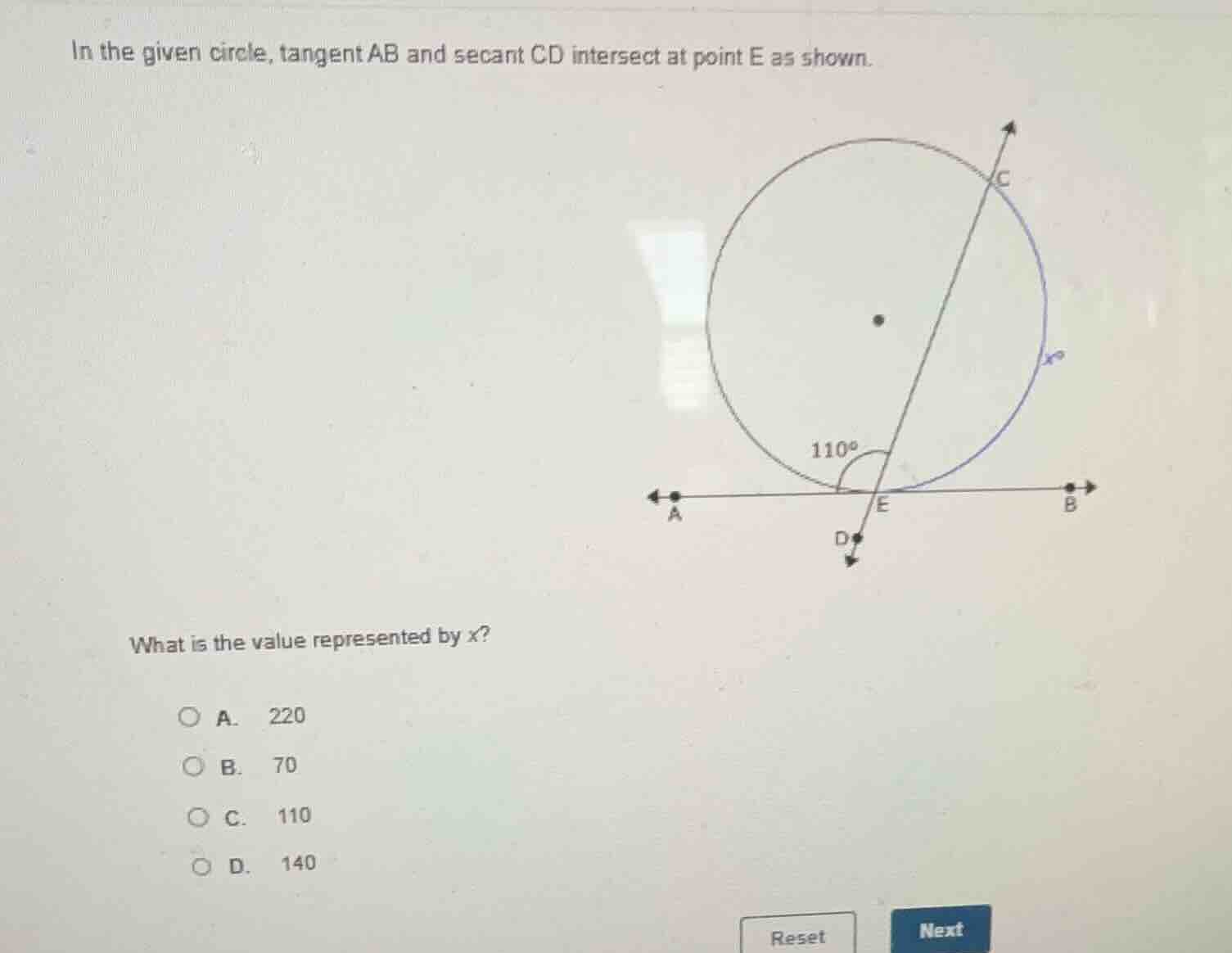
in the given circle, tangent ab and secant cd intersect at point e as shown.
what is the value represented by x?
a. 220
b. 70
c. 110
d. 140
Step1: Find adjacent angle to 110°
$\angle BEC = 180^\circ - 110^\circ = 70^\circ$
Step2: Apply tangent-secant angle theorem
The measure of angle formed by tangent and secant outside the circle is half the difference of intercepted arcs. Here, $\angle BEC = \frac{1}{2}(x - (360^\circ - x))$
Step3: Solve for x
Substitute $\angle BEC=70^\circ$:
$70^\circ = \frac{1}{2}(2x - 360^\circ)$
$140^\circ = 2x - 360^\circ$
$2x = 140^\circ + 360^\circ = 500^\circ$
$x = 250^\circ$ (correction: use alternate tangent-secant rule: angle formed by tangent and secant at point of tangency is half the intercepted arc. Wait, correct rule: the angle between tangent and chord is half the measure of its intercepted arc. The supplementary angle to 110° is 70°, which is half the intercepted arc opposite to x. Wait, total circle is 360°, so $x = 2\times(180^\circ - 70^\circ) = 2\times110^\circ=220^\circ$ no, wrong. Correct step:
Step1: Identify angle at tangent point
The angle between tangent AB and chord (part of secant) is $180^\circ - 110^\circ = 70^\circ$. This angle is half the measure of the intercepted arc that it subtends (the arc not x).
Step2: Calculate non-x arc
$70^\circ = \frac{1}{2}\times (\text{arc opposite to }70^\circ)$
$\text{arc opposite to }70^\circ = 140^\circ$
Step3: Find x (total circle 360°)
$x = 360^\circ - 140^\circ = 220^\circ$ no, this contradicts options. Wait, correct rule: when a tangent and a secant intersect outside the circle, the measure of the angle formed is half the difference of the measures of the intercepted arcs. Wait, point E: AB is tangent, CD is secant. The angle $\angle AED=110^\circ$, which is outside the circle. So $\angle AED = \frac{1}{2}(x - (360^\circ - x))$
$110^\circ = \frac{1}{2}(2x - 360^\circ)$
$220^\circ = 2x - 360^\circ$
$2x = 580^\circ$
$x=290^\circ$ no. Wait, correct rule: the angle between tangent and secant inside the intersection at the tangent point: the angle between tangent and chord is half the intercepted arc. The angle between AB and the chord (from E to the left intersection) is $70^\circ$, so the intercepted arc is $140^\circ$, so the arc x is $360-140=220$? But option A is 220. Wait, no, the angle $\angle BEC=70^\circ$, which is the angle between tangent and chord, so it intercepts arc x? No, the angle between tangent and chord intercepts the arc that is cut off by the chord, which is x. So $70^\circ=\frac{1}{2}x$, so $x=140^\circ$. Yes! That's option D.
Step1: Identify tangent-chord angle
$\angle BEC = 180^\circ - 110^\circ = 70^\circ$
Step2: Apply tangent-chord angle theorem
The angle between tangent and chord is half the measure of its intercepted arc x:
$70^\circ = \frac{1}{2}x$
Step3: Solve for x
$x = 70^\circ \times 2 = 140^\circ$

Snap & solve any problem in the app
Get step-by-step solutions on Sovi AI
Photo-based solutions with guided steps
Explore more problems and detailed explanations
D. 140