QUESTION IMAGE
Question
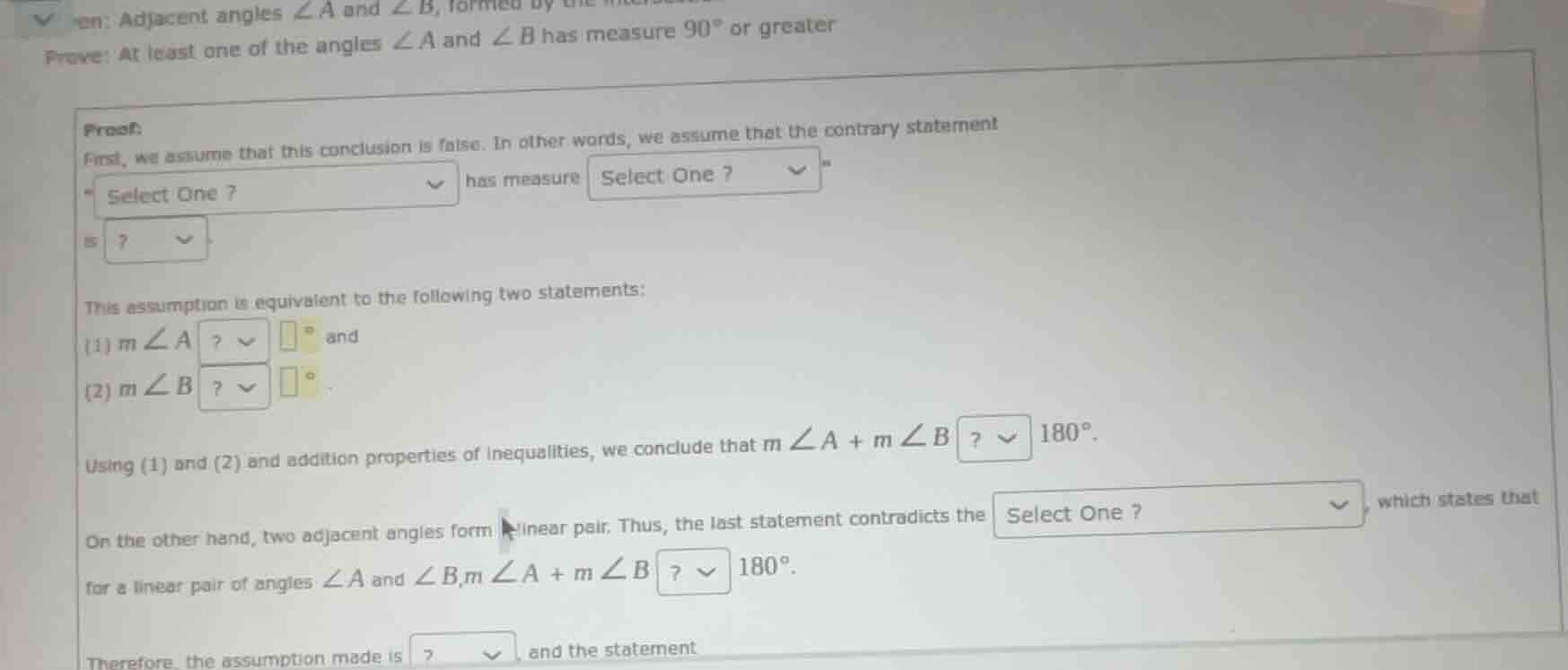
given: adjacent angles \\(\angle a\\) and \\(\angle b\\), formed by the intersection...
prove: at least one of the angles \\(\angle a\\) and \\(\angle b\\) has measure \\(90^\circ\\) or greater
proof:
first, we assume that this conclusion is false. in other words, we assume that the contrary statement
\select one ? has measure select one ?\
is ?.
this assumption is equivalent to the following two statements:
(1) \\(m\angle a\\) ??\\(^\circ\\) and
(2) \\(m\angle b\\) ??\\(^\circ\\).
using (1) and (2) and addition properties of inequalities, we conclude that \\(m\angle a + m\angle b\\) ? \\(180^\circ\\).
on the other hand, two adjacent angles form a linear pair. thus, the last statement contradicts the select one ? which states that for a linear pair of angles \\(\angle a\\) and \\(\angle b\\), \\(m\angle a + m\angle b\\) ? \\(180^\circ\\).
therefore, the assumption made is ? and the statement
Negate the conclusion for indirect proof
Sum the inequalities and identify the contradiction
Conclude the proof

Snap & solve any problem in the app
Get step-by-step solutions on Sovi AI
Photo-based solutions with guided steps
Explore more problems and detailed explanations
Given: Adjacent angles \(\angle A\) and \(\angle B\), formed by the intersection...
Prove: At least one of the angles \(\angle A\) and \(\angle B\) has measure \(90^\circ\) or greater.
Proof:
First, we assume that this conclusion is false. In other words, we assume that the contrary statement " <blank>both angles \(\angle A\) and \(\angle B\)</blank> has measure <blank>less than \(90^\circ\)</blank> " is <blank>true</blank>.
This assumption is equivalent to the following two statements:
(1) \(m\angle A\) <blank>\(<\)</blank> \(90^\circ\) and
(2) \(m\angle B\) <blank>\(<\)</blank> \(90^\circ\).
Using (1) and (2) and addition properties of inequalities, we conclude that \(m\angle A + m\angle B\) <blank>\(<\)</blank> \(180^\circ\).
On the other hand, two adjacent angles form a linear pair. Thus, the last statement contradicts the <blank>Linear Pair Postulate</blank> which states that for a linear pair of angles \(\angle A\) and \(\angle B\), \(m\angle A + m\angle B\) <blank>\(=\)</blank> \(180^\circ\).
Therefore, the assumption made is <blank>false</blank> and the statement is true.