QUESTION IMAGE
Question
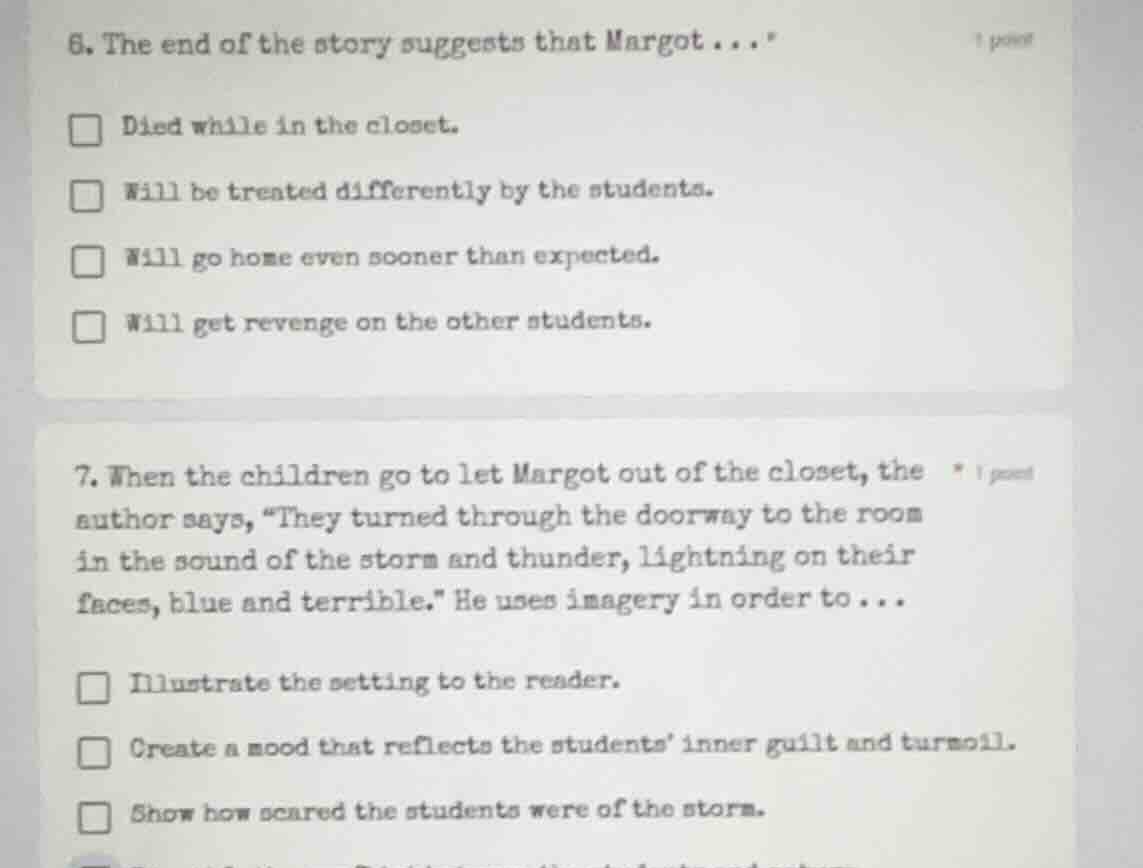
- the end of the story suggests that margot... * 1 point
died while in the closet.
will be treated differently by the students.
will go home even sooner than expected.
will get revenge on the other students.
- when the children go to let margot out of the closet, the * 1 point
author says, \they turned through the doorway to the room
in the sound of the storm and thunder, lightning on their
faces, blue and terrible.\ he uses imagery in order to...
illustrate the setting to the reader.
create a mood that reflects the students inner guilt and turmoil.
show how scared the students were of the storm.
🆕 New Concept Discovered: Literary Inference and Imagery Analysis
Reading between the lines and analyzing sensory details.
Step 1: Analyze Question 6
The question asks what the end of Ray Bradbury's short story "All Summer in a Day" suggests about Margot.
At the end of the story, the children realize they locked Margot in a closet, causing her to miss the single hour of sunshine on Venus. When they go to let her out, they are silent, slow, and unable to look each other in the eye. This profound shift in their behavior suggests they feel deep guilt and shame. Consequently, they will no longer treat her with the same cruelty and exclusion as before.
- Died while in the closet: Incorrect. The text indicates she is still there and silent, but there is no evidence she died.
- Will be treated differently by the students: Correct. The children's collective guilt and realization of their cruelty change their dynamic with her.
- Will go home even sooner than expected: Incorrect. Her family's plans to return to Earth are mentioned earlier, but the ending does not suggest this timeline has changed.
- Will get revenge on the other students: Incorrect. Margot is depicted as frail, passive, and withdrawn, not vengeful.
Step 2: Analyze Question 7
The question asks why the author uses specific imagery ("sound of the storm and thunder, lightning on their faces, blue and terrible") when the children go to let Margot out.
Imagery uses sensory details to create a vivid mental picture and evoke specific emotions (mood). The description of the storm's return—specifically the "blue and terrible" lightning reflecting on their faces—mirrors the internal state of the children. The harsh, dark, and stormy atmosphere reflects their heavy conscience, shame, and the realization of the terrible thing they have done.
- Illustrate the setting to the reader: Incorrect. While it does describe the setting, this is not the primary literary purpose of using such dramatic and ominous imagery at this specific emotional climax.
- Create a mood that reflects the students' inner guilt and turmoil: Correct. The external storm serves as a visual and emotional metaphor for their internal feelings of guilt.
- Show how scared the students were of the storm: Incorrect. The children are used to the rain; their hesitation and solemnity are due to their guilt regarding Margot, not fear of the weather.

Snap & solve any problem in the app
Get step-by-step solutions on Sovi AI
Photo-based solutions with guided steps
Explore more problems and detailed explanations
- Question 6: Will be treated differently by the students.
- Question 7: Create a mood that reflects the students' inner guilt and turmoil.