QUESTION IMAGE
Question
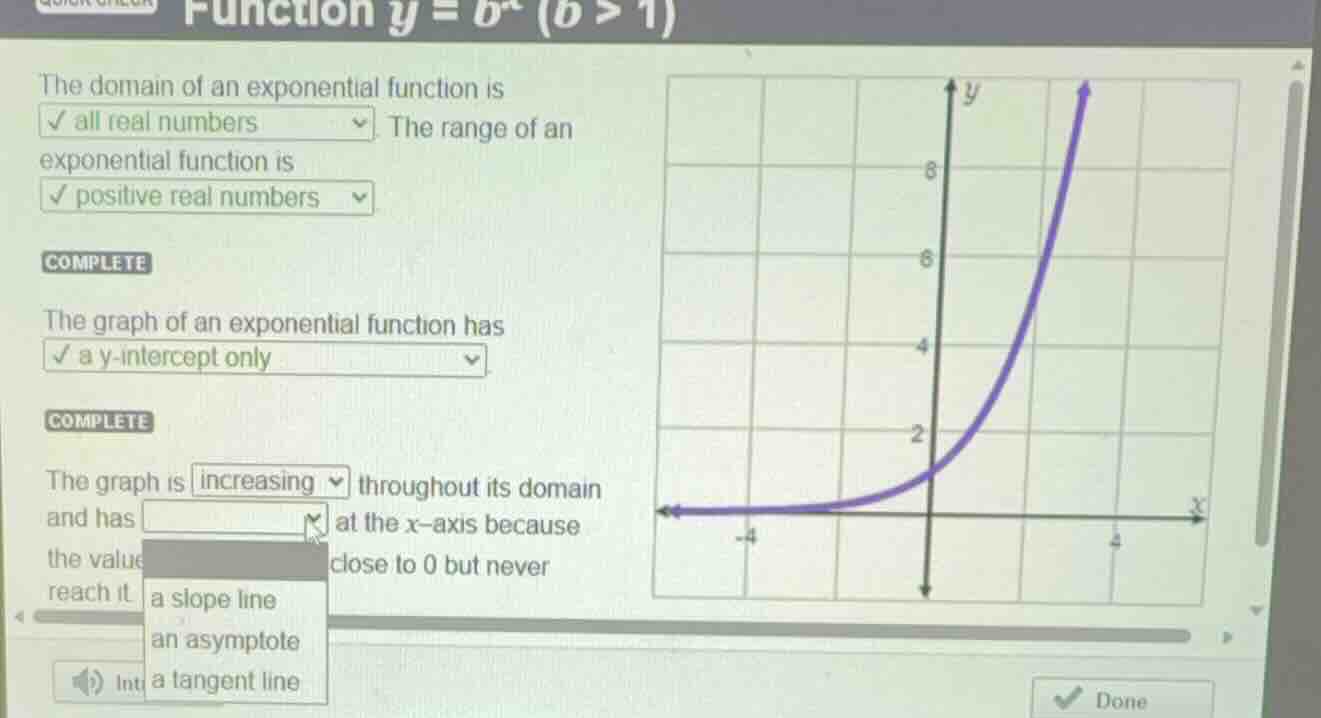
the domain of an exponential function is all real numbers. the range of an exponential function is positive real numbers.
the graph of an exponential function has a y-intercept only.
the graph is increasing throughout its domain and has at the x-axis because the values get close to 0 but never reach it.
options for the dropdown:
- a slope line
- an asymptote
- a tangent line
<pre_analysis>
{
"quality": "clear",
"question_count": 1,
"skills_matched": [
"direct_cot",
"blank_filling_formatter",
"explain_then_answer",
"tutor",
"mastery_adaptive_brevity"
],
"needs_drawing": false,
"concepts_used": [
"Domain of Exponential Functions",
"Range of Exponential Functions",
"Exponential Function Graphs"
],
"new_concepts": [],
"current_concepts": [
"Domain of Exponential Functions",
"Range of Exponential Functions",
"Exponential Function Graphs"
]
}
</pre_analysis>
<reasoning>
Analyze the domain and range
Using the Domain of Exponential Functions and Range of Exponential Functions knowledge points
- The domain of the parent exponential function \(y = b^x\) (\(b > 1\)) consists of all real numbers, as \(x\) can take any real value.
- The range consists of all positive real numbers, as \(b^x > 0\) for all real \(x\).
Analyze the intercepts
Using the Exponential Function Graphs knowledge point
- Since \(b^x > 0\), there is no \(x\)-intercept.
- When \(x = 0\), \(y = b^0 = 1\), giving a \(y\)-intercept at \((0, 1)\). Thus, the graph has a \(y\)-intercept only.
Analyze the behavior and asymptote
Using the Exponential Function Graphs knowledge point
- Since \(b > 1\), the function values increase as \(x\) increases, meaning the graph is increasing throughout its domain.
- As \(x \to -\infty\), the values of \(b^x\) approach \(0\) but never reach \(0\). This horizontal boundary line \(y = 0\) (the \(x\)-axis) is called an asymptote.
</reasoning>
<answer>
The domain of an exponential function is <blank>all real numbers</blank>. The range of an exponential function is <blank>positive real numbers</blank>.
The graph of an exponential function has <blank>a y-intercept only</blank>.
The graph is <blank>increasing</blank> throughout its domain and has <blank>an asymptote</blank> at the x-axis because the values get close to 0 but never reach it.
</answer>
<post_analysis>
{
"subject": "Mathematics",
"question_type": "Fill-in-the-blank",
"knowledge_point": [
"Mathematics",
"Algebra",
"Exponential Function Graphs"
]
}
</post_analysis>
Snap & solve any problem in the app
Get step-by-step solutions on Sovi AI
Photo-based solutions with guided steps
Explore more problems and detailed explanations
<pre_analysis>
{
"quality": "clear",
"question_count": 1,
"skills_matched": [
"direct_cot",
"blank_filling_formatter",
"explain_then_answer",
"tutor",
"mastery_adaptive_brevity"
],
"needs_drawing": false,
"concepts_used": [
"Domain of Exponential Functions",
"Range of Exponential Functions",
"Exponential Function Graphs"
],
"new_concepts": [],
"current_concepts": [
"Domain of Exponential Functions",
"Range of Exponential Functions",
"Exponential Function Graphs"
]
}
</pre_analysis>
<reasoning>
Analyze the domain and range
Using the Domain of Exponential Functions and Range of Exponential Functions knowledge points
- The domain of the parent exponential function \(y = b^x\) (\(b > 1\)) consists of all real numbers, as \(x\) can take any real value.
- The range consists of all positive real numbers, as \(b^x > 0\) for all real \(x\).
Analyze the intercepts
Using the Exponential Function Graphs knowledge point
- Since \(b^x > 0\), there is no \(x\)-intercept.
- When \(x = 0\), \(y = b^0 = 1\), giving a \(y\)-intercept at \((0, 1)\). Thus, the graph has a \(y\)-intercept only.
Analyze the behavior and asymptote
Using the Exponential Function Graphs knowledge point
- Since \(b > 1\), the function values increase as \(x\) increases, meaning the graph is increasing throughout its domain.
- As \(x \to -\infty\), the values of \(b^x\) approach \(0\) but never reach \(0\). This horizontal boundary line \(y = 0\) (the \(x\)-axis) is called an asymptote.
</reasoning>
<answer>
The domain of an exponential function is <blank>all real numbers</blank>. The range of an exponential function is <blank>positive real numbers</blank>.
The graph of an exponential function has <blank>a y-intercept only</blank>.
The graph is <blank>increasing</blank> throughout its domain and has <blank>an asymptote</blank> at the x-axis because the values get close to 0 but never reach it.
</answer>
<post_analysis>
{
"subject": "Mathematics",
"question_type": "Fill-in-the-blank",
"knowledge_point": [
"Mathematics",
"Algebra",
"Exponential Function Graphs"
]
}
</post_analysis>