Sovi.AI - AI Math Tutor

Scan to solve math questions

QUESTION IMAGE

describe and correct the error in solving using the quadratic formula. …

Question

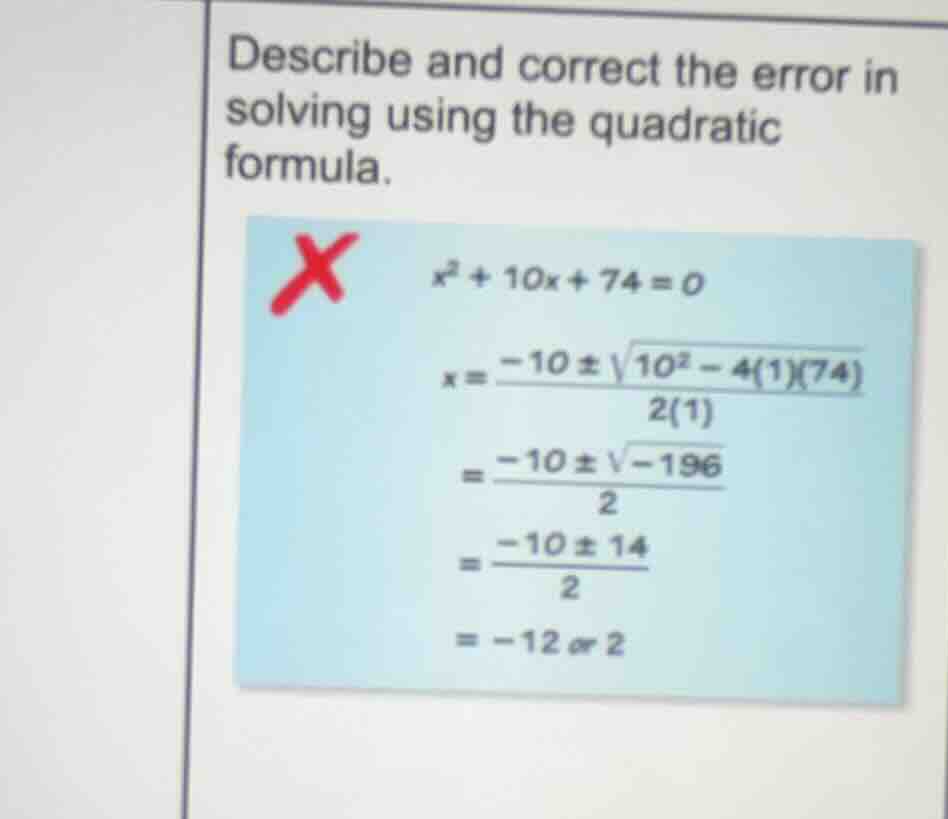
describe and correct the error in solving using the quadratic formula.

\\x^2 + 10x + 74 = 0\\
\\x = \frac{-10 \pm \sqrt{10^2 - 4(1)(74)}}{2(1)}\\
\\= \frac{-10 \pm \sqrt{-196}}{2}\\
\\= \frac{-10 \pm 14}{2}\\
\\= -12 \text{ or } 2\\

Explanation:

Response

<pre_analysis>
{
"quality": "clear",
"question_count": 1,
"skills_matched": [
"step_cot",
"explain_then_answer",
"tutor"
],
"needs_drawing": false,
"concepts_used": [],
"new_concepts": [
"Quadratic Formula",
"Complex Roots",
"Error Analysis"
],
"current_concepts": [
"Quadratic Formula",
"Complex Roots",
"Error Analysis"
]
}
</pre_analysis>

<reasoning>

Identify the error in the work

The student incorrectly simplified the square root of a negative number:
\[\sqrt{-196}
eq 14\]
The square root of a negative number yields an imaginary number:
\[\sqrt{-196} = \sqrt{-1 \cdot 196} = 14i\]

Apply the quadratic formula correctly

For the equation \(x^2 + 10x + 74 = 0\), the coefficients are \(a = 1\), \(b = 10\), and \(c = 74\):
\[x = \frac{-10 \pm \sqrt{10^2 - 4(1)(74)}}{2(1)}\]
\[x = \frac{-10 \pm \sqrt{100 - 296}}{2}\]
\[x = \frac{-10 \pm \sqrt{-196}}{2}\]

Simplify the complex expression

Using the definition of the imaginary unit, simplify the radical:
\[x = \frac{-10 \pm 14i}{2}\]
Divide each term in the numerator by the denominator:
\[x = -5 \pm 7i\]
</reasoning>

<answer>
Error Description:
The error occurred when simplifying \(\sqrt{-196}\). The student simplified it as \(14\) instead of \(14i\), neglecting the negative sign under the radical which yields complex solutions.

Correct Solution:
\[x = -5 \pm 7i\]
</answer>

<post_analysis>
{
"subject": "Mathematics",
"question_type": "Free Response",
"knowledge_point": [
"Mathematics",
"Algebra",
"Quadratic Formula"
]
}
</post_analysis>

Answer:

<pre_analysis>
{
"quality": "clear",
"question_count": 1,
"skills_matched": [
"step_cot",
"explain_then_answer",
"tutor"
],
"needs_drawing": false,
"concepts_used": [],
"new_concepts": [
"Quadratic Formula",
"Complex Roots",
"Error Analysis"
],
"current_concepts": [
"Quadratic Formula",
"Complex Roots",
"Error Analysis"
]
}
</pre_analysis>

<reasoning>

Identify the error in the work

The student incorrectly simplified the square root of a negative number:
\[\sqrt{-196}
eq 14\]
The square root of a negative number yields an imaginary number:
\[\sqrt{-196} = \sqrt{-1 \cdot 196} = 14i\]

Apply the quadratic formula correctly

For the equation \(x^2 + 10x + 74 = 0\), the coefficients are \(a = 1\), \(b = 10\), and \(c = 74\):
\[x = \frac{-10 \pm \sqrt{10^2 - 4(1)(74)}}{2(1)}\]
\[x = \frac{-10 \pm \sqrt{100 - 296}}{2}\]
\[x = \frac{-10 \pm \sqrt{-196}}{2}\]

Simplify the complex expression

Using the definition of the imaginary unit, simplify the radical:
\[x = \frac{-10 \pm 14i}{2}\]
Divide each term in the numerator by the denominator:
\[x = -5 \pm 7i\]
</reasoning>

<answer>
Error Description:
The error occurred when simplifying \(\sqrt{-196}\). The student simplified it as \(14\) instead of \(14i\), neglecting the negative sign under the radical which yields complex solutions.

Correct Solution:
\[x = -5 \pm 7i\]
</answer>

<post_analysis>
{
"subject": "Mathematics",
"question_type": "Free Response",
"knowledge_point": [
"Mathematics",
"Algebra",
"Quadratic Formula"
]
}
</post_analysis>