Sovi.AI - AI Math Tutor

Scan to solve math questions

QUESTION IMAGE

as the deathbed whereon it must expire consumed with that which it was …

Question

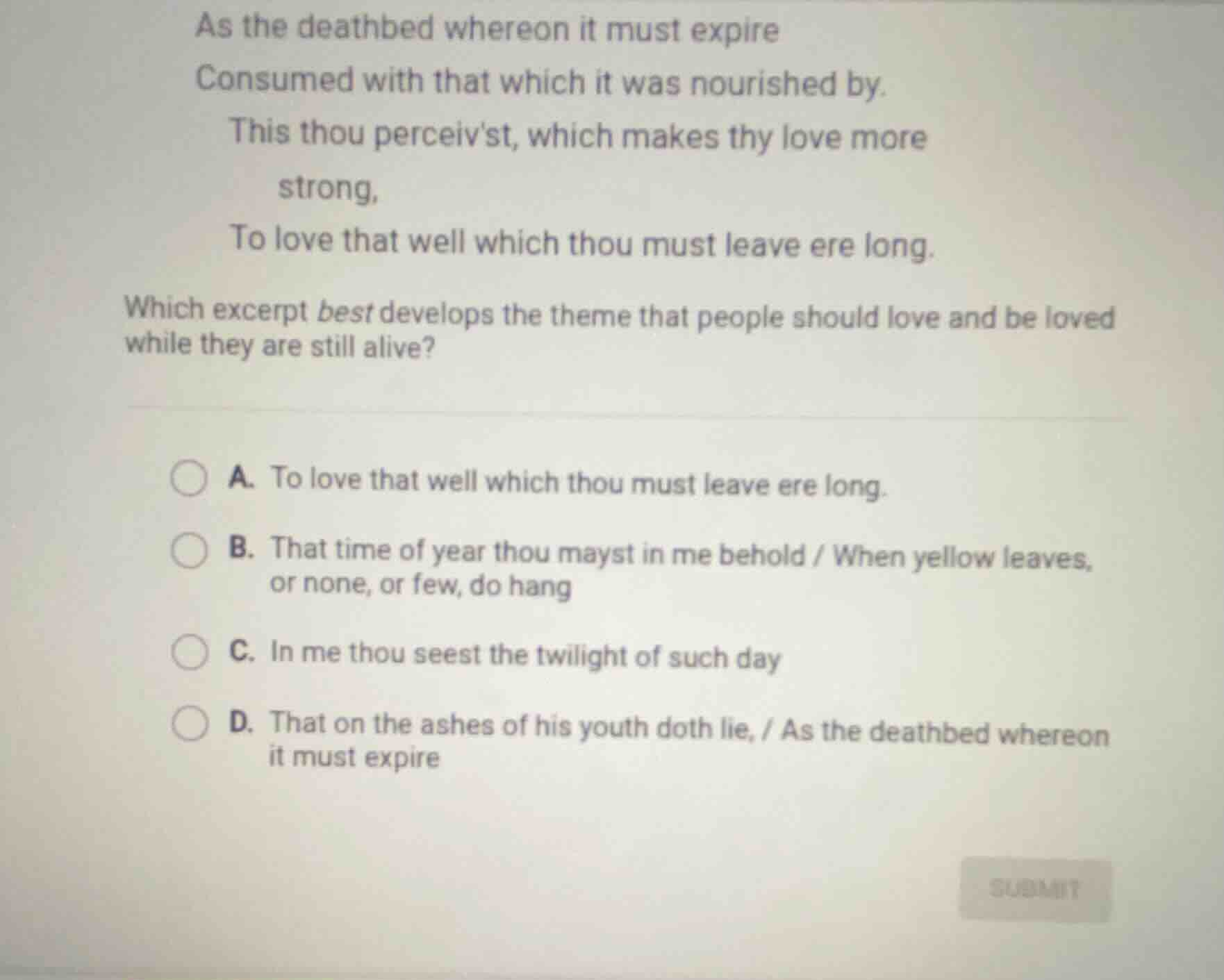
as the deathbed whereon it must expire
consumed with that which it was nourished by.
this thou perceivst, which makes thy love more strong,
to love that well which thou must leave ere long.

which excerpt best develops the theme that people should love and be loved while they are still alive?

a. to love that well which thou must leave ere long.
b. that time of year thou mayst in me behold / when yellow leaves, or none, or few, do hang
c. in me thou seest the twilight of such day
d. that on the ashes of his youth doth lie, / as the deathbed whereon it must expire

Explanation:

Response

<pre_analysis>
{
"quality": "clear",
"question_count": 1,
"skills_matched": [
"direct_cot",
"multiple_choice_formatter",
"explain_then_answer",
"tutor"
],
"needs_drawing": false,
"concepts_used": [
"Theme Identification",
"Poetry Interpretation",
"Shakespearean Sonnets"
],
"new_concepts": [],
"current_concepts": [
"Theme Identification",
"Poetry Interpretation",
"Shakespearean Sonnets"
]
}
</pre_analysis>

<reasoning>

Analyze the theme in the prompt

The question asks which excerpt best develops the theme that "people should love and be loved while they are still alive." This theme is a variation of the classic carpe diem (seize the day) motif, emphasizing the urgency of loving deeply because life and youth are fleeting.

Evaluate the context of the poem

The provided text at the top is the concluding quatrain and couplet of William Shakespeare's Sonnet 73:
"As the deathbed whereon it must expire
Consumed with that which it was nourished by.
This thou perceiv'st, which makes thy love more strong,
To love that well which thou must leave ere long."

This poem uses Shakespearean Sonnets structure to reflect on aging and mortality, building up to a final realization about love.

Connect the theme to the options

Using Poetry Interpretation, we examine how each option relates to the target theme:

  • Option A: "To love that well which thou must leave ere long." This line directly addresses the necessity of loving strongly because the speaker (or life itself) will soon be gone ("leave ere long"). This directly supports Theme Identification regarding loving while still alive.
  • Option B: "That time of year thou mayst in me behold / When yellow leaves, or none, or few, do hang" describes the physical state of aging (autumn of life) but does not yet connect it to the imperative of loving.
  • Option C: "In me thou seest the twilight of such day" is a metaphor for aging and approaching death, but lacks the explicit call to love.
  • Option D: "That on the ashes of his youth doth lie, / As the deathbed whereon it must expire" describes the dying out of youth's fire, focusing on decay rather than the active choice to love.

Formulate the final conclusion

Option A is the only excerpt that explicitly links the awareness of impending death ("which thou must leave ere long") to the action of loving deeply ("To love that well").
</reasoning>

<answer>
<mcq-correct>(A) To love that well which thou must leave ere long.</mcq-correct>
<mcq-option>(B) That time of year thou mayst in me behold / When yellow leaves, or none, or few, do hang</mcq-option>
<mcq-option>(C) In me thou seest the twilight of such day</mcq-option>
<mcq-option>(D) That on the ashes of his youth doth lie, / As the deathbed whereon it must expire</mcq-option>
</answer>

<post_analysis>
{
"subject": "Arts",
"question_type": "Multiple Choice",
"knowledge_point": [
"Arts",
"Others",
"Poetry Analysis"
]
}
</post_analysis>

Answer:

<pre_analysis>
{
"quality": "clear",
"question_count": 1,
"skills_matched": [
"direct_cot",
"multiple_choice_formatter",
"explain_then_answer",
"tutor"
],
"needs_drawing": false,
"concepts_used": [
"Theme Identification",
"Poetry Interpretation",
"Shakespearean Sonnets"
],
"new_concepts": [],
"current_concepts": [
"Theme Identification",
"Poetry Interpretation",
"Shakespearean Sonnets"
]
}
</pre_analysis>

<reasoning>

Analyze the theme in the prompt

The question asks which excerpt best develops the theme that "people should love and be loved while they are still alive." This theme is a variation of the classic carpe diem (seize the day) motif, emphasizing the urgency of loving deeply because life and youth are fleeting.

Evaluate the context of the poem

The provided text at the top is the concluding quatrain and couplet of William Shakespeare's Sonnet 73:
"As the deathbed whereon it must expire
Consumed with that which it was nourished by.
This thou perceiv'st, which makes thy love more strong,
To love that well which thou must leave ere long."

This poem uses Shakespearean Sonnets structure to reflect on aging and mortality, building up to a final realization about love.

Connect the theme to the options

Using Poetry Interpretation, we examine how each option relates to the target theme:

  • Option A: "To love that well which thou must leave ere long." This line directly addresses the necessity of loving strongly because the speaker (or life itself) will soon be gone ("leave ere long"). This directly supports Theme Identification regarding loving while still alive.
  • Option B: "That time of year thou mayst in me behold / When yellow leaves, or none, or few, do hang" describes the physical state of aging (autumn of life) but does not yet connect it to the imperative of loving.
  • Option C: "In me thou seest the twilight of such day" is a metaphor for aging and approaching death, but lacks the explicit call to love.
  • Option D: "That on the ashes of his youth doth lie, / As the deathbed whereon it must expire" describes the dying out of youth's fire, focusing on decay rather than the active choice to love.

Formulate the final conclusion

Option A is the only excerpt that explicitly links the awareness of impending death ("which thou must leave ere long") to the action of loving deeply ("To love that well").
</reasoning>

<answer>
<mcq-correct>(A) To love that well which thou must leave ere long.</mcq-correct>
<mcq-option>(B) That time of year thou mayst in me behold / When yellow leaves, or none, or few, do hang</mcq-option>
<mcq-option>(C) In me thou seest the twilight of such day</mcq-option>
<mcq-option>(D) That on the ashes of his youth doth lie, / As the deathbed whereon it must expire</mcq-option>
</answer>

<post_analysis>
{
"subject": "Arts",
"question_type": "Multiple Choice",
"knowledge_point": [
"Arts",
"Others",
"Poetry Analysis"
]
}
</post_analysis>