QUESTION IMAGE
Question
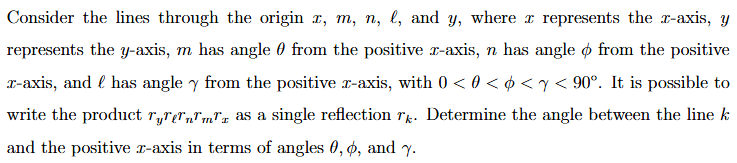
consider the lines through the origin (x), (m), (n), (ell), and (y), where (x) represents the (x)-axis, (y) represents the (y)-axis, (m) has angle (\theta) from the positive (x)-axis, (n) has angle (phi) from the positive (x)-axis, and (ell) has angle (gamma) from the positive (x)-axis, with (0 < \theta < phi < gamma < 90^{circ}). it is possible to write the product (r_y r_{ell} r_n r_m r_x) as a single reflection (r_k). determine the angle between the line (k) and the positive (x)-axis in terms of angles (\theta), (phi), and (gamma).
⚡ Using what you learned: Compositions of Transformations
Step 1: Represent reflections as matrix transformations
Let \( r_{\alpha} \) denote the reflection across a line through the origin making an angle \( \alpha \) with the positive \( x \)-axis. The matrix representing this reflection is:
The given lines have the following angles with the positive \( x \)-axis:
- Line \( x \): angle \( 0 \)
- Line \( m \): angle \( \theta \)
- Line \( n \): angle \( \phi \)
- Line \( \ell \): angle \( \gamma \)
- Line \( y \): angle \( 90^\circ \)
Step 2: Compose the reflections
The composition of transformations is applied from right to left: \( r_y \circ r_{\ell} \circ r_n \circ r_m \circ r_x \).
Using the property that the composition of two reflections \( r_{\beta} \circ r_{\alpha} \) is a rotation by \( 2(\beta - \alpha) \):
We group the composition as:
- \( r_n \circ r_m \) is a rotation by \( 2(\phi - \theta) \).
- \( r_y \circ r_{\ell} \) is a rotation by \( 2(90^\circ - \gamma) \).
Combining these rotations:
Step 3: Apply the final reflection
Now, compose this rotation with the remaining reflection \( r_x \) (where the angle is \( 0 \)):
A rotation by \( \delta \) composed with a reflection across a line at angle \( 0 \) results in a reflection across a line at angle \( \frac{\delta}{2} \):

Snap & solve any problem in the app
Get step-by-step solutions on Sovi AI
Photo-based solutions with guided steps
Explore more problems and detailed explanations
The angle between the line \( k \) and the positive \( x \)-axis is: