Sovi.AI - AI Math Tutor

Scan to solve math questions

QUESTION IMAGE

in ________ conditioning, the unconditioned stimulus unconditionally el…

Question

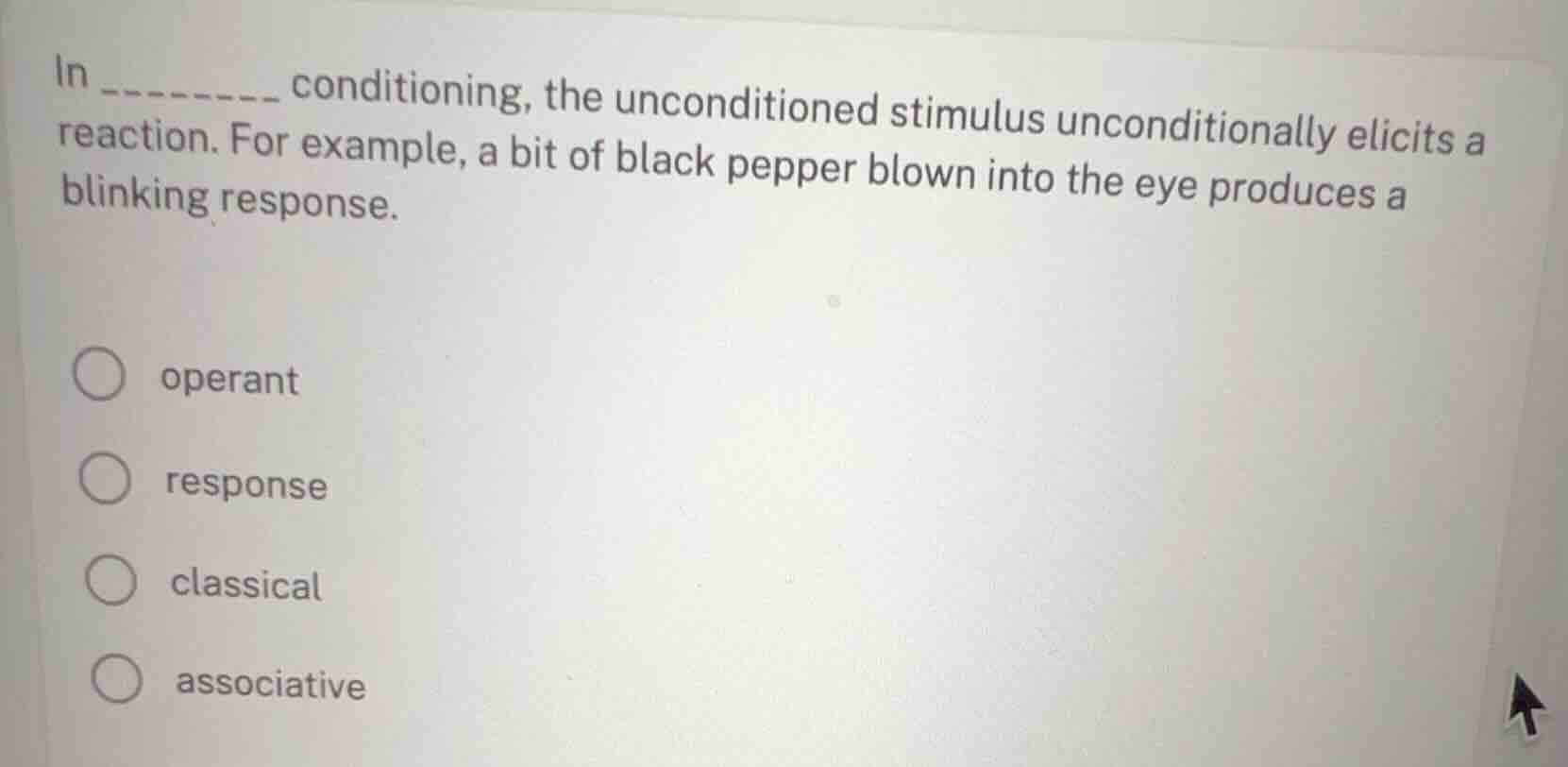
in ________ conditioning, the unconditioned stimulus unconditionally elicits a reaction. for example, a bit of black pepper blown into the eye produces a blinking response.

operant
response
classical
associative

Explanation:

Response

<pre_analysis>
{
"quality": "clear",
"question_count": 1,
"skills_matched": [
"direct_cot",
"multiple_choice_formatter",
"explain_then_answer",
"tutor",
"mastery_adaptive_brevity"
],
"needs_drawing": false,
"concepts_used": [
"Classical Conditioning"
],
"new_concepts": [],
"current_concepts": [
"Classical Conditioning",
"Operant Conditioning"
]
}
</pre_analysis>

<reasoning>

Analyze the mechanism of the stimulus-response relationship

Using the Classical Conditioning knowledge point
In this form of learning, an unconditioned stimulus (UCS) naturally and automatically triggers a reflexive, unconditioned response (UCR) without any prior learning. The example of black pepper (UCS) causing an involuntary eye blink (UCR) is a classic illustration of this biological reflex mechanism.

Differentiate from other forms of conditioning

  • Operant conditioning involves learning associations between behaviors and their consequences (reinforcements or punishments), rather than reflexive responses to stimuli.
  • Associative conditioning is a broad category that includes both classical and operant conditioning, but the specific mechanism described (unconditioned stimulus eliciting a reaction) specifically defines classical conditioning.
  • Response conditioning is not a standard term for this type of learning.

</reasoning>

<answer>
<mcq-option>operant</mcq-option>
<mcq-option>response</mcq-option>
<mcq-correct>classical</mcq-correct>
<mcq-option>associative</mcq-option>
</answer>

<post_analysis>
{
"subject": "Social Science",
"question_type": "Multiple Choice",
"knowledge_point": [
"Social Science",
"Psychology",
"Classical Conditioning"
]
}
</post_analysis>

Answer:

<pre_analysis>
{
"quality": "clear",
"question_count": 1,
"skills_matched": [
"direct_cot",
"multiple_choice_formatter",
"explain_then_answer",
"tutor",
"mastery_adaptive_brevity"
],
"needs_drawing": false,
"concepts_used": [
"Classical Conditioning"
],
"new_concepts": [],
"current_concepts": [
"Classical Conditioning",
"Operant Conditioning"
]
}
</pre_analysis>

<reasoning>

Analyze the mechanism of the stimulus-response relationship

Using the Classical Conditioning knowledge point
In this form of learning, an unconditioned stimulus (UCS) naturally and automatically triggers a reflexive, unconditioned response (UCR) without any prior learning. The example of black pepper (UCS) causing an involuntary eye blink (UCR) is a classic illustration of this biological reflex mechanism.

Differentiate from other forms of conditioning

  • Operant conditioning involves learning associations between behaviors and their consequences (reinforcements or punishments), rather than reflexive responses to stimuli.
  • Associative conditioning is a broad category that includes both classical and operant conditioning, but the specific mechanism described (unconditioned stimulus eliciting a reaction) specifically defines classical conditioning.
  • Response conditioning is not a standard term for this type of learning.

</reasoning>

<answer>
<mcq-option>operant</mcq-option>
<mcq-option>response</mcq-option>
<mcq-correct>classical</mcq-correct>
<mcq-option>associative</mcq-option>
</answer>

<post_analysis>
{
"subject": "Social Science",
"question_type": "Multiple Choice",
"knowledge_point": [
"Social Science",
"Psychology",
"Classical Conditioning"
]
}
</post_analysis>