Sovi.AI - AI Math Tutor

Scan to solve math questions

QUESTION IMAGE

choose the end behavior of the graph of each polynomial function. (a) c…

Question

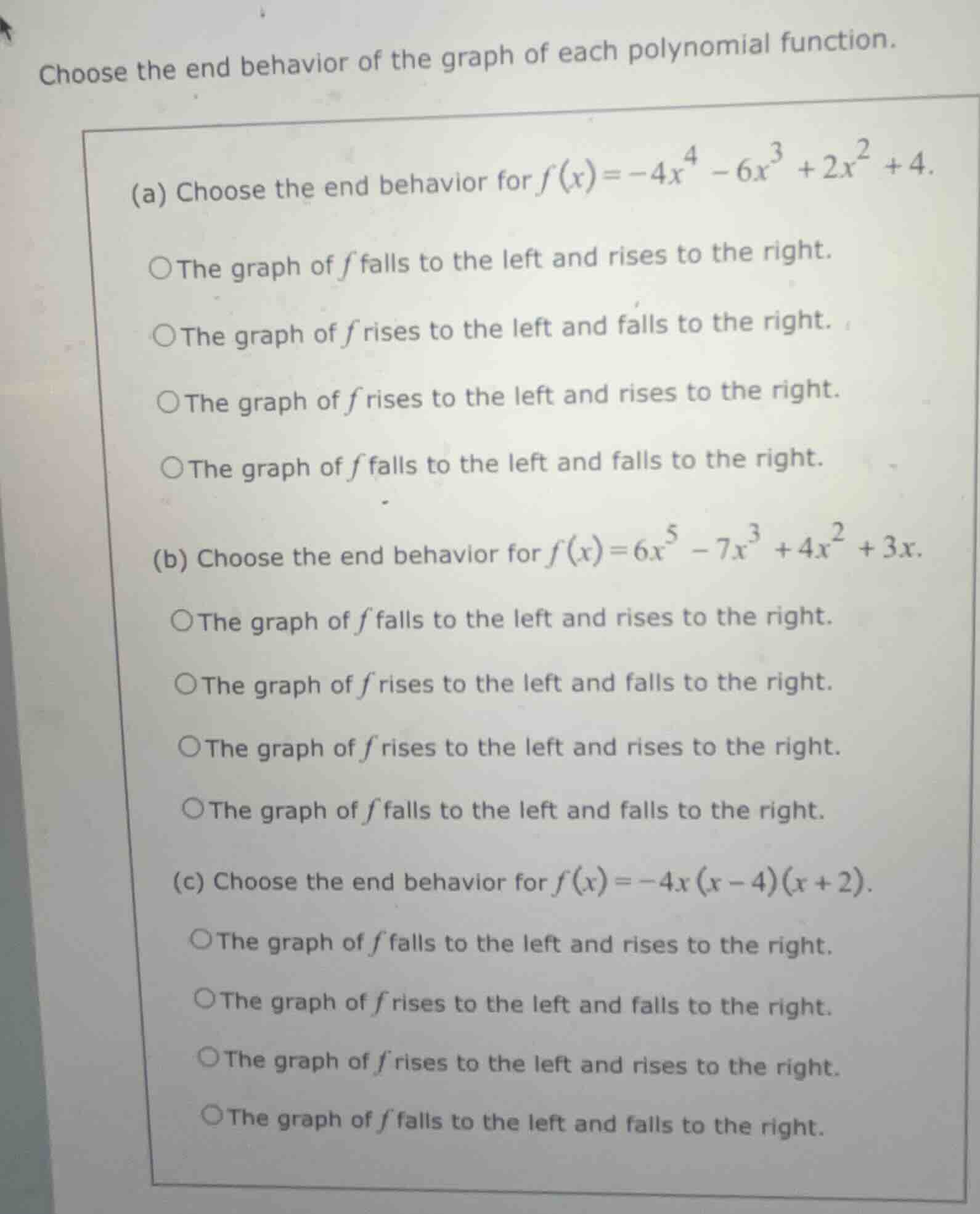
choose the end behavior of the graph of each polynomial function.

(a) choose the end behavior for (f(x) = -4x^4 - 6x^3 + 2x^2 + 4).

  • the graph of (f) falls to the left and rises to the right.
  • the graph of (f) rises to the left and falls to the right.
  • the graph of (f) rises to the left and rises to the right.
  • the graph of (f) falls to the left and falls to the right.

(b) choose the end behavior for (f(x) = 6x^5 - 7x^3 + 4x^2 + 3x).

  • the graph of (f) falls to the left and rises to the right.
  • the graph of (f) rises to the left and falls to the right.
  • the graph of (f) rises to the left and rises to the right.
  • the graph of (f) falls to the left and falls to the right.

(c) choose the end behavior for (f(x) = -4x(x - 4)(x + 2)).

  • the graph of (f) falls to the left and rises to the right.
  • the graph of (f) rises to the left and falls to the right.
  • the graph of (f) rises to the left and rises to the right.
  • the graph of (f) falls to the left and falls to the right.

Explanation:

Response

<pre_analysis>
{
"quality": "clear",
"question_count": 3,
"skills_matched": [
"step_cot",
"multiple_choice_formatter",
"explain_then_answer",
"tutor"
],
"needs_drawing": false,
"concepts_used": [],
"new_concepts": [
"End Behavior",
"Leading Coefficient Test",
"Polynomial Degree"
],
"current_concepts": [
"End Behavior",
"Leading Coefficient Test",
"Polynomial Degree"
]
}
</pre_analysis>

<reasoning>

Identify the leading term of function (a)

The function is \(f(x) = -4x^4 - 6x^3 + 2x^2 + 4\).
The term with the highest power of \(x\) is \(-4x^4\).
The degree \(n = 4\) is even.
The leading coefficient \(a_n = -4\) is negative.

Determine end behavior for function (a)

Since the degree is even, both ends go in the same direction.
Since the leading coefficient is negative, both ends go downward.
As \(x \to -\infty\), \(f(x) \to -\infty\) (falls to the left).
As \(x \to \infty\), \(f(x) \to -\infty\) (falls to the right).

Identify the leading term of function (b)

The function is \(f(x) = 6x^5 - 7x^3 + 4x^2 + 3x\).
The term with the highest power of \(x\) is \(6x^5\).
The degree \(n = 5\) is odd.
The leading coefficient \(a_n = 6\) is positive.

Determine end behavior for function (b)

Since the degree is odd, the ends go in opposite directions.
Since the leading coefficient is positive, the graph rises to the right.
As \(x \to -\infty\), \(f(x) \to -\infty\) (falls to the left).
As \(x \to \infty\), \(f(x) \to \infty\) (rises to the right).

Analyze function (c) and determine its end behavior

The function is \(f(x) = -4x(x - 4)(x + 2)\).
Expanding the leading term: \(-4x \cdot x \cdot x = -4x^3\).
The degree \(n = 3\) is odd.
The leading coefficient \(a_n = -4\) is negative.
Since the degree is odd, the ends go in opposite directions.
Since the leading coefficient is negative, the graph falls to the right.
As \(x \to -\infty\), \(f(x) \to \infty\) (rises to the left).
As \(x \to \infty\), \(f(x) \to -\infty\) (falls to the right).
</reasoning>

<answer>

Question 1

<mcq-option>The graph of \(f\) falls to the left and rises to the right.</mcq-option>
<mcq-option>The graph of \(f\) rises to the left and falls to the right.</mcq-option>
<mcq-option>The graph of \(f\) rises to the left and rises to the right.</mcq-option>
<mcq-correct>The graph of \(f\) falls to the left and falls to the right.</mcq-correct>

Question 2

<mcq-correct>The graph of \(f\) falls to the left and rises to the right.</mcq-correct>
<mcq-option>The graph of \(f\) rises to the left and falls to the right.</mcq-option>
<mcq-option>The graph of \(f\) rises to the left and rises to the right.</mcq-option>
<mcq-option>The graph of \(f\) falls to the left and falls to the right.</mcq-option>

Question 3

<mcq-option>The graph of \(f\) falls to the left and rises to the right.</mcq-option>
<mcq-correct>The graph of \(f\) rises to the left and falls to the right.</mcq-correct>
<mcq-option>The graph of \(f\) rises to the left and rises to the right.</mcq-option>
<mcq-option>The graph of \(f\) falls to the left and falls to the right.</mcq-option>
</answer>

<post_analysis>
{
"subject": "Mathematics",
"question_type": "Multiple Choice",
"knowledge_point": [
"Mathematics",
"Algebra",
"End Behavior"
]
}
</post_analysis>

Answer:

<pre_analysis>
{
"quality": "clear",
"question_count": 3,
"skills_matched": [
"step_cot",
"multiple_choice_formatter",
"explain_then_answer",
"tutor"
],
"needs_drawing": false,
"concepts_used": [],
"new_concepts": [
"End Behavior",
"Leading Coefficient Test",
"Polynomial Degree"
],
"current_concepts": [
"End Behavior",
"Leading Coefficient Test",
"Polynomial Degree"
]
}
</pre_analysis>

<reasoning>

Identify the leading term of function (a)

The function is \(f(x) = -4x^4 - 6x^3 + 2x^2 + 4\).
The term with the highest power of \(x\) is \(-4x^4\).
The degree \(n = 4\) is even.
The leading coefficient \(a_n = -4\) is negative.

Determine end behavior for function (a)

Since the degree is even, both ends go in the same direction.
Since the leading coefficient is negative, both ends go downward.
As \(x \to -\infty\), \(f(x) \to -\infty\) (falls to the left).
As \(x \to \infty\), \(f(x) \to -\infty\) (falls to the right).

Identify the leading term of function (b)

The function is \(f(x) = 6x^5 - 7x^3 + 4x^2 + 3x\).
The term with the highest power of \(x\) is \(6x^5\).
The degree \(n = 5\) is odd.
The leading coefficient \(a_n = 6\) is positive.

Determine end behavior for function (b)

Since the degree is odd, the ends go in opposite directions.
Since the leading coefficient is positive, the graph rises to the right.
As \(x \to -\infty\), \(f(x) \to -\infty\) (falls to the left).
As \(x \to \infty\), \(f(x) \to \infty\) (rises to the right).

Analyze function (c) and determine its end behavior

The function is \(f(x) = -4x(x - 4)(x + 2)\).
Expanding the leading term: \(-4x \cdot x \cdot x = -4x^3\).
The degree \(n = 3\) is odd.
The leading coefficient \(a_n = -4\) is negative.
Since the degree is odd, the ends go in opposite directions.
Since the leading coefficient is negative, the graph falls to the right.
As \(x \to -\infty\), \(f(x) \to \infty\) (rises to the left).
As \(x \to \infty\), \(f(x) \to -\infty\) (falls to the right).
</reasoning>

<answer>

Question 1

<mcq-option>The graph of \(f\) falls to the left and rises to the right.</mcq-option>
<mcq-option>The graph of \(f\) rises to the left and falls to the right.</mcq-option>
<mcq-option>The graph of \(f\) rises to the left and rises to the right.</mcq-option>
<mcq-correct>The graph of \(f\) falls to the left and falls to the right.</mcq-correct>

Question 2

<mcq-correct>The graph of \(f\) falls to the left and rises to the right.</mcq-correct>
<mcq-option>The graph of \(f\) rises to the left and falls to the right.</mcq-option>
<mcq-option>The graph of \(f\) rises to the left and rises to the right.</mcq-option>
<mcq-option>The graph of \(f\) falls to the left and falls to the right.</mcq-option>

Question 3

<mcq-option>The graph of \(f\) falls to the left and rises to the right.</mcq-option>
<mcq-correct>The graph of \(f\) rises to the left and falls to the right.</mcq-correct>
<mcq-option>The graph of \(f\) rises to the left and rises to the right.</mcq-option>
<mcq-option>The graph of \(f\) falls to the left and falls to the right.</mcq-option>
</answer>

<post_analysis>
{
"subject": "Mathematics",
"question_type": "Multiple Choice",
"knowledge_point": [
"Mathematics",
"Algebra",
"End Behavior"
]
}
</post_analysis>