QUESTION IMAGE
Question
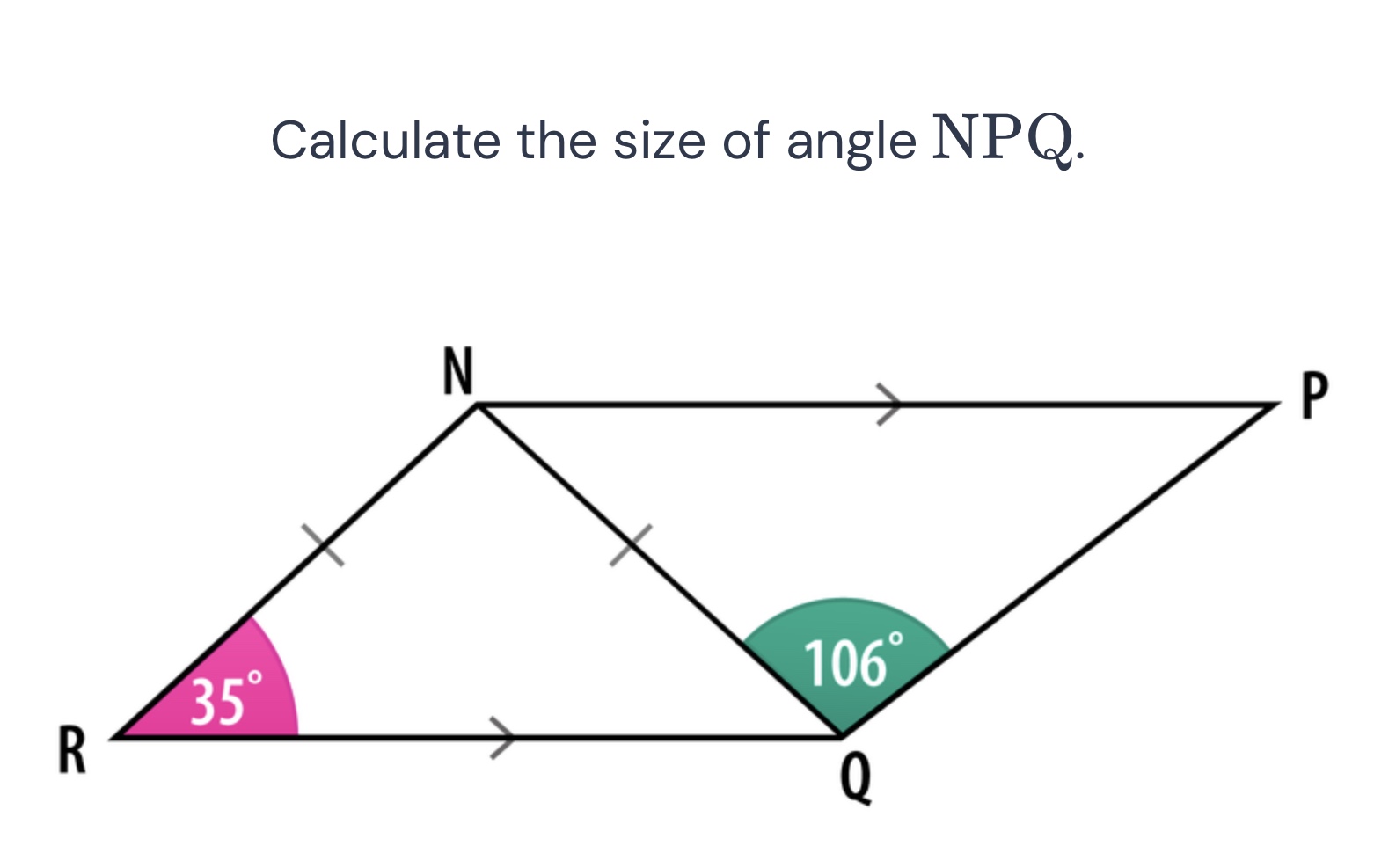
calculate the size of angle \\(npq\\).
⚡ Using what you learned: lines and angles (parallel, transversal, vertical)
Step 1: Find the angles in triangle RNQ
Triangle \( \text{RNQ} \) is an isosceles triangle because the tick marks show that side \( \text{RN} \) is equal in length to side \( \text{NQ} \) (\( \text{RN} = \text{NQ} \)).
In an isosceles triangle, the angles opposite the equal sides are also equal:
The sum of angles in a triangle is \( 180^\circ \):
Step 2: Use parallel lines to find angle PNQ
The arrows on lines \( \text{NP} \) and \( \text{RQ} \) indicate that they are parallel (\( \text{NP} \parallel \text{RQ} \)).
Using the alternate interior angles theorem with the transversal line \( \text{NQ} \):
Step 3: Find angle NQP
We are given that the total angle \( \angle \text{RQP} = 106^\circ \).
Since \( \angle \text{RQP} = \angle \text{RQN} + \angle \text{NQP} \):
Step 4: Calculate angle NPQ
In triangle \( \text{NPQ} \), the sum of the interior angles must be \( 180^\circ \):

Snap & solve any problem in the app
Get step-by-step solutions on Sovi AI
Photo-based solutions with guided steps
Explore more problems and detailed explanations
\( 74^\circ \)