Sovi.AI - AI Math Tutor

Scan to solve math questions

QUESTION IMAGE

birch syrup contains glucose. the chemical formula for glucose is shown…

Question

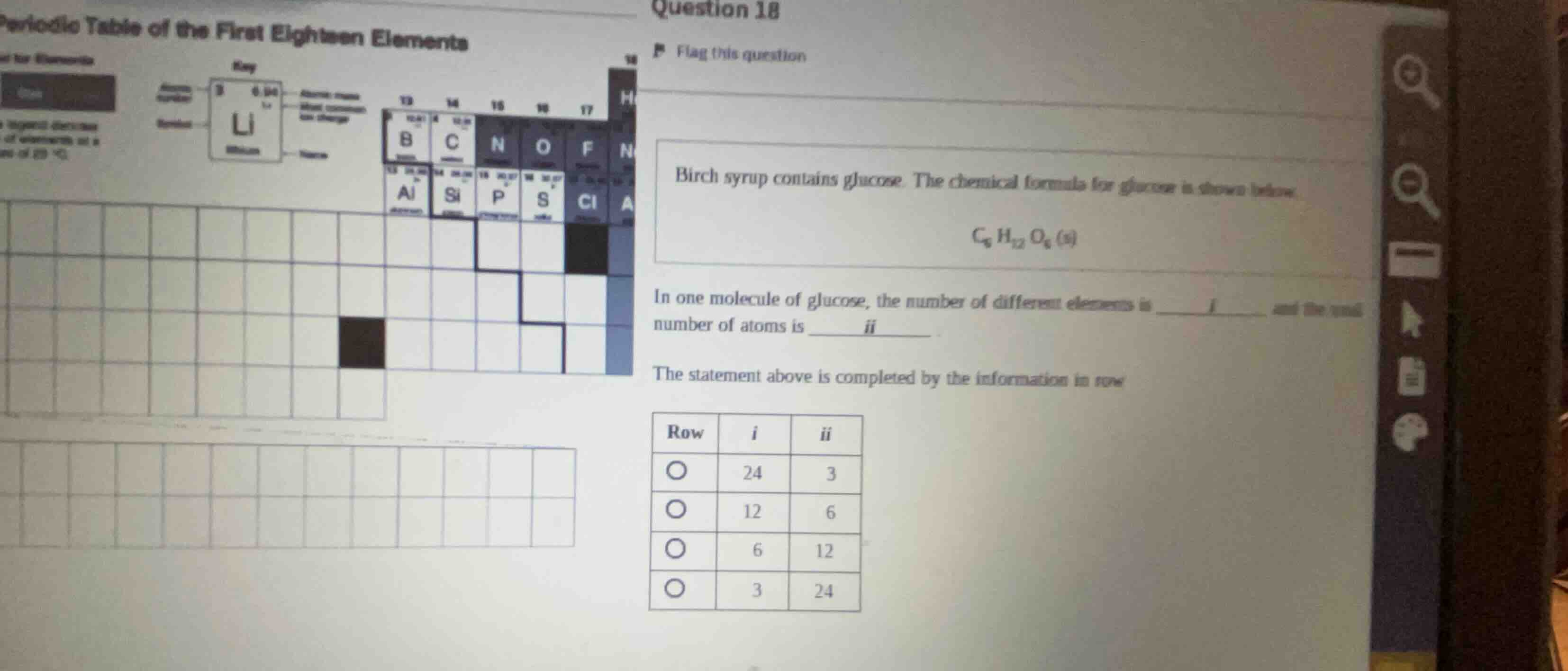
birch syrup contains glucose. the chemical formula for glucose is shown below.

\\\text{c}_6\text{h}_{12}\text{o}_6\text{ (s)}\\

in one molecule of glucose, the number of different elements is \\(i\\) and the total number of atoms is \\(ii\\).

the statement above is completed by the information in row

\

$$\begin{tabular}{|c|c|c|} \\hline \\textbf{row} & \\(i\\) & \\(ii\\) \\\\ \\hline \\bigcirc & 24 & 3 \\\\ \\hline \\bigcirc & 12 & 6 \\\\ \\hline \\bigcirc & 6 & 12 \\\\ \\hline \\bigcirc & 3 & 24 \\\\ \\hline \\end{tabular}$$

Explanation:

Response

<pre_analysis>
{
"quality": "clear",
"question_count": 1,
"skills_matched": [
"step_cot",
"multiple_choice_formatter",
"explain_then_answer",
"tutor"
],
"needs_drawing": false,
"concepts_used": [
"Elements and Compounds"
],
"new_concepts": [
"Chemical Formula Analysis",
"Atom Counting"
],
"current_concepts": [
"Elements and Compounds",
"Chemical Formula Analysis",
"Atom Counting"
]
}
</pre_analysis>

<reasoning>

Identify the chemical formula

The chemical formula given for glucose is:
\[
\text{C}_6\text{H}_{12}\text{O}_6\text{(s)}
\]

Determine the number of different elements

Using the Elements and Compounds knowledge point, we identify the unique chemical symbols in the formula:

  • \(\text{C}\) represents Carbon.
  • \(\text{H}\) represents Hydrogen.
  • \(\text{O}\) represents Oxygen.

There are 3 different elements present in one molecule of glucose. Thus, \(i = 3\).

Calculate the total number of atoms

We sum the subscripts of each element in the chemical formula:

  • Carbon atoms: 6
  • Hydrogen atoms: 12
  • Oxygen atoms: 6

\[
\text{Total atoms} = 6 + 12 + 6 = 24
\]

Thus, \(ii = 24\).

Match with the given options

We look for the row in the table where:

  • \(i = 3\)
  • \(ii = 24\)

This corresponds to the fourth row of the table.
</reasoning>

<answer>
<mcq-option>Row 1: \(i = 24\), \(ii = 3\)</mcq-option>
<mcq-option>Row 2: \(i = 12\), \(ii = 6\)</mcq-option>
<mcq-option>Row 3: \(i = 6\), \(ii = 12\)</mcq-option>
<mcq-correct>Row 4: \(i = 3\), \(ii = 24\)</mcq-correct>
</answer>

<post_analysis>
{
"subject": "Natural Science",
"question_type": "Multiple Choice",
"knowledge_point": [
"Natural Science",
"Chemistry",
"Chemical Formula Analysis"
]
}
</post_analysis>

Answer:

<pre_analysis>
{
"quality": "clear",
"question_count": 1,
"skills_matched": [
"step_cot",
"multiple_choice_formatter",
"explain_then_answer",
"tutor"
],
"needs_drawing": false,
"concepts_used": [
"Elements and Compounds"
],
"new_concepts": [
"Chemical Formula Analysis",
"Atom Counting"
],
"current_concepts": [
"Elements and Compounds",
"Chemical Formula Analysis",
"Atom Counting"
]
}
</pre_analysis>

<reasoning>

Identify the chemical formula

The chemical formula given for glucose is:
\[
\text{C}_6\text{H}_{12}\text{O}_6\text{(s)}
\]

Determine the number of different elements

Using the Elements and Compounds knowledge point, we identify the unique chemical symbols in the formula:

  • \(\text{C}\) represents Carbon.
  • \(\text{H}\) represents Hydrogen.
  • \(\text{O}\) represents Oxygen.

There are 3 different elements present in one molecule of glucose. Thus, \(i = 3\).

Calculate the total number of atoms

We sum the subscripts of each element in the chemical formula:

  • Carbon atoms: 6
  • Hydrogen atoms: 12
  • Oxygen atoms: 6

\[
\text{Total atoms} = 6 + 12 + 6 = 24
\]

Thus, \(ii = 24\).

Match with the given options

We look for the row in the table where:

  • \(i = 3\)
  • \(ii = 24\)

This corresponds to the fourth row of the table.
</reasoning>

<answer>
<mcq-option>Row 1: \(i = 24\), \(ii = 3\)</mcq-option>
<mcq-option>Row 2: \(i = 12\), \(ii = 6\)</mcq-option>
<mcq-option>Row 3: \(i = 6\), \(ii = 12\)</mcq-option>
<mcq-correct>Row 4: \(i = 3\), \(ii = 24\)</mcq-correct>
</answer>

<post_analysis>
{
"subject": "Natural Science",
"question_type": "Multiple Choice",
"knowledge_point": [
"Natural Science",
"Chemistry",
"Chemical Formula Analysis"
]
}
</post_analysis>