QUESTION IMAGE
Question
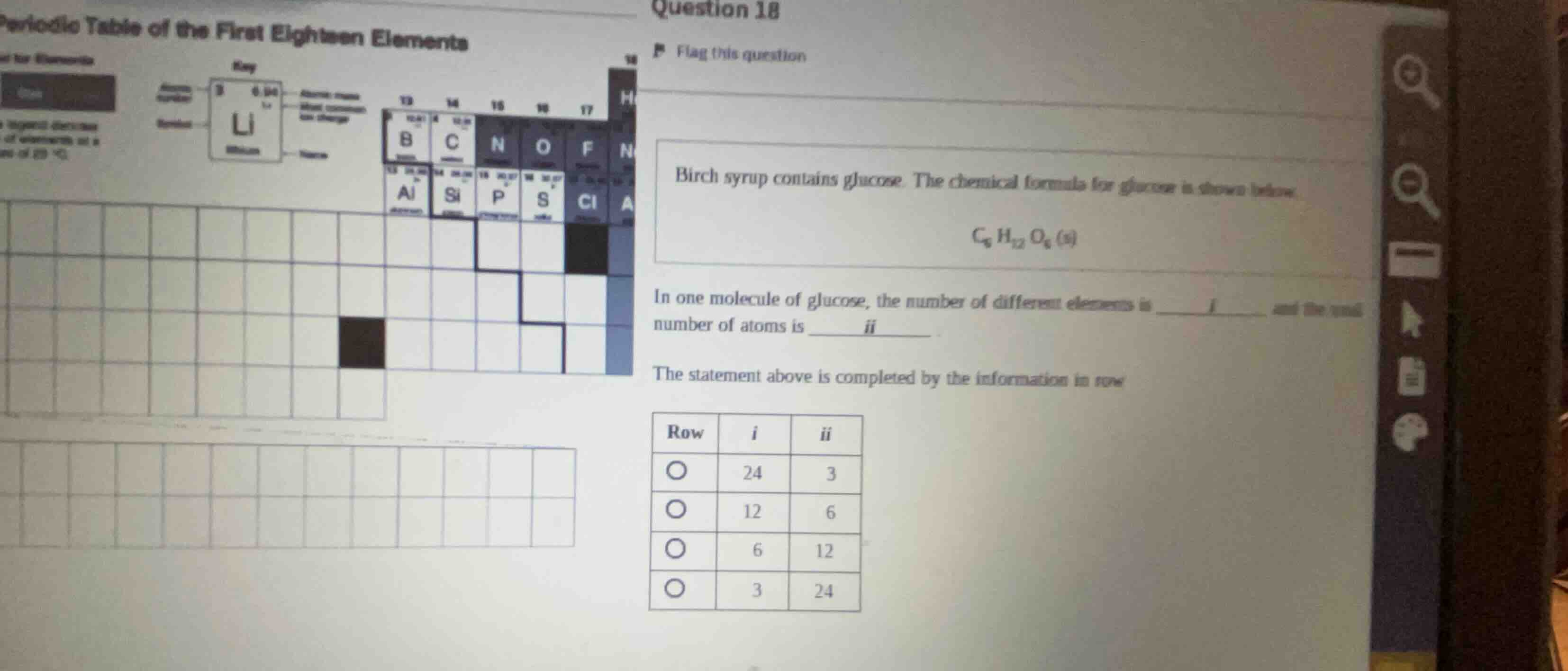
birch syrup contains glucose. the chemical formula for glucose is shown below.
\\\text{c}_6\text{h}_{12}\text{o}_6\text{ (s)}\\
in one molecule of glucose, the number of different elements is \\(i\\) and the total number of atoms is \\(ii\\).
the statement above is completed by the information in row
\
<pre_analysis>
{
"quality": "clear",
"question_count": 1,
"skills_matched": [
"step_cot",
"multiple_choice_formatter",
"explain_then_answer",
"tutor"
],
"needs_drawing": false,
"concepts_used": [
"Elements and Compounds"
],
"new_concepts": [
"Chemical Formula Analysis",
"Atom Counting"
],
"current_concepts": [
"Elements and Compounds",
"Chemical Formula Analysis",
"Atom Counting"
]
}
</pre_analysis>
<reasoning>
Identify the chemical formula
The chemical formula given for glucose is:
\[
\text{C}_6\text{H}_{12}\text{O}_6\text{(s)}
\]
Determine the number of different elements
Using the Elements and Compounds knowledge point, we identify the unique chemical symbols in the formula:
- \(\text{C}\) represents Carbon.
- \(\text{H}\) represents Hydrogen.
- \(\text{O}\) represents Oxygen.
There are 3 different elements present in one molecule of glucose. Thus, \(i = 3\).
Calculate the total number of atoms
We sum the subscripts of each element in the chemical formula:
- Carbon atoms: 6
- Hydrogen atoms: 12
- Oxygen atoms: 6
\[
\text{Total atoms} = 6 + 12 + 6 = 24
\]
Thus, \(ii = 24\).
Match with the given options
We look for the row in the table where:
- \(i = 3\)
- \(ii = 24\)
This corresponds to the fourth row of the table.
</reasoning>
<answer>
<mcq-option>Row 1: \(i = 24\), \(ii = 3\)</mcq-option>
<mcq-option>Row 2: \(i = 12\), \(ii = 6\)</mcq-option>
<mcq-option>Row 3: \(i = 6\), \(ii = 12\)</mcq-option>
<mcq-correct>Row 4: \(i = 3\), \(ii = 24\)</mcq-correct>
</answer>
<post_analysis>
{
"subject": "Natural Science",
"question_type": "Multiple Choice",
"knowledge_point": [
"Natural Science",
"Chemistry",
"Chemical Formula Analysis"
]
}
</post_analysis>
Snap & solve any problem in the app
Get step-by-step solutions on Sovi AI
Photo-based solutions with guided steps
Explore more problems and detailed explanations
<pre_analysis>
{
"quality": "clear",
"question_count": 1,
"skills_matched": [
"step_cot",
"multiple_choice_formatter",
"explain_then_answer",
"tutor"
],
"needs_drawing": false,
"concepts_used": [
"Elements and Compounds"
],
"new_concepts": [
"Chemical Formula Analysis",
"Atom Counting"
],
"current_concepts": [
"Elements and Compounds",
"Chemical Formula Analysis",
"Atom Counting"
]
}
</pre_analysis>
<reasoning>
Identify the chemical formula
The chemical formula given for glucose is:
\[
\text{C}_6\text{H}_{12}\text{O}_6\text{(s)}
\]
Determine the number of different elements
Using the Elements and Compounds knowledge point, we identify the unique chemical symbols in the formula:
- \(\text{C}\) represents Carbon.
- \(\text{H}\) represents Hydrogen.
- \(\text{O}\) represents Oxygen.
There are 3 different elements present in one molecule of glucose. Thus, \(i = 3\).
Calculate the total number of atoms
We sum the subscripts of each element in the chemical formula:
- Carbon atoms: 6
- Hydrogen atoms: 12
- Oxygen atoms: 6
\[
\text{Total atoms} = 6 + 12 + 6 = 24
\]
Thus, \(ii = 24\).
Match with the given options
We look for the row in the table where:
- \(i = 3\)
- \(ii = 24\)
This corresponds to the fourth row of the table.
</reasoning>
<answer>
<mcq-option>Row 1: \(i = 24\), \(ii = 3\)</mcq-option>
<mcq-option>Row 2: \(i = 12\), \(ii = 6\)</mcq-option>
<mcq-option>Row 3: \(i = 6\), \(ii = 12\)</mcq-option>
<mcq-correct>Row 4: \(i = 3\), \(ii = 24\)</mcq-correct>
</answer>
<post_analysis>
{
"subject": "Natural Science",
"question_type": "Multiple Choice",
"knowledge_point": [
"Natural Science",
"Chemistry",
"Chemical Formula Analysis"
]
}
</post_analysis>