QUESTION IMAGE
Question
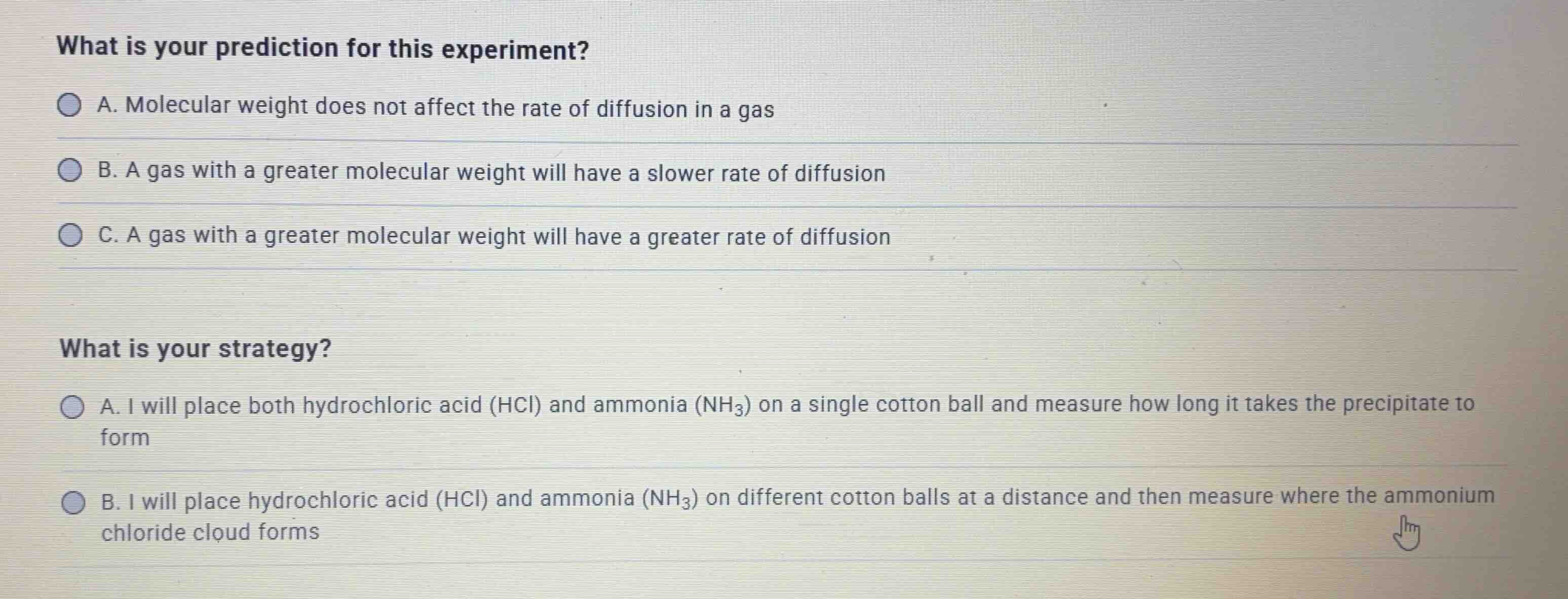
what is your prediction for this experiment?
a. molecular weight does not affect the rate of diffusion in a gas
b. a gas with a greater molecular weight will have a slower rate of diffusion
c. a gas with a greater molecular weight will have a greater rate of diffusion
what is your strategy?
a. i will place both hydrochloric acid (hcl) and ammonia (nh3) on a single cotton ball and measure how long it takes the precipitate to form
b. i will place hydrochloric acid (hcl) and ammonia (nh3) on different cotton balls at a distance and then measure where the ammonium chloride cloud forms
Analyze the prediction question
Using the Diffusion Rate Factors knowledge point, we know that the rate of diffusion of a substance is inversely proportional to the square root of its molecular mass (Graham's Law). Therefore, molecules with a greater molecular weight move more slowly and diffuse at a slower rate compared to lighter molecules. Thus, the correct prediction is that a gas with a greater molecular weight will have a slower rate of diffusion.
Analyze the strategy question
To test how molecular weight affects the rate of gas diffusion, we need to observe the diffusion of two different gases as they travel toward each other. Placing hydrochloric acid (\(\text{HCl}\)) and ammonia (\(\text{NH}_3\)) on separate cotton balls at opposite ends of a closed tube allows the gaseous molecules to diffuse through the air. When they meet, they react to form a visible white precipitate of ammonium chloride (\(\text{NH}_4\text{Cl}\)). Measuring the distance from each source to the meeting point reveals their relative diffusion rates.

Snap & solve any problem in the app
Get step-by-step solutions on Sovi AI
Photo-based solutions with guided steps
Explore more problems and detailed explanations
Question 1
- A. Molecular weight does not affect the rate of diffusion in a gas
- B. A gas with a greater molecular weight will have a slower rate of diffusion (Correct answer)
- C. A gas with a greater molecular weight will have a greater rate of diffusion
Question 2
- A. I will place both hydrochloric acid (HCl) and ammonia (\(\text{NH}_3\)) on a single cotton ball and measure how long it takes the precipitate to form
- B. I will place hydrochloric acid (HCl) and ammonia (\(\text{NH}_3\)) on different cotton balls at a distance and then measure where the ammonium chloride cloud forms (Correct answer)