QUESTION IMAGE
Question
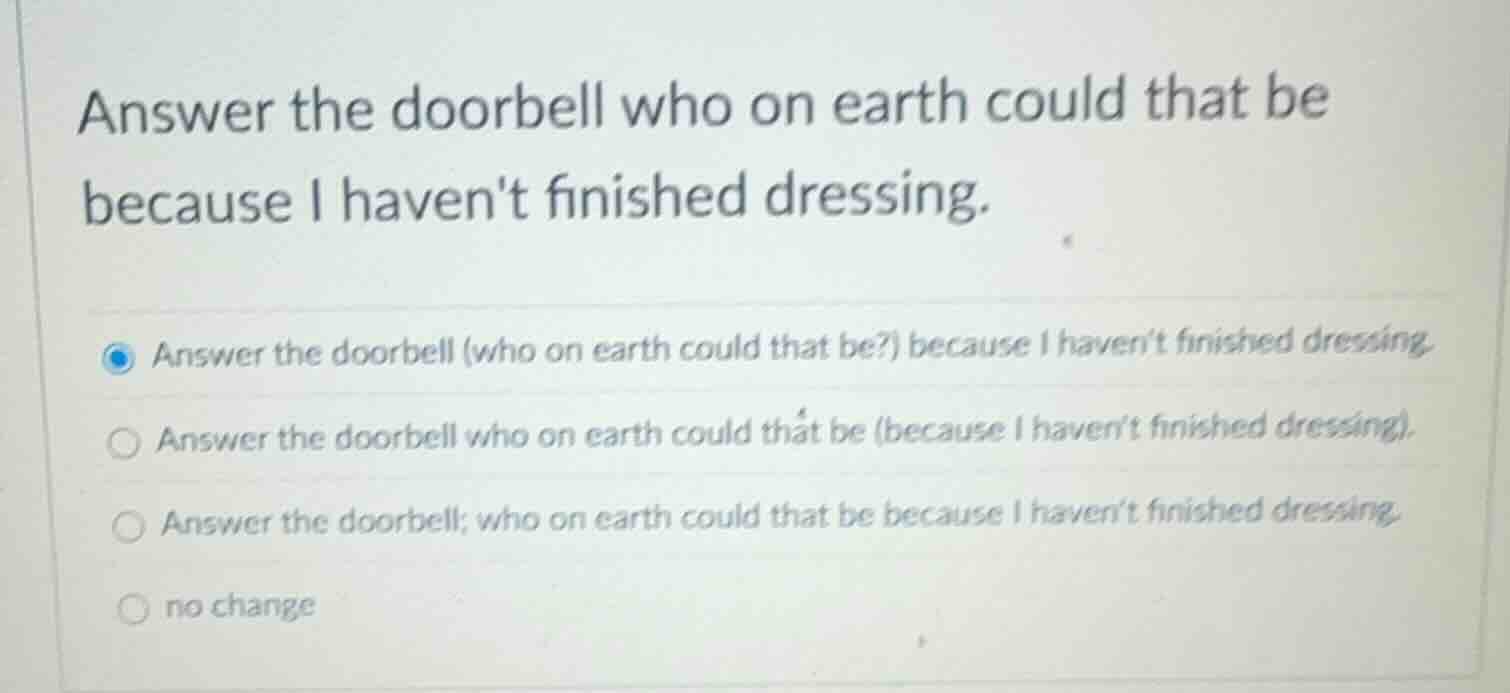
answer the doorbell who on earth could that be because i havent finished dressing.
- answer the doorbell (who on earth could that be?) because i havent finished dressing.
- answer the doorbell who on earth could that be (because i havent finished dressing).
- answer the doorbell; who on earth could that be because i havent finished dressing.
- no change
<pre_analysis>
{
"quality": "clear",
"question_count": 1,
"skills_matched": [
"direct_cot",
"multiple_choice_formatter",
"explain_then_answer",
"quick"
],
"needs_drawing": false,
"concepts_used": [
"Parenthetical Elements",
"Punctuation Rules"
],
"new_concepts": [],
"current_concepts": [
"Parenthetical Elements",
"Punctuation Rules",
"Run-on Sentences"
]
}
</pre_analysis>
<reasoning>
Analyze the sentence structure and identify the run-on error
The original sentence "Answer the doorbell who on earth could that be because I haven't finished dressing." contains an abrupt, interrupting question ("who on earth could that be") wedged between an imperative clause ("Answer the doorbell") and a subordinate adverbial clause ("because I haven't finished dressing"). Without punctuation, this creates a confusing run-on sentence.
Evaluate the punctuation options for the parenthetical question
The question "who on earth could that be?" is a parenthetical insertion that interrupts the main flow of the sentence. Standard English punctuation rules require parenthetical elements that express an aside or sudden question to be enclosed in parentheses, complete with its own terminal punctuation (a question mark) inside the parentheses.
Compare the choices
- Option 1: "Answer the doorbell (who on earth could that be?) because I haven't finished dressing." correctly uses parentheses and a question mark to isolate the interrupting question.
- Option 2: "Answer the doorbell who on earth could that be (because I haven't finished dressing)." incorrectly places parentheses around the essential cause clause and leaves the run-on question unpunctuated.
- Option 3: "Answer the doorbell; who on earth could that be because I haven't finished dressing." uses a semicolon but fails to isolate the question, leaving a run-on structure at the end.
- Option 4: "no change" leaves the sentence as an unpunctuated run-on.
</reasoning>
<answer>
<mcq-correct>(A) Answer the doorbell (who on earth could that be?) because I haven't finished dressing.</mcq-correct>
<mcq-option>(B) Answer the doorbell who on earth could that be (because I haven't finished dressing).</mcq-option>
<mcq-option>(C) Answer the doorbell; who on earth could that be because I haven't finished dressing.</mcq-option>
<mcq-option>(D) no change</mcq-option>
</answer>
<post_analysis>
{
"subject": "Arts",
"question_type": "Multiple Choice",
"knowledge_point": [
"Arts",
"Others",
"Punctuation Rules"
]
}
</post_analysis>
Snap & solve any problem in the app
Get step-by-step solutions on Sovi AI
Photo-based solutions with guided steps
Explore more problems and detailed explanations
<pre_analysis>
{
"quality": "clear",
"question_count": 1,
"skills_matched": [
"direct_cot",
"multiple_choice_formatter",
"explain_then_answer",
"quick"
],
"needs_drawing": false,
"concepts_used": [
"Parenthetical Elements",
"Punctuation Rules"
],
"new_concepts": [],
"current_concepts": [
"Parenthetical Elements",
"Punctuation Rules",
"Run-on Sentences"
]
}
</pre_analysis>
<reasoning>
Analyze the sentence structure and identify the run-on error
The original sentence "Answer the doorbell who on earth could that be because I haven't finished dressing." contains an abrupt, interrupting question ("who on earth could that be") wedged between an imperative clause ("Answer the doorbell") and a subordinate adverbial clause ("because I haven't finished dressing"). Without punctuation, this creates a confusing run-on sentence.
Evaluate the punctuation options for the parenthetical question
The question "who on earth could that be?" is a parenthetical insertion that interrupts the main flow of the sentence. Standard English punctuation rules require parenthetical elements that express an aside or sudden question to be enclosed in parentheses, complete with its own terminal punctuation (a question mark) inside the parentheses.
Compare the choices
- Option 1: "Answer the doorbell (who on earth could that be?) because I haven't finished dressing." correctly uses parentheses and a question mark to isolate the interrupting question.
- Option 2: "Answer the doorbell who on earth could that be (because I haven't finished dressing)." incorrectly places parentheses around the essential cause clause and leaves the run-on question unpunctuated.
- Option 3: "Answer the doorbell; who on earth could that be because I haven't finished dressing." uses a semicolon but fails to isolate the question, leaving a run-on structure at the end.
- Option 4: "no change" leaves the sentence as an unpunctuated run-on.
</reasoning>
<answer>
<mcq-correct>(A) Answer the doorbell (who on earth could that be?) because I haven't finished dressing.</mcq-correct>
<mcq-option>(B) Answer the doorbell who on earth could that be (because I haven't finished dressing).</mcq-option>
<mcq-option>(C) Answer the doorbell; who on earth could that be because I haven't finished dressing.</mcq-option>
<mcq-option>(D) no change</mcq-option>
</answer>
<post_analysis>
{
"subject": "Arts",
"question_type": "Multiple Choice",
"knowledge_point": [
"Arts",
"Others",
"Punctuation Rules"
]
}
</post_analysis>