QUESTION IMAGE
Question
analyzing historical documents
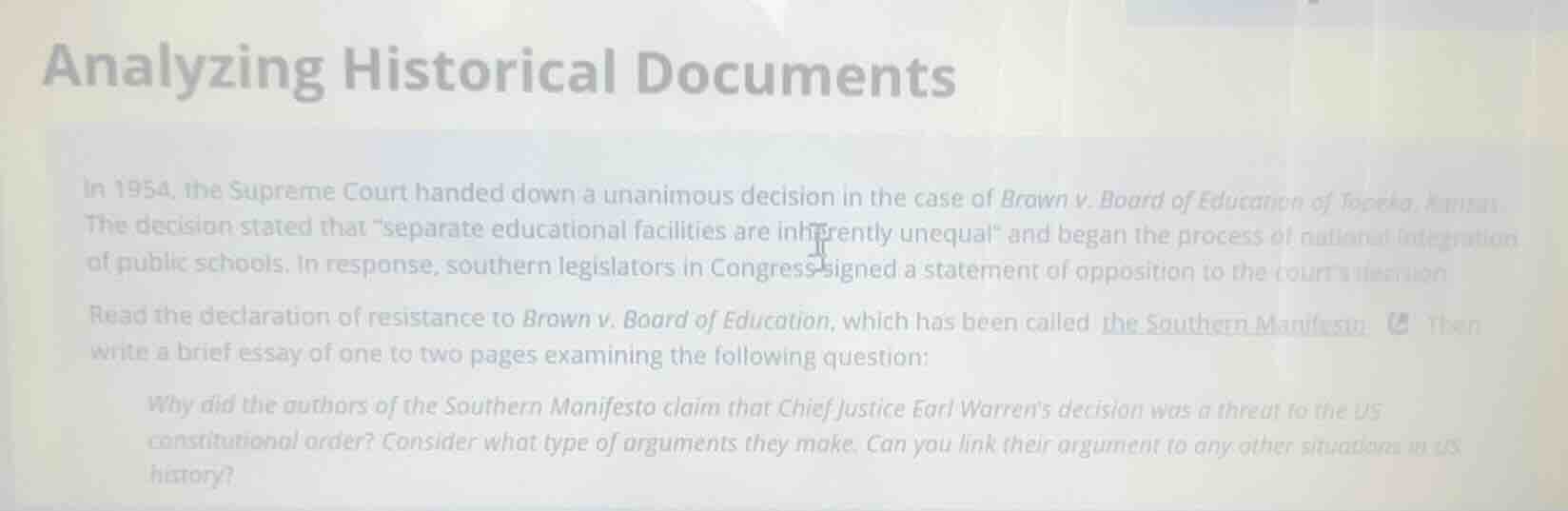
in 1954, the supreme court handed down a unanimous decision in the case of brown v. board of education of topeka, kansas. the decision stated that \separate educational facilities are inherently unequal\ and began the process of national integration of public schools. in response, southern legislators in congress signed a statement of opposition to the courts decision.
read the declaration of resistance to brown v. board of education, which has been called the southern manifesto. then write a brief essay of one to two pages examining the following question:
why did the authors of the southern manifesto claim that chief justice earl warrens decision was a threat to the us constitutional order? consider what type of arguments they make. can you link their argument to any other situations in us history?
🆕 New Concept Discovered: Historical Document Analysis
Evaluating primary sources by examining their arguments, context, and connections.
Step 1: Understand the Core Arguments of the Southern Manifesto
To answer why the authors of the Southern Manifesto (1956) claimed that the Brown v. Board of Education decision threatened the US constitutional order, we must look at the specific legal and political arguments they used:
- Abuse of Judicial Power (Judicial Activism): The authors argued that the Supreme Court encroached upon the legislative branch. They claimed the Constitution does not mention education, and therefore, under the Tenth Amendment, the power to regulate schools belongs solely to the states, not the federal judiciary.
- Violation of Precedent: They argued that the Court threw out established legal precedent—specifically the "separate but equal" doctrine established in Plessy v. Ferguson (1896)—without any constitutional basis, substituting personal political opinions for established law.
- Encroachment on States' Rights: They asserted that the federal government was overstepping its bounds and destroying the system of dual sovereignty (federalism) by dictating local social and educational policies.
Step 2: Identify the Types of Arguments Made
The authors structured their opposition using three main types of arguments:
- Constitutional/Legal Arguments: Relying heavily on the Tenth Amendment (reserved powers to the states) and the original intent of the Fourteenth Amendment (arguing that its framers did not intend to integrate public schools).
- Social/Practical Arguments: Claiming that the decision would destroy amicable relations between races and cause chaos, confusion, and civil discord in communities where segregation was deeply rooted.
- Democratic Legitimacy Arguments: Arguing that changes to social institutions should only come through the legislative process (elected representatives) or constitutional amendments, not by "judicial decree."
Step 3: Link to Other Historical Situations (Historical Parallels)
The arguments in the Southern Manifesto are not unique; they echo several major conflicts over federalism and state sovereignty in US history:
- The Nullification Crisis (1832–1833): John C. Calhoun argued that states had the right to nullify federal laws (like tariffs) they deemed unconstitutional. The Manifesto uses a similar logic of state-level resistance to federal authority.
- The Virginia and Kentucky Resolutions (1798): Drafted by Thomas Jefferson and James Madison, these resolutions argued that the states had the right to declare federal acts (the Alien and Sedition Acts) unconstitutional, establishing an early framework for states' rights arguments.
- Secession and the Civil War: The fundamental debate over whether the federal government can impose laws or values on states regarding local institutions (which, in the 1850s, was slavery) directly mirrors the rhetoric used by Southern segregationists in the 1950s.
---

Snap & solve any problem in the app
Get step-by-step solutions on Sovi AI
Photo-based solutions with guided steps
Explore more problems and detailed explanations
Essay Outline & Key Points for Your Assignment
Below is a structured guide to help you write your one- to two-page essay answering the prompt:
1. Introduction
- Historical Context: Briefly introduce the 1954 Brown v. Board of Education decision and the subsequent backlash, culminating in the 1956 Southern Manifesto (signed by over 100 Southern congressmen).
- Thesis Statement: The authors of the Southern Manifesto claimed that the Brown decision threatened the US constitutional order because they viewed it as an unconstitutional exercise of judicial power that violated states' rights, bypassed the legislative process, and ignored legal precedent.
2. Body Paragraph 1: The Threat to Constitutional Order & Types of Arguments
- Judicial Encroachment: Explain how the authors accused the Supreme Court of "naked judicial power" rather than interpreting the law.
- The Tenth Amendment Argument: Detail their claim that education is not mentioned in the Constitution, meaning it is a power reserved strictly to the states.
- Original Intent: Mention their argument that the Fourteenth Amendment was never intended by its creators to affect public education systems.
3. Body Paragraph 2: Historical Connections to States' Rights
- The Nullification Tradition: Connect the Manifesto's rhetoric of "interposition" and resistance to John C. Calhoun's Nullification Crisis and the Virginia and Kentucky Resolutions. Show how Southern politicians historically relied on "states' rights" arguments to protect local institutions (such as slavery in the 19th century and Jim Crow segregation in the 20th century) from federal intervention.
4. Conclusion
- Summary: Restate how the Manifesto framed segregation not merely as a social preference, but as a defense of the US Constitution and federalism.
- Significance: Conclude by noting how this document laid the groundwork for "massive resistance" across the South, showing how constitutional arguments are often leveraged to resist social progress.