QUESTION IMAGE
Question
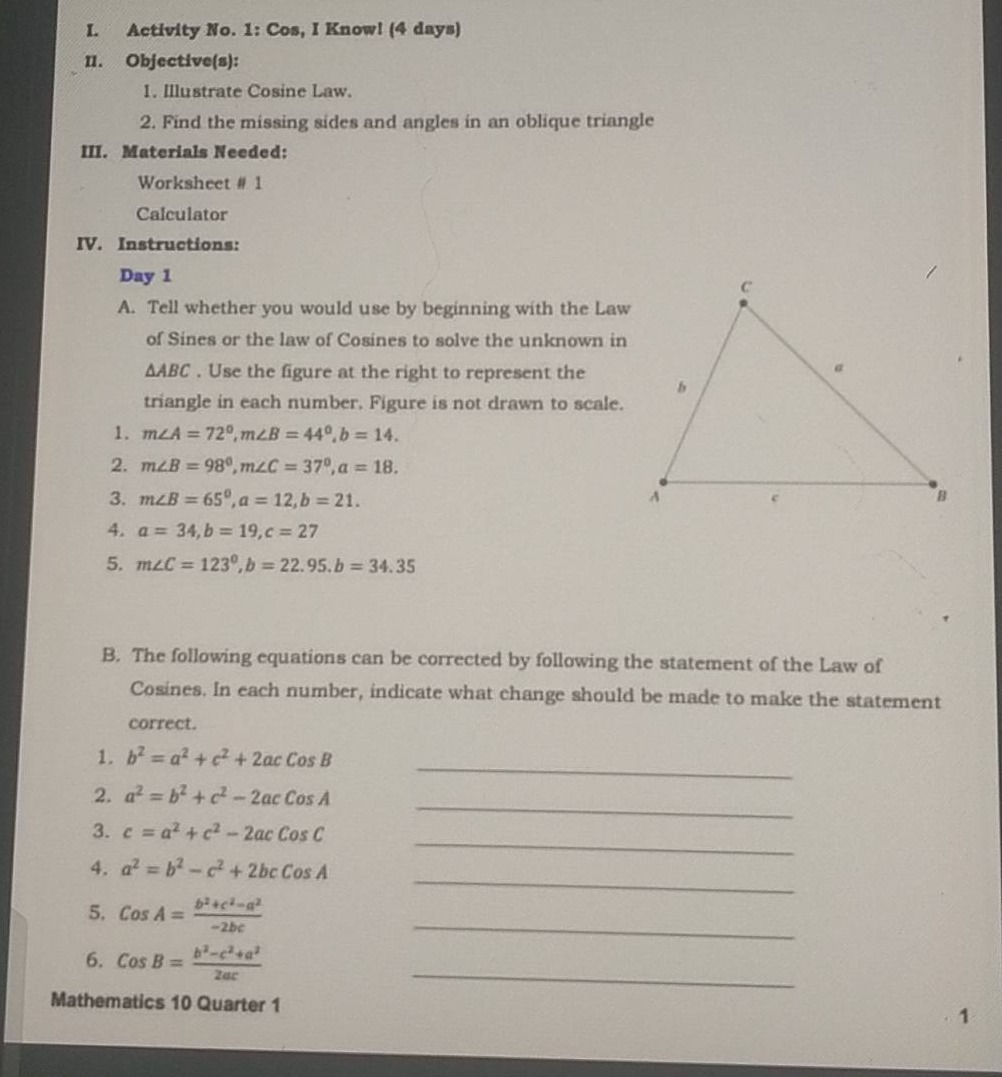
i. activity no. 1: cos, i know! (4 days)
ii. objective(s):
- illustrate cosine law.
- find the missing sides and angles in an oblique triangle
iii. materials needed:
worksheet # 1
calculator
iv. instructions:
day 1
a. tell whether you would use by beginning with the law of sines or the law of cosines to solve the unknown in \\(\delta abc\\). use the figure at the right to represent the triangle in each number. figure is not drawn to scale.
- \\(m\angle a = 72^{\circ}, m\angle b = 44^{\circ}, b = 14\\).
- \\(m\angle b = 98^{\circ}, m\angle c = 37^{\circ}, a = 18\\).
- \\(m\angle b = 65^{\circ}, a = 12, b = 21\\).
- \\(a = 34, b = 19, c = 27\\).
- \\(m\angle c = 123^{\circ}, b = 22.95, b = 34.35\\).
b. the following equations can be corrected by following the statement of the law of cosines. in each number, indicate what change should be made to make the statement correct.
- \\(b^2 = a^2 + c^2 + 2ac \cos b\\)
- \\(a^2 = b^2 + c^2 - 2ac \cos a\\)
- \\(c = a^2 + c^2 - 2ac \cos c\\)
- \\(a^2 = b^2 - c^2 + 2bc \cos a\\)
- \\(\cos a = \frac{b^2+c^2-a^2}{-2bc}\\)
- \\(\cos b = \frac{b^2-c^2+a^2}{2ac}\\)
🆕 New Concept Discovered: Law of Sines and Law of Cosines
Solving non-right triangles using side and angle relationships
---
Step 1: Understand the Rules for Choosing the Law of Sines vs. Law of Cosines (Part A)
To decide which law to use first when solving an oblique (non-right) triangle, we look at the given information:
- Law of Sines is used when we know an angle and its opposite side (an "opposite pair"), plus one other piece of information. This includes:
- ASA (Angle-Side-Angle): Two angles and the included side.
- AAS (Angle-Angle-Side): Two angles and a non-included side.
- SSA (Side-Side-Angle): Two sides and a non-included angle.
- Law of Cosines is used when we do not have any known opposite angle-side pairs. This includes:
- SAS (Side-Angle-Side): Two sides and their included angle.
- SSS (Side-Side-Side): All three sides.
---
Step 2: Solve Part A (Questions 1 to 5)
Let's analyze each case based on the given values:
- Given: \( m\angle A = 72^\circ \), \( m\angle B = 44^\circ \), \( b = 14 \)
- Analysis: We are given two angles and one side. Since we know angle \( B \) and its opposite side \( b \), we have a complete opposite pair.
- Decision: Law of Sines
- Given: \( m\angle B = 98^\circ \), \( m\angle C = 37^\circ \), \( a = 18 \)
- Analysis: We are given two angles and the included side (ASA). We can easily find the third angle \( A \) because the angles sum to \( 180^\circ \), which then gives us an opposite pair \( (A, a) \).
- Decision: Law of Sines
- Given: \( m\angle B = 65^\circ \), \( a = 12 \), \( b = 21 \)
- Analysis: We are given two sides and a non-included angle. We have the opposite pair \( (B, b) \).
- Decision: Law of Sines
- Given: \( a = 34 \), \( b = 19 \), \( c = 27 \)
- Analysis: We are given all three sides (SSS) and no angles.
- Decision: Law of Cosines
- Given: \( m\angle C = 123^\circ \), \( b = 22.95 \), \( c = 34.35 \) (Note: The worksheet contains a typo writing "b = 34.35" twice; looking at the standard triangle notation, the second value represents side \( c \))
- Analysis: We are given two sides and an angle. Since we have angle \( C \) and its opposite side \( c \), we have a complete opposite pair.
- Decision: Law of Sines
---
Step 3: Understand the Standard Formulas for the Law of Cosines (Part B)
The standard forms of the Law of Cosines for a triangle with sides \( a, b, c \) and opposite angles \( A, B, C \) are:
- Side-finding forms:
- Angle-finding forms (rearranged):
---
Step 4: Solve Part B (Questions 1 to 6)
Let's identify the error in each equation and state the correction:
- Equation: \( b^2 = a^2 + c^2 + 2ac \cos B \)
- Correction: Change the plus sign before \( 2ac \) to a minus sign.
- Correct Equation: \( b^2 = a^2 + c^2 - 2ac \cos B \)
- Equation: \( a^2 = b^2 + c^2 - 2ac \cos A \)
- Correction: Change the variable \( a \) in \( 2ac \) to \( b \).
- Correct Equation: \( a^2 = b^2 + c^2 - 2bc \cos A \)
- Equation: \( c = a^2 + c^2 - 2ac \cos C \)
- **C…

Snap & solve any problem in the app
Get step-by-step solutions on Sovi AI
Photo-based solutions with guided steps
Explore more problems and detailed explanations
Part A
- Law of Sines
- Law of Sines
- Law of Sines
- Law of Cosines
- Law of Sines
Part B
- Change \( + 2ac \cos B \) to \( - 2ac \cos B \)
- Change \( 2ac \) to \( 2bc \)
- Change the left side to \( c^2 \), change the right-side \( c^2 \) to \( b^2 \), and change \( 2ac \) to \( 2ab \)
- Change \( - c^2 + 2bc \cos A \) to \( + c^2 - 2bc \cos A \)
- Change the denominator from \( -2bc \) to \( 2bc \)
- Change the numerator from \( b^2 - c^2 + a^2 \) to \( a^2 + c^2 - b^2 \)