QUESTION IMAGE
Question
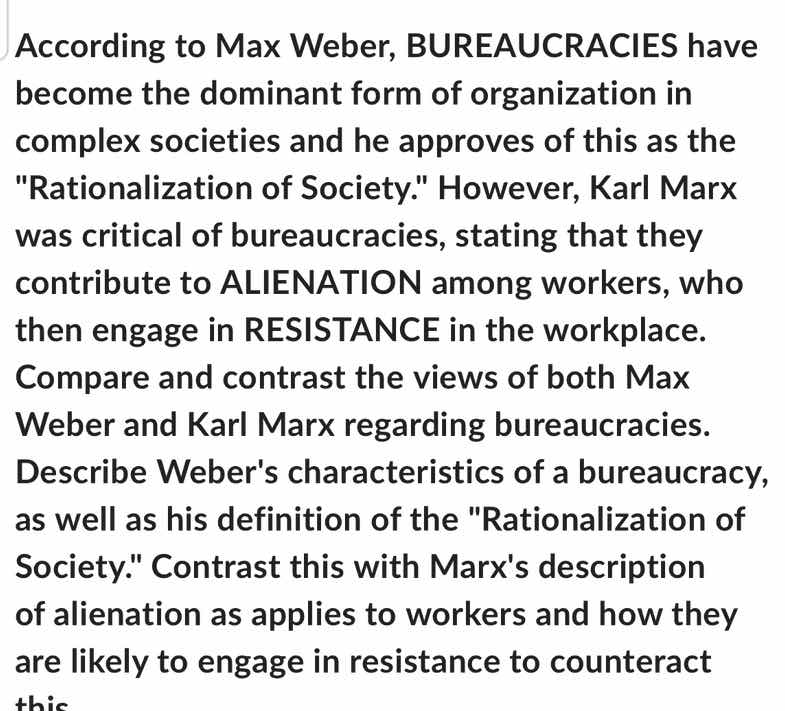
according to max weber, bureaucracies have become the dominant form of organization in complex societies and he approves of this as the
ationalization of society.\ however, karl marx was critical of bureaucracies, stating that they contribute to alienation among workers, who then engage in resistance in the workplace. compare and contrast the views of both max weber and karl marx regarding bureaucracies. describe webers characteristics of a bureaucracy, as well as his definition of the
ationalization of society.\ contrast this with marxs description of alienation as applies to workers and how they are likely to engage in resistance to counteract this.
<pre_analysis>
{
"quality": "clear",
"question_count": 1,
"skills_matched": [
"direct_cot",
"explain_then_answer",
"tutor"
],
"needs_drawing": false,
"concepts_used": [],
"new_concepts": [
"Weberian Bureaucracy",
"Rationalization of Society",
"Marxist Alienation"
],
"current_concepts": [
"Weberian Bureaucracy",
"Rationalization of Society",
"Marxist Alienation",
"Workplace Resistance"
]
}
</pre_analysis>
<reasoning>
Analyze Weber's view on bureaucracies
Max Weber viewed bureaucracies as highly efficient, rational, and necessary structures. He identified key characteristics: hierarchy, division of labor, written rules, and impersonality.
Define Weber's rationalization of society
Weber defined "Rationalization of Society" as shifting from traditional to logical, rule-based systems. He argued this shift maximizes efficiency but risks creating an impersonal "iron cage."
Analyze Marx's view on bureaucracies
Karl Marx criticized bureaucracies as tools of the ruling class. He argued they dehumanize workers, strip away autonomy, and enforce capitalist control.
Explain Marx's concept of alienation
Marx described alienation as workers feeling disconnected from their labor, products, and humanity. This occurs because workers lack control over their daily tasks.
Describe workplace resistance to alienation
To counteract alienation, workers engage in resistance. This includes informal actions like slowing down work, or formal actions like unionizing.
</reasoning>
<answer>
Max Weber and Karl Marx offer contrasting sociological perspectives on the rise of bureaucracies in modern society:
- Max Weber's Perspective:
- Characteristics of Bureaucracy: Weber identified bureaucracy as the most efficient form of organization, characterized by a clear hierarchy of authority, a specialized division of labor, explicit written rules, and impersonal relationships.
- Rationalization of Society: This refers to the historical shift from traditional, emotion-driven social organization to logical, rule-bound, and highly efficient systems. While Weber appreciated its efficiency, he warned that extreme rationalization could trap individuals in an impersonal, inescapable "iron cage" of bureaucratic rules.
- Karl Marx's Perspective:
- Alienation: Marx argued that capitalist bureaucracies strip workers of their humanity. Workers experience alienation in four ways: from the product of their labor, from the act of production, from their human potential, and from their co-workers.
- Workplace Resistance: To reclaim control and counteract this alienation, workers engage in resistance. This can range from informal acts (such as working slowly, taking unauthorized breaks, or minor sabotage) to formal collective actions (such as forming unions, organizing strikes, and demanding workplace democracy).
</answer>
<post_analysis>
{
"subject": "Social Science",
"question_type": "Free Response",
"knowledge_point": [
"Social Science",
"Sociology",
"Sociological Theory"
]
}
</post_analysis>
Snap & solve any problem in the app
Get step-by-step solutions on Sovi AI
Photo-based solutions with guided steps
Explore more problems and detailed explanations
<pre_analysis>
{
"quality": "clear",
"question_count": 1,
"skills_matched": [
"direct_cot",
"explain_then_answer",
"tutor"
],
"needs_drawing": false,
"concepts_used": [],
"new_concepts": [
"Weberian Bureaucracy",
"Rationalization of Society",
"Marxist Alienation"
],
"current_concepts": [
"Weberian Bureaucracy",
"Rationalization of Society",
"Marxist Alienation",
"Workplace Resistance"
]
}
</pre_analysis>
<reasoning>
Analyze Weber's view on bureaucracies
Max Weber viewed bureaucracies as highly efficient, rational, and necessary structures. He identified key characteristics: hierarchy, division of labor, written rules, and impersonality.
Define Weber's rationalization of society
Weber defined "Rationalization of Society" as shifting from traditional to logical, rule-based systems. He argued this shift maximizes efficiency but risks creating an impersonal "iron cage."
Analyze Marx's view on bureaucracies
Karl Marx criticized bureaucracies as tools of the ruling class. He argued they dehumanize workers, strip away autonomy, and enforce capitalist control.
Explain Marx's concept of alienation
Marx described alienation as workers feeling disconnected from their labor, products, and humanity. This occurs because workers lack control over their daily tasks.
Describe workplace resistance to alienation
To counteract alienation, workers engage in resistance. This includes informal actions like slowing down work, or formal actions like unionizing.
</reasoning>
<answer>
Max Weber and Karl Marx offer contrasting sociological perspectives on the rise of bureaucracies in modern society:
- Max Weber's Perspective:
- Characteristics of Bureaucracy: Weber identified bureaucracy as the most efficient form of organization, characterized by a clear hierarchy of authority, a specialized division of labor, explicit written rules, and impersonal relationships.
- Rationalization of Society: This refers to the historical shift from traditional, emotion-driven social organization to logical, rule-bound, and highly efficient systems. While Weber appreciated its efficiency, he warned that extreme rationalization could trap individuals in an impersonal, inescapable "iron cage" of bureaucratic rules.
- Karl Marx's Perspective:
- Alienation: Marx argued that capitalist bureaucracies strip workers of their humanity. Workers experience alienation in four ways: from the product of their labor, from the act of production, from their human potential, and from their co-workers.
- Workplace Resistance: To reclaim control and counteract this alienation, workers engage in resistance. This can range from informal acts (such as working slowly, taking unauthorized breaks, or minor sabotage) to formal collective actions (such as forming unions, organizing strikes, and demanding workplace democracy).
</answer>
<post_analysis>
{
"subject": "Social Science",
"question_type": "Free Response",
"knowledge_point": [
"Social Science",
"Sociology",
"Sociological Theory"
]
}
</post_analysis>