QUESTION IMAGE
Question
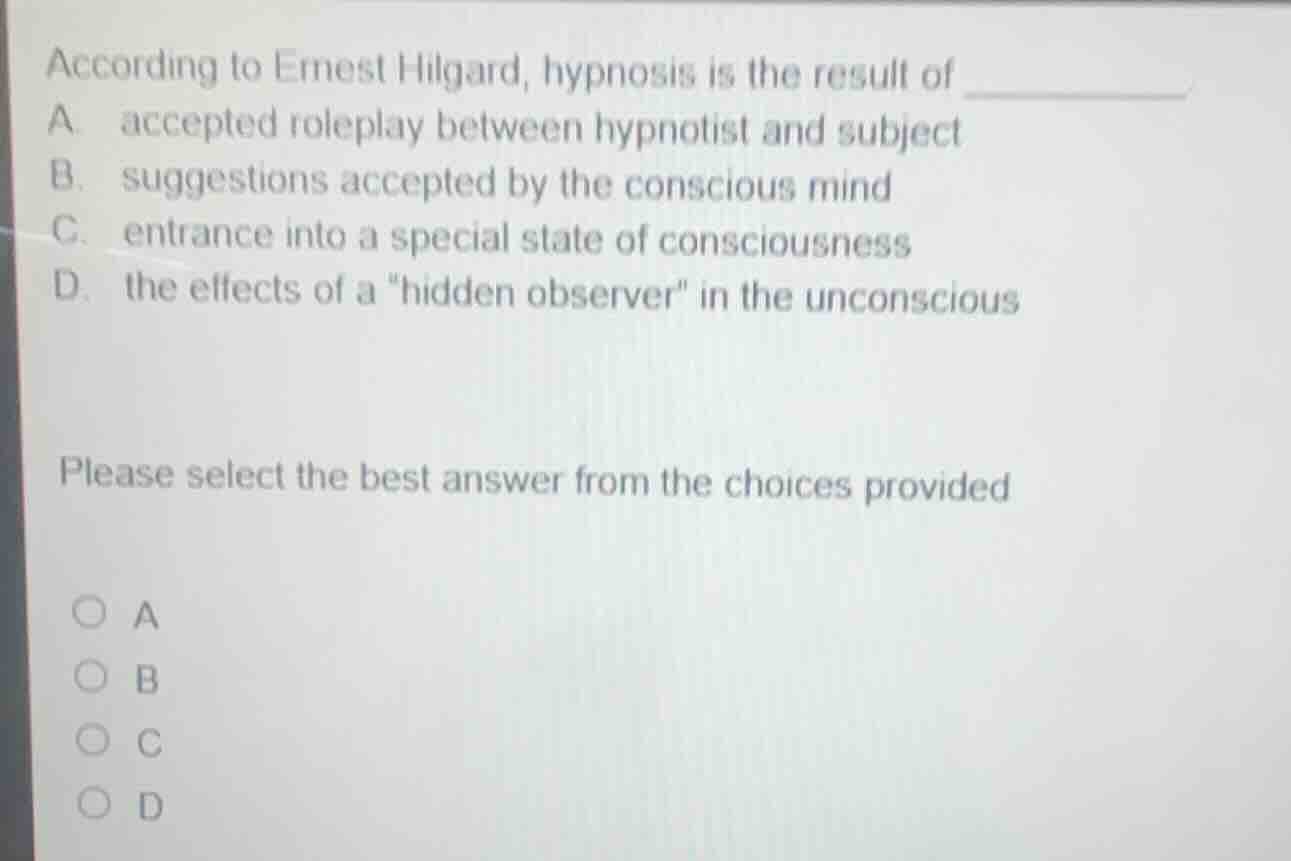
according to ernest hilgard, hypnosis is the result of _______
a. accepted roleplay between hypnotist and subject
b. suggestions accepted by the conscious mind
c. entrance into a special state of consciousness
d. the effects of a \hidden observer\ in the unconscious
please select the best answer from the choices provided
a
b
c
d
<pre_analysis>
{
"quality": "clear",
"question_count": 1,
"skills_matched": [
"direct_cot",
"multiple_choice_formatter",
"explain_then_answer",
"quick"
],
"needs_drawing": false,
"concepts_used": [
"History of Hypnosis"
],
"new_concepts": [
"Neodissociation Theory",
"Hidden Observer"
],
"current_concepts": [
"History of Hypnosis",
"Neodissociation Theory",
"Hidden Observer"
]
}
</pre_analysis>
<reasoning>
Identify Hilgard's theory of hypnosis
Ernest Hilgard proposed the neodissociation theory of hypnosis, which asserts that hypnosis causes a split or dissociation in consciousness.
Analyze the role of the hidden observer
According to Hilgard, one part of the consciousness responds to the hypnotist's suggestions, while another dissociated part, termed the "hidden observer," remains aware of everything happening (such as pain or reality) at an unconscious or background level.
Evaluate the given options
- Option A refers to the social-cognitive/role-playing theory of hypnosis (associated with Theodore Sarbin and Nicholas Spanos).
- Option B does not align with Hilgard's dissociation model.
- Option C is a general description of altered states but is not specific to Hilgard's defining mechanism.
- Option D directly identifies the "hidden observer" in the unconscious, which is the hallmark of Hilgard's neodissociation theory.
</reasoning>
<answer>
<mcq-option>A. accepted roleplay between hypnotist and subject</mcq-option>
<mcq-option>B. suggestions accepted by the conscious mind</mcq-option>
<mcq-option>C. entrance into a special state of consciousness</mcq-option>
<mcq-correct>D. the effects of a "hidden observer" in the unconscious</mcq-correct>
</answer>
<post_analysis>
{
"subject": "Social Science",
"question_type": "Multiple Choice",
"knowledge_point": [
"Social Science",
"Psychology",
"States of Consciousness"
]
}
</post_analysis>
Snap & solve any problem in the app
Get step-by-step solutions on Sovi AI
Photo-based solutions with guided steps
Explore more problems and detailed explanations
<pre_analysis>
{
"quality": "clear",
"question_count": 1,
"skills_matched": [
"direct_cot",
"multiple_choice_formatter",
"explain_then_answer",
"quick"
],
"needs_drawing": false,
"concepts_used": [
"History of Hypnosis"
],
"new_concepts": [
"Neodissociation Theory",
"Hidden Observer"
],
"current_concepts": [
"History of Hypnosis",
"Neodissociation Theory",
"Hidden Observer"
]
}
</pre_analysis>
<reasoning>
Identify Hilgard's theory of hypnosis
Ernest Hilgard proposed the neodissociation theory of hypnosis, which asserts that hypnosis causes a split or dissociation in consciousness.
Analyze the role of the hidden observer
According to Hilgard, one part of the consciousness responds to the hypnotist's suggestions, while another dissociated part, termed the "hidden observer," remains aware of everything happening (such as pain or reality) at an unconscious or background level.
Evaluate the given options
- Option A refers to the social-cognitive/role-playing theory of hypnosis (associated with Theodore Sarbin and Nicholas Spanos).
- Option B does not align with Hilgard's dissociation model.
- Option C is a general description of altered states but is not specific to Hilgard's defining mechanism.
- Option D directly identifies the "hidden observer" in the unconscious, which is the hallmark of Hilgard's neodissociation theory.
</reasoning>
<answer>
<mcq-option>A. accepted roleplay between hypnotist and subject</mcq-option>
<mcq-option>B. suggestions accepted by the conscious mind</mcq-option>
<mcq-option>C. entrance into a special state of consciousness</mcq-option>
<mcq-correct>D. the effects of a "hidden observer" in the unconscious</mcq-correct>
</answer>
<post_analysis>
{
"subject": "Social Science",
"question_type": "Multiple Choice",
"knowledge_point": [
"Social Science",
"Psychology",
"States of Consciousness"
]
}
</post_analysis>