QUESTION IMAGE
Question
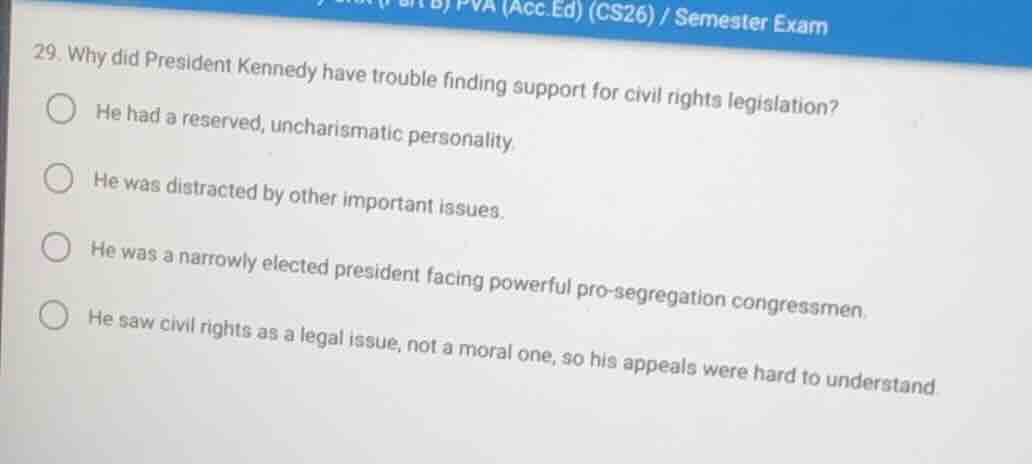
- why did president kennedy have trouble finding support for civil rights legislation?
he had a reserved, uncharismatic personality.
he was distracted by other important issues.
he was a narrowly elected president facing powerful pro-segregation congressmen.
he saw civil rights as a legal issue, not a moral one, so his appeals were hard to understand.
<pre_analysis>
{
"quality": "clear",
"question_count": 1,
"skills_matched": [
"direct_cot",
"multiple_choice_formatter",
"explain_then_answer",
"tutor"
],
"needs_drawing": false,
"concepts_used": [
"Civil Rights Movement"
],
"new_concepts": [
"JFK Administration",
"Southern Democrats in Congress"
],
"current_concepts": [
"Civil Rights Movement",
"JFK Administration",
"Southern Democrats in Congress"
]
}
</pre_analysis>
<reasoning>
Analyze Kennedy's electoral mandate
President John F. Kennedy won the 1960 presidential election by one of the narrowest popular vote margins in American history. This narrow victory meant he lacked a strong popular mandate, making him cautious about pursuing controversial domestic policies that could alienate key factions of his party.
Identify congressional obstacles
During his presidency, Congress was heavily influenced by powerful Southern Democrats who chaired key committees. These conservative Southern congressmen strongly opposed civil rights legislation and held the power to block not only civil rights bills but also other parts of Kennedy's "New Frontier" legislative agenda.
Connect to the Civil Rights Movement
Because of these political realities, Kennedy initially hesitated to push aggressively for federal civil rights legislation, fearing it would fracture the Democratic Party and stall his other legislative goals. This directly relates to the political dynamics of the Civil Rights Movement era, where legislative progress required navigating intense regional divisions.
Evaluate the given options
- Option 1: Kennedy was widely known for his highly charismatic, youthful, and engaging personality, making this option historically incorrect.
- Option 2: While foreign policy issues like the Cold War were prominent, the primary structural barrier to domestic civil rights legislation was political opposition in Congress.
- Option 3: This option accurately describes his narrow electoral victory and the immense legislative power wielded by pro-segregation Southern Democrats in Congress.
- Option 4: Kennedy famously declared civil rights to be a "moral issue" in his June 1963 televised address, making this option incorrect.
</reasoning>
<answer>
<mcq-option>He had a reserved, uncharismatic personality.</mcq-option>
<mcq-option>He was distracted by other important issues.</mcq-option>
<mcq-correct>He was a narrowly elected president facing powerful pro-segregation congressmen.</mcq-correct>
<mcq-option>He saw civil rights as a legal issue, not a moral one, so his appeals were hard to understand.</mcq-option>
</answer>
<post_analysis>
{
"subject": "Social Science",
"question_type": "Multiple Choice",
"knowledge_point": [
"Social Science",
"U.S. History",
"Civil Rights Movement and JFK Administration"
]
}
</post_analysis>
Snap & solve any problem in the app
Get step-by-step solutions on Sovi AI
Photo-based solutions with guided steps
Explore more problems and detailed explanations
<pre_analysis>
{
"quality": "clear",
"question_count": 1,
"skills_matched": [
"direct_cot",
"multiple_choice_formatter",
"explain_then_answer",
"tutor"
],
"needs_drawing": false,
"concepts_used": [
"Civil Rights Movement"
],
"new_concepts": [
"JFK Administration",
"Southern Democrats in Congress"
],
"current_concepts": [
"Civil Rights Movement",
"JFK Administration",
"Southern Democrats in Congress"
]
}
</pre_analysis>
<reasoning>
Analyze Kennedy's electoral mandate
President John F. Kennedy won the 1960 presidential election by one of the narrowest popular vote margins in American history. This narrow victory meant he lacked a strong popular mandate, making him cautious about pursuing controversial domestic policies that could alienate key factions of his party.
Identify congressional obstacles
During his presidency, Congress was heavily influenced by powerful Southern Democrats who chaired key committees. These conservative Southern congressmen strongly opposed civil rights legislation and held the power to block not only civil rights bills but also other parts of Kennedy's "New Frontier" legislative agenda.
Connect to the Civil Rights Movement
Because of these political realities, Kennedy initially hesitated to push aggressively for federal civil rights legislation, fearing it would fracture the Democratic Party and stall his other legislative goals. This directly relates to the political dynamics of the Civil Rights Movement era, where legislative progress required navigating intense regional divisions.
Evaluate the given options
- Option 1: Kennedy was widely known for his highly charismatic, youthful, and engaging personality, making this option historically incorrect.
- Option 2: While foreign policy issues like the Cold War were prominent, the primary structural barrier to domestic civil rights legislation was political opposition in Congress.
- Option 3: This option accurately describes his narrow electoral victory and the immense legislative power wielded by pro-segregation Southern Democrats in Congress.
- Option 4: Kennedy famously declared civil rights to be a "moral issue" in his June 1963 televised address, making this option incorrect.
</reasoning>
<answer>
<mcq-option>He had a reserved, uncharismatic personality.</mcq-option>
<mcq-option>He was distracted by other important issues.</mcq-option>
<mcq-correct>He was a narrowly elected president facing powerful pro-segregation congressmen.</mcq-correct>
<mcq-option>He saw civil rights as a legal issue, not a moral one, so his appeals were hard to understand.</mcq-option>
</answer>
<post_analysis>
{
"subject": "Social Science",
"question_type": "Multiple Choice",
"knowledge_point": [
"Social Science",
"U.S. History",
"Civil Rights Movement and JFK Administration"
]
}
</post_analysis>