QUESTION IMAGE
Question
20
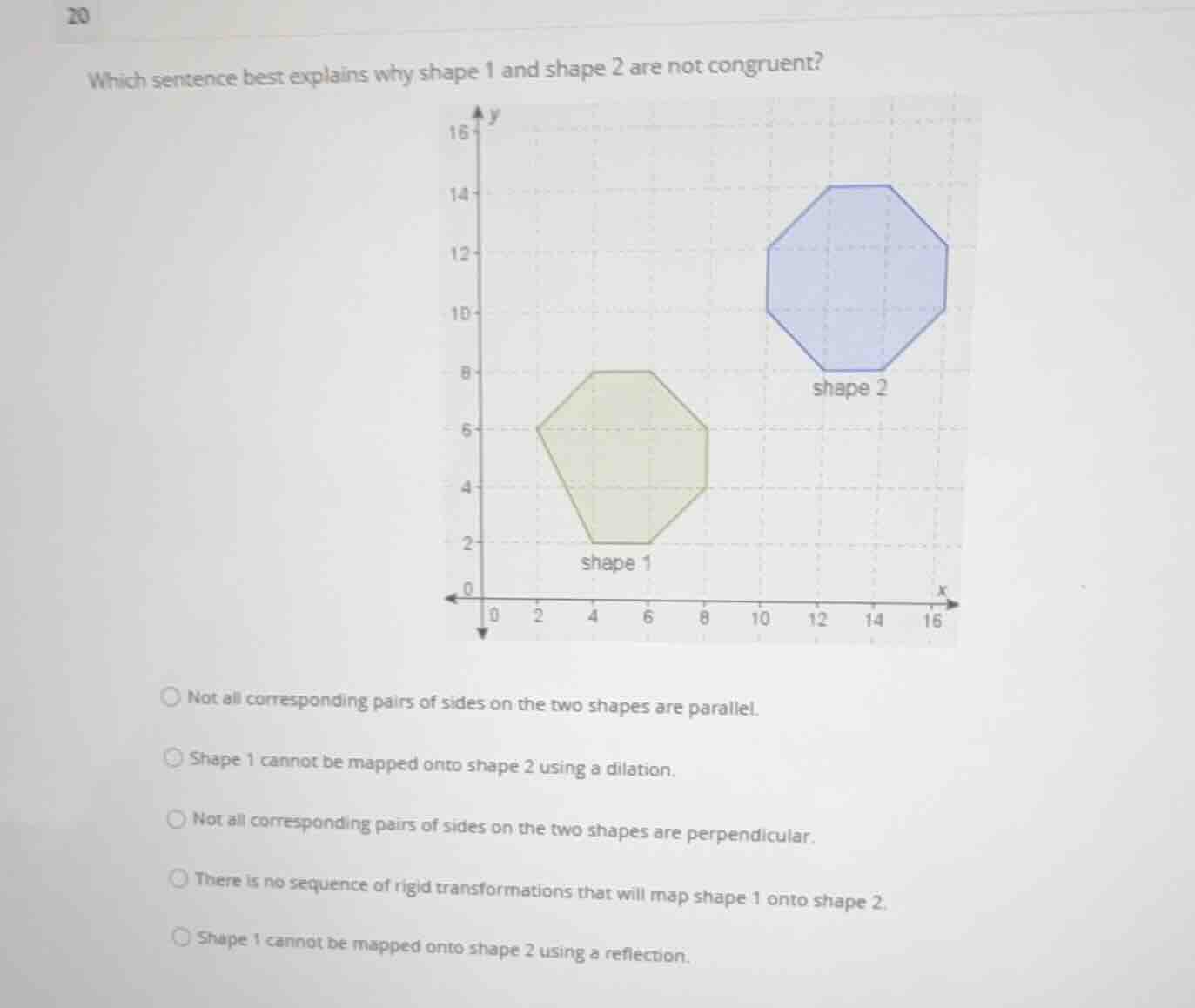
which sentence best explains why shape 1 and shape 2 are not congruent?
not all corresponding pairs of sides on the two shapes are parallel.
shape 1 cannot be mapped onto shape 2 using a dilation.
not all corresponding pairs of sides on the two shapes are perpendicular.
there is no sequence of rigid transformations that will map shape 1 onto shape 2.
shape 1 cannot be mapped onto shape 2 using a reflection.
Analyze the shapes
Using the Rigid Transformations knowledge point
- Shape 1 is a heptagon (7-sided polygon) with vertices at \((2,6)\), \((4,8)\), \((6,8)\), \((8,6)\), \((8,4)\), \((6,2)\), and \((4,2)\).
- Shape 2 is an octagon (8-sided polygon) with vertices at \((10,10)\), \((10,12)\), \((12,14)\), \((14,14)\), \((16,12)\), \((16,10)\), \((14,8)\), and \((12,8)\).
Apply congruence definition
- Congruent figures must have the same size and shape.
- Mathematically, two figures are congruent if and only if there exists a sequence of rigid transformations (translations, rotations, and reflections) that maps one figure onto the other.
- Since Shape 1 has 7 sides and Shape 2 has 8 sides, they are not congruent.
- Therefore, no sequence of rigid transformations can map Shape 1 onto Shape 2.
Evaluate the options
- Option 1: Parallel sides are not required for congruence.
- Option 2: Dilations change size, which is not used to show congruence.
- Option 3: Perpendicular sides are not required for congruence.
- Option 4: Correctly states that no sequence of rigid transformations can map Shape 1 onto Shape 2.
- Option 5: A single reflection is not the only way to show congruence.

Snap & solve any problem in the app
Get step-by-step solutions on Sovi AI
Photo-based solutions with guided steps
Explore more problems and detailed explanations
- Not all corresponding pairs of sides on the two shapes are parallel.
- Shape 1 cannot be mapped onto shape 2 using a dilation.
- Not all corresponding pairs of sides on the two shapes are perpendicular.
- There is no sequence of rigid transformations that will map shape 1 onto shape 2. (Correct answer)
- Shape 1 cannot be mapped onto shape 2 using a reflection.