Sovi.AI - AI Math Tutor

Scan to solve math questions

QUESTION IMAGE

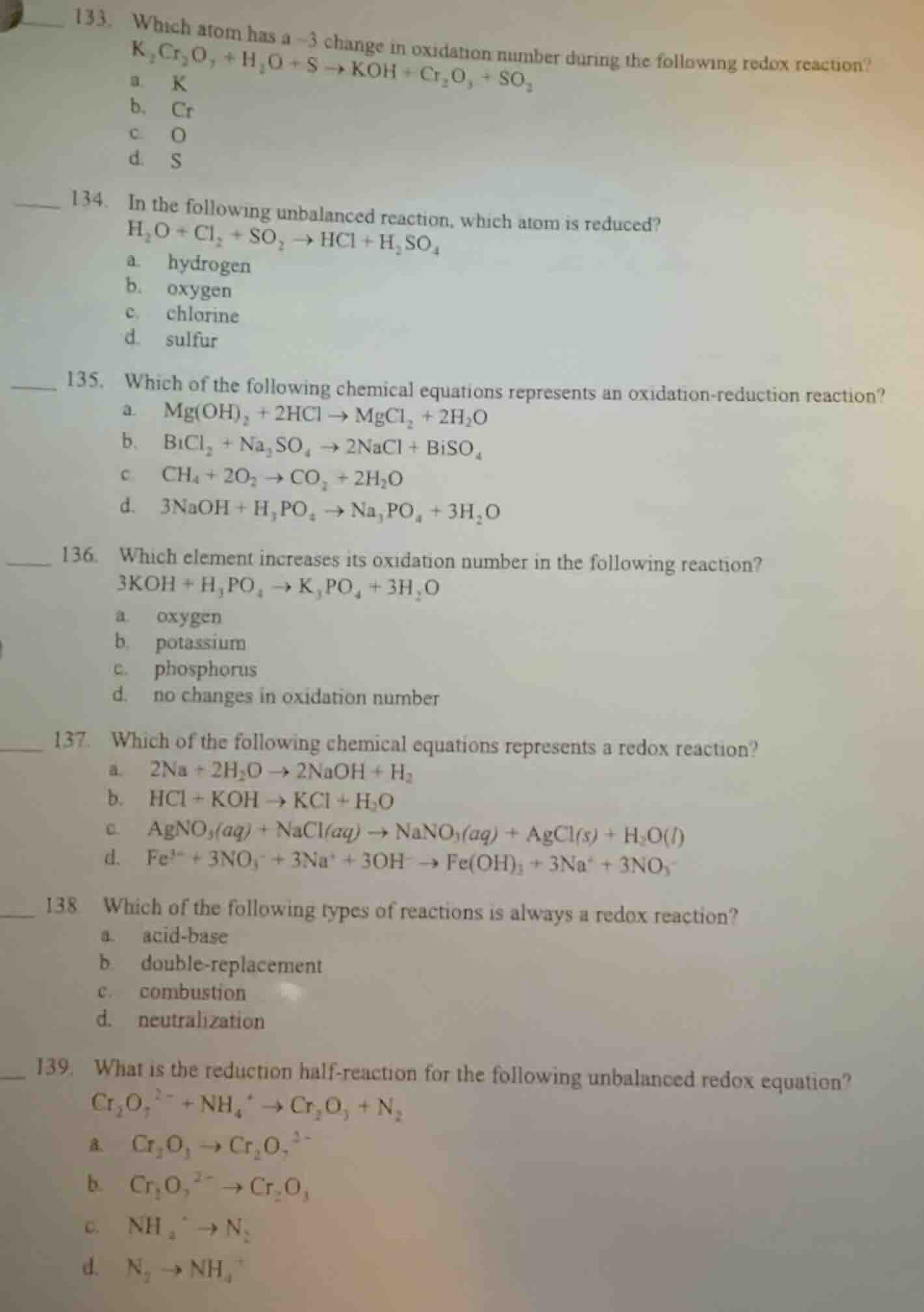
133. which atom has a -3 change in oxidation number during the followin…

Question

  1. which atom has a -3 change in oxidation number during the following redox reaction?

\\(\text{k}_2\text{cr}_2\text{o}_7 + \text{h}_2\text{o} + \text{s} \
ightarrow \text{koh} + \text{cr}_2\text{o}_3 + \text{so}_2\\)
a. k
b. cr
c. o
d. s

  1. in the following unbalanced reaction, which atom is reduced?

\\(\text{h}_2\text{o} + \text{cl}_2 + \text{so}_2 \
ightarrow \text{hcl} + \text{h}_2\text{so}_4\\)
a. hydrogen
b. oxygen
c. chlorine
d. sulfur

  1. which of the following chemical equations represents an oxidation-reduction reaction?

a. \\(\text{mg(oh)}_2 + 2\text{hcl} \
ightarrow \text{mgcl}_2 + 2\text{h}_2\text{o}\\)
b. \\(\text{bicl}_3 + \text{na}_2\text{so}_4 \
ightarrow 2\text{nacl} + \text{biso}_4\\)
c. \\(\text{ch}_4 + 2\text{o}_2 \
ightarrow \text{co}_2 + 2\text{h}_2\text{o}\\)
d. \\(3\text{naoh} + \text{h}_3\text{po}_4 \
ightarrow \text{na}_3\text{po}_4 + 3\text{h}_2\text{o}\\)

  1. which element increases its oxidation number in the following reaction?

\\(3\text{koh} + \text{h}_3\text{po}_4 \
ightarrow \text{k}_3\text{po}_4 + 3\text{h}_2\text{o}\\)
a. oxygen
b. potassium
c. phosphorus
d. no changes in oxidation number

  1. which of the following chemical equations represents a redox reaction?

a. \\(2\text{na} + 2\text{h}_2\text{o} \
ightarrow 2\text{naoh} + \text{h}_2\\)
b. \\(\text{hcl} + \text{koh} \
ightarrow \text{kcl} + \text{h}_2\text{o}\\)
c. \\(\text{agno}_3(aq) + \text{nacl}(aq) \
ightarrow \text{nano}_3(aq) + \text{agcl}(s) + \text{h}_2\text{o}(l)\\)
d. \\(\text{fe}^{3+} + 3\text{no}_3^- + 3\text{na}^+ + 3\text{oh}^- \
ightarrow \text{fe(oh)}_3 + 3\text{na}^+ + 3\text{no}_3^-\\)

  1. which of the following types of reactions is always a redox reaction?

a. acid-base
b. double-replacement
c. combustion
d. neutralization

  1. what is the reduction half-reaction for the following unbalanced redox equation?

\\(\text{cr}_2\text{o}_7^{2-} + \text{nh}_4^+ \
ightarrow \text{cr}_2\text{o}_3 + \text{n}_2\\)
a. \\(\text{cr}_2\text{o}_3 \
ightarrow \text{cr}_2\text{o}_7^{2-}\\)
b. \\(\text{cr}_2\text{o}_7^{2-} \
ightarrow \text{cr}_2\text{o}_3\\)
c. \\(\text{nh}_4^+ \
ightarrow \text{n}_2\\)
d. \\(\text{n}_2 \
ightarrow \text{nh}_4^+\\)

Explanation:

Response

<pre_analysis>
{
"quality": "clear",
"question_count": 7,
"skills_matched": [
"step_cot",
"multiple_choice_formatter",
"explain_then_answer",
"tutor",
"mastery_adaptive_brevity"
],
"needs_drawing": false,
"concepts_used": [
"Oxidation Numbers",
"Redox Rules",
"Half-Reaction Method"
],
"new_concepts": [],
"current_concepts": [
"Oxidation Numbers",
"Redox Rules",
"Half-Reaction Method",
"Redox Balancing"
]
}
</pre_analysis>

<reasoning>

Determine oxidation state changes for Question 133

Using the Oxidation Numbers and Redox Rules knowledge points
\[

$$\begin{aligned} &\text{In } \text{K}_2\text{Cr}_2\text{O}_7: \text{K} = +1, \text{O} = -2 \implies 2(+1) + 2(\text{Cr}) + 7(-2) = 0 \implies \text{Cr} = +6\\ &\text{In } \text{Cr}_2\text{O}_3: \text{O} = -2 \implies 2(\text{Cr}) + 3(-2) = 0 \implies \text{Cr} = +3\\ &\text{Change for Cr}: +3 - (+6) = -3 \end{aligned}$$

\]

Identify the reduced atom in Question 134

Using the Oxidation Numbers and Redox Rules knowledge points
\[

$$\begin{aligned} &\text{In } \text{Cl}_2 \text{ (elemental form)}: \text{Cl} = 0\\ &\text{In } \text{HCl}: \text{H} = +1 \implies \text{Cl} = -1\\ &\text{Since the oxidation number of chlorine decreases from } 0 \text{ to } -1\text{, chlorine is reduced.} \end{aligned}$$

\]

Identify the redox reaction in Question 135

Using the Oxidation Numbers and Redox Rules knowledge points
\[

$$\begin{aligned} &\text{In reaction (c): } \text{CH}_4 + 2\text{O}_2 ightarrow \text{CO}_2 + 2\text{H}_2\text{O}\\ &\text{Reactants: C in } \text{CH}_4 = -4, \text{O in } \text{O}_2 = 0\\ &\text{Products: C in } \text{CO}_2 = +4, \text{O in } \text{CO}_2 \text{ and } \text{H}_2\text{O} = -2\\ &\text{Since oxidation numbers change, this is a redox reaction.} \end{aligned}$$

\]

Analyze oxidation number changes in Question 136

Using the Oxidation Numbers and Redox Rules knowledge points
\[

$$\begin{aligned} &\text{Reactants: } \text{K} = +1, \text{O} = -2, \text{H} = +1 \text{ (in KOH and } \text{H}_3\text{PO}_4\text{)}, \text{P} = +5 \text{ (in } \text{H}_3\text{PO}_4\text{)}\\ &\text{Products: } \text{K} = +1, \text{P} = +5, \text{O} = -2 \text{ (in } \text{K}_3\text{PO}_4\text{)}, \text{H} = +1, \text{O} = -2 \text{ (in } \text{H}_2\text{O}\text{)}\\ &\text{No elements change their oxidation numbers during this acid-base neutralization reaction.} \end{aligned}$$

\]

Identify the redox reaction in Question 137

Using the Oxidation Numbers and Redox Rules knowledge points
\[

$$\begin{aligned} &\text{In reaction (a): } 2\text{Na} + 2\text{H}_2\text{O} ightarrow 2\text{NaOH} + \text{H}_2\\ &\text{Reactants: Na} = 0, \text{H in } \text{H}_2\text{O} = +1\\ &\text{Products: Na in NaOH} = +1, \text{H in } \text{H}_2 = 0\\ &\text{Since oxidation numbers change, this is a redox reaction.} \end{aligned}$$

\]

Determine the reaction type that is always redox in Question 138

Using the Oxidation Numbers knowledge point
\[

$$\begin{aligned} &\text{Combustion always involves a substance reacting with elemental oxygen } (\text{O}_2, \text{ oxidation state } 0)\\ &\text{to form compounds where oxygen has an oxidation state of } -2.\\ &\text{Therefore, combustion is always a redox reaction.} \end{aligned}$$

\]

Identify the reduction half-reaction in Question 139

Using the Half-Reaction Method and Oxidation Numbers knowledge points
\[
\begin{aligned}
&\text{In } \text{Cr}_2\text{O}_7^{2-}: \text{Cr} = +6\\
&\text{In } \text{Cr}_2\text{O}_3: \text{Cr} = +3\\
&\text{Reduction is the decrease in oxidation state: } \text…

Answer:

<pre_analysis>
{
"quality": "clear",
"question_count": 7,
"skills_matched": [
"step_cot",
"multiple_choice_formatter",
"explain_then_answer",
"tutor",
"mastery_adaptive_brevity"
],
"needs_drawing": false,
"concepts_used": [
"Oxidation Numbers",
"Redox Rules",
"Half-Reaction Method"
],
"new_concepts": [],
"current_concepts": [
"Oxidation Numbers",
"Redox Rules",
"Half-Reaction Method",
"Redox Balancing"
]
}
</pre_analysis>

<reasoning>

Determine oxidation state changes for Question 133

Using the Oxidation Numbers and Redox Rules knowledge points
\[

$$\begin{aligned} &\text{In } \text{K}_2\text{Cr}_2\text{O}_7: \text{K} = +1, \text{O} = -2 \implies 2(+1) + 2(\text{Cr}) + 7(-2) = 0 \implies \text{Cr} = +6\\ &\text{In } \text{Cr}_2\text{O}_3: \text{O} = -2 \implies 2(\text{Cr}) + 3(-2) = 0 \implies \text{Cr} = +3\\ &\text{Change for Cr}: +3 - (+6) = -3 \end{aligned}$$

\]

Identify the reduced atom in Question 134

Using the Oxidation Numbers and Redox Rules knowledge points
\[

$$\begin{aligned} &\text{In } \text{Cl}_2 \text{ (elemental form)}: \text{Cl} = 0\\ &\text{In } \text{HCl}: \text{H} = +1 \implies \text{Cl} = -1\\ &\text{Since the oxidation number of chlorine decreases from } 0 \text{ to } -1\text{, chlorine is reduced.} \end{aligned}$$

\]

Identify the redox reaction in Question 135

Using the Oxidation Numbers and Redox Rules knowledge points
\[

$$\begin{aligned} &\text{In reaction (c): } \text{CH}_4 + 2\text{O}_2 ightarrow \text{CO}_2 + 2\text{H}_2\text{O}\\ &\text{Reactants: C in } \text{CH}_4 = -4, \text{O in } \text{O}_2 = 0\\ &\text{Products: C in } \text{CO}_2 = +4, \text{O in } \text{CO}_2 \text{ and } \text{H}_2\text{O} = -2\\ &\text{Since oxidation numbers change, this is a redox reaction.} \end{aligned}$$

\]

Analyze oxidation number changes in Question 136

Using the Oxidation Numbers and Redox Rules knowledge points
\[

$$\begin{aligned} &\text{Reactants: } \text{K} = +1, \text{O} = -2, \text{H} = +1 \text{ (in KOH and } \text{H}_3\text{PO}_4\text{)}, \text{P} = +5 \text{ (in } \text{H}_3\text{PO}_4\text{)}\\ &\text{Products: } \text{K} = +1, \text{P} = +5, \text{O} = -2 \text{ (in } \text{K}_3\text{PO}_4\text{)}, \text{H} = +1, \text{O} = -2 \text{ (in } \text{H}_2\text{O}\text{)}\\ &\text{No elements change their oxidation numbers during this acid-base neutralization reaction.} \end{aligned}$$

\]

Identify the redox reaction in Question 137

Using the Oxidation Numbers and Redox Rules knowledge points
\[

$$\begin{aligned} &\text{In reaction (a): } 2\text{Na} + 2\text{H}_2\text{O} ightarrow 2\text{NaOH} + \text{H}_2\\ &\text{Reactants: Na} = 0, \text{H in } \text{H}_2\text{O} = +1\\ &\text{Products: Na in NaOH} = +1, \text{H in } \text{H}_2 = 0\\ &\text{Since oxidation numbers change, this is a redox reaction.} \end{aligned}$$

\]

Determine the reaction type that is always redox in Question 138

Using the Oxidation Numbers knowledge point
\[

$$\begin{aligned} &\text{Combustion always involves a substance reacting with elemental oxygen } (\text{O}_2, \text{ oxidation state } 0)\\ &\text{to form compounds where oxygen has an oxidation state of } -2.\\ &\text{Therefore, combustion is always a redox reaction.} \end{aligned}$$

\]

Identify the reduction half-reaction in Question 139

Using the Half-Reaction Method and Oxidation Numbers knowledge points
\[

$$\begin{aligned} &\text{In } \text{Cr}_2\text{O}_7^{2-}: \text{Cr} = +6\\ &\text{In } \text{Cr}_2\text{O}_3: \text{Cr} = +3\\ &\text{Reduction is the decrease in oxidation state: } \text{Cr}_2\text{O}_7^{2-} ightarrow \text{Cr}_2\text{O}_3 \end{aligned}$$

\]
</reasoning>

<answer>

Question 133

<mcq-option>a. K</mcq-option>
<mcq-correct>b. Cr</mcq-correct>
<mcq-option>c. O</mcq-option>
<mcq-option>d. S</mcq-option>

Question 134

<mcq-option>a. hydrogen</mcq-option>
<mcq-option>b. oxygen</mcq-correct>
<mcq-correct>c. chlorine</mcq-correct>
<mcq-option>d. sulfur</mcq-option>

Question 135

<mcq-option>a. Mg(OH)₂ + 2HCl → MgCl₂ + 2H₂O</mcq-option>
<mcq-option>b. BiCl₂ + Na₂SO₄ → 2NaCl + BiSO₄</mcq-option>
<mcq-correct>c. CH₄ + 2O₂ → CO₂ + 2H₂O</mcq-correct>
<mcq-option>d. 3NaOH + H₃PO₄ → Na₃PO₄ + 3H₂O</mcq-option>

Question 136

<mcq-option>a. oxygen</mcq-option>
<mcq-option>b. potassium</mcq-option>
<mcq-option>c. phosphorus</mcq-option>
<mcq-correct>d. no changes in oxidation number</mcq-correct>

Question 137

<mcq-correct>a. 2Na + 2H₂O → 2NaOH + H₂</mcq-correct>
<mcq-option>b. HCl + KOH → KCl + H₂O</mcq-option>
<mcq-option>c. AgNO₃(aq) + NaCl(aq) → NaNO₃(aq) + AgCl(s) + H₂O(l)</mcq-option>
<mcq-option>d. Fe³⁺ + 3NO₃⁻ + 3Na⁺ + 3OH⁻ → Fe(OH)₃ + 3Na⁺ + 3NO₃⁻</mcq-option>

Question 138

<mcq-option>a. acid-base</mcq-option>
<mcq-option>b. double-replacement</mcq-option>
<mcq-correct>c. combustion</mcq-correct>
<mcq-option>d. neutralization</mcq-option>

Question 139

<mcq-option>a. Cr₂O₃ → Cr₂O₇²⁻</mcq-option>
<mcq-correct>b. Cr₂O₇²⁻ → Cr₂O₃</mcq-correct>
<mcq-option>c. NH₄⁺ → N₂</mcq-option>
<mcq-option>d. N₂ → NH₄⁺</mcq-option>
</answer>

<post_analysis>
{
"subject": "Natural Science",
"question_type": "Multi-part",
"knowledge_point": [
"Natural Science",
"Chemistry",
"Redox Reactions"
]
}
</post_analysis>