QUESTION IMAGE
Question
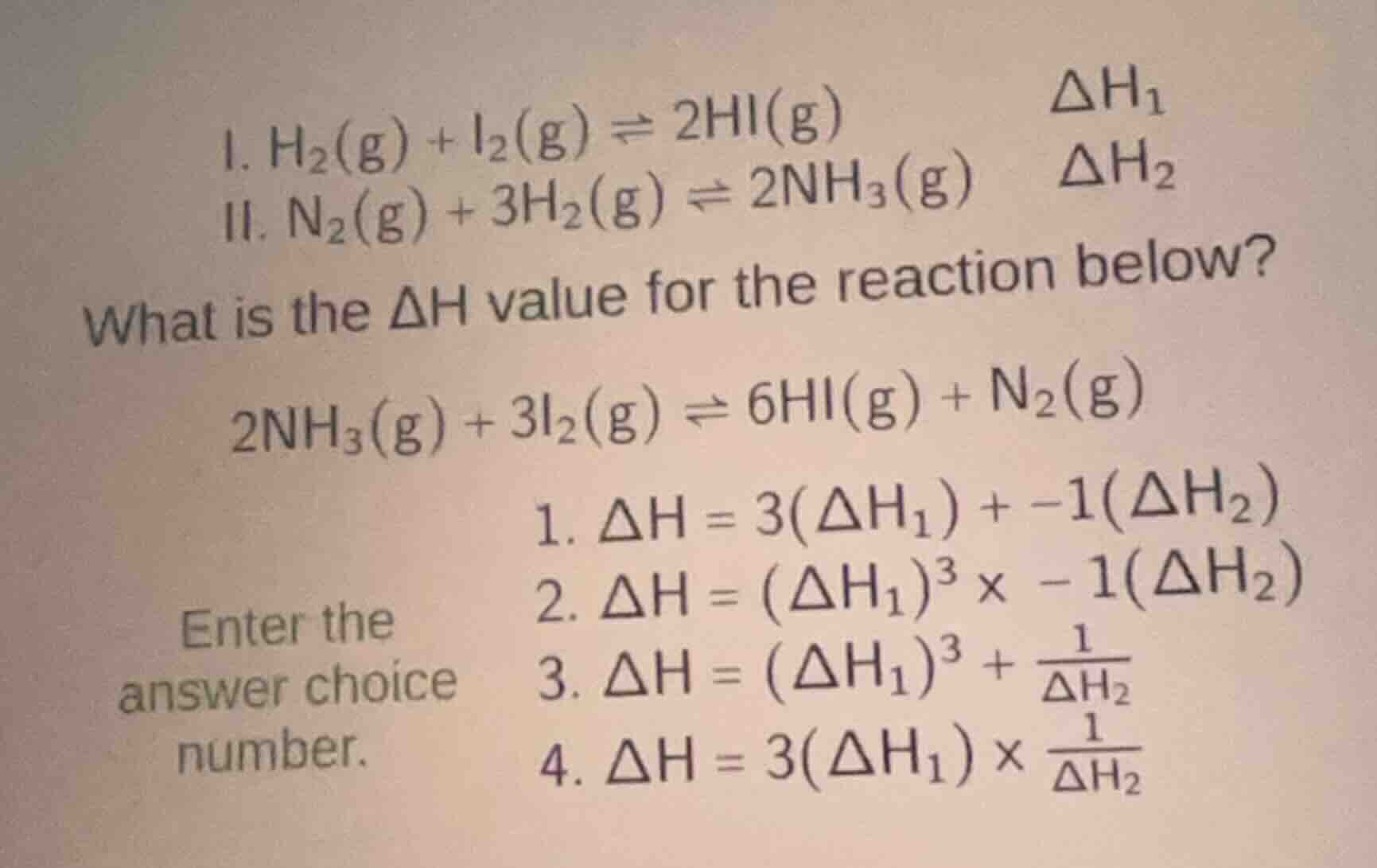
i. \\(\text{h}_2(\text{g}) + \text{i}_2(\text{g}) \
ightleftharpoons 2\text{hi}(\text{g})\\) \\(\delta h_1\\)
ii. \\(\text{n}_2(\text{g}) + 3\text{h}_2(\text{g}) \
ightleftharpoons 2\text{nh}_3(\text{g})\\) \\(\delta h_2\\)
what is the \\(\delta h\\) value for the reaction below?
\\(2\text{nh}_3(\text{g}) + 3\text{i}_2(\text{g}) \
ightleftharpoons 6\text{hi}(\text{g}) + \text{n}_2(\text{g})\\)
enter the answer choice number.
- \\(\delta h = 3(\delta h_1) + -1(\delta h_2)\\)
- \\(\delta h = (\delta h_1)^3 \times -1(\delta h_2)\\)
- \\(\delta h = (\delta h_1)^3 + \frac{1}{\delta h_2}\\)
- \\(\delta h = 3(\delta h_1) \times \frac{1}{\delta h_2}\\)
Analyze the target chemical reaction
Using the Hesss Law for Equilibrium knowledge point
We need to find the enthalpy change \(\Delta H\) for the target reaction:
Express target reaction using given steps
Using the Hesss Law for Equilibrium knowledge point
We are given two reference reactions with their respective enthalpy changes:
- \(\text{H}_2(g) + \text{I}_2(g)
ightleftharpoons 2\text{HI}(g) \quad \Delta H_1\)
- \(\text{N}_2(g) + 3\text{H}_2(g)
ightleftharpoons 2\text{NH}_3(g) \quad \Delta H_2\)
To construct the target reaction:
- We need \(2\text{NH}_3(g)\) on the reactant side. We reverse reaction II:
- We need \(6\text{HI}(g)\) on the product side. We multiply reaction I by 3:
Combine the modified reactions
Using the Hesss Law for Equilibrium knowledge point
Adding the two modified equations:
The overall enthalpy change \(\Delta H\) is the sum of the modified enthalpies:
This matches option 1.

Snap & solve any problem in the app
Get step-by-step solutions on Sovi AI
Photo-based solutions with guided steps
Explore more problems and detailed explanations
- 1. \(\Delta H = 3(\Delta H_1) + -1(\Delta H_2)\) (Correct answer)
- 2. \(\Delta H = (\Delta H_1)^3 \times -1(\Delta H_2)\)
- 3. \(\Delta H = (\Delta H_1)^3 + \frac{1}{\Delta H_2}\)
- 4. \(\Delta H = 3(\Delta H_1) \times \frac{1}{\Delta H_2}\)