QUESTION IMAGE
Question
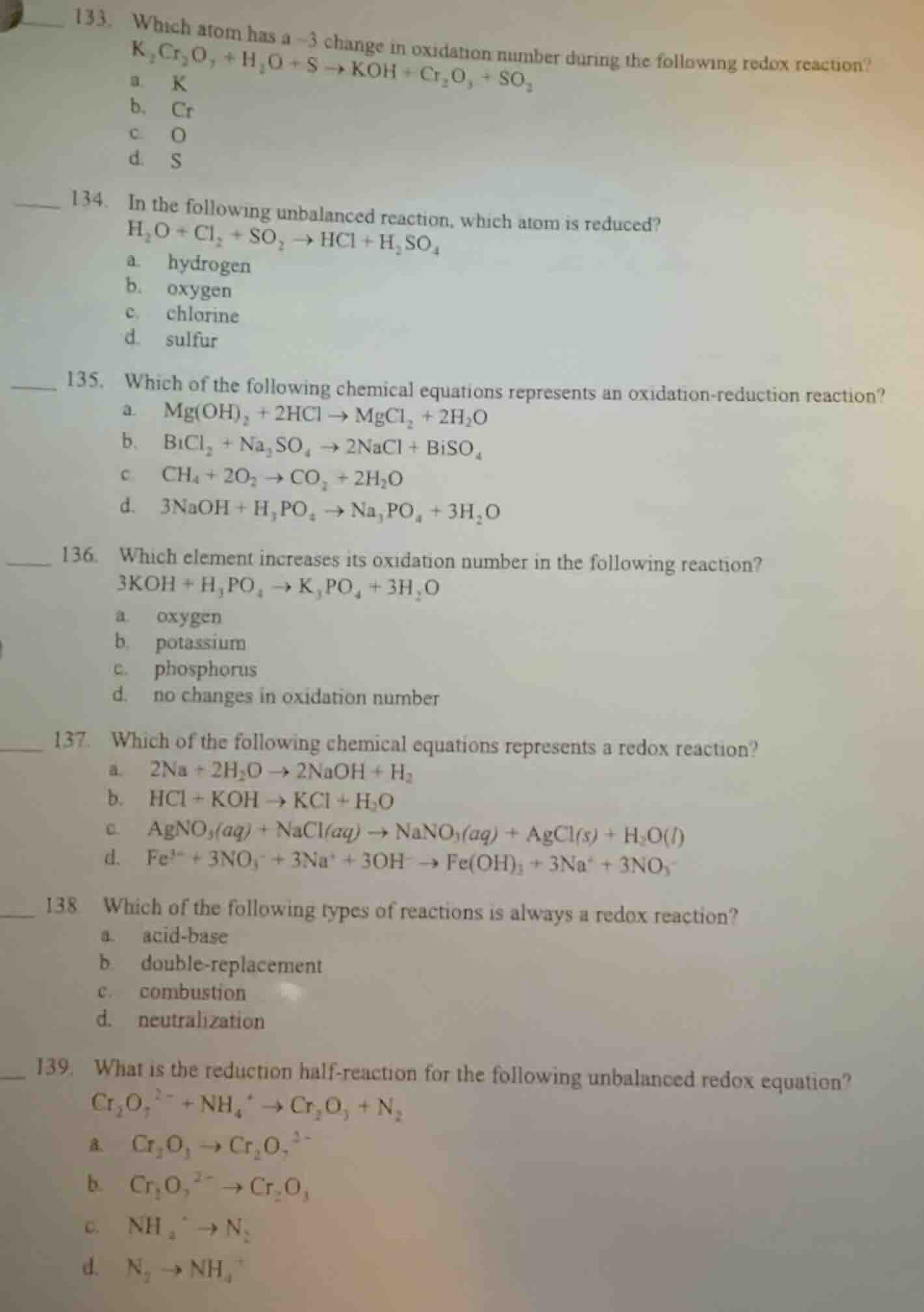
- which atom has a -3 change in oxidation number during the following redox reaction?
\\(\text{k}_2\text{cr}_2\text{o}_7 + \text{h}_2\text{o} + \text{s} \
ightarrow \text{koh} + \text{cr}_2\text{o}_3 + \text{so}_2\\)
a. k
b. cr
c. o
d. s
- in the following unbalanced reaction, which atom is reduced?
\\(\text{h}_2\text{o} + \text{cl}_2 + \text{so}_2 \
ightarrow \text{hcl} + \text{h}_2\text{so}_4\\)
a. hydrogen
b. oxygen
c. chlorine
d. sulfur
- which of the following chemical equations represents an oxidation-reduction reaction?
a. \\(\text{mg(oh)}_2 + 2\text{hcl} \
ightarrow \text{mgcl}_2 + 2\text{h}_2\text{o}\\)
b. \\(\text{bicl}_3 + \text{na}_2\text{so}_4 \
ightarrow 2\text{nacl} + \text{biso}_4\\)
c. \\(\text{ch}_4 + 2\text{o}_2 \
ightarrow \text{co}_2 + 2\text{h}_2\text{o}\\)
d. \\(3\text{naoh} + \text{h}_3\text{po}_4 \
ightarrow \text{na}_3\text{po}_4 + 3\text{h}_2\text{o}\\)
- which element increases its oxidation number in the following reaction?
\\(3\text{koh} + \text{h}_3\text{po}_4 \
ightarrow \text{k}_3\text{po}_4 + 3\text{h}_2\text{o}\\)
a. oxygen
b. potassium
c. phosphorus
d. no changes in oxidation number
- which of the following chemical equations represents a redox reaction?
a. \\(2\text{na} + 2\text{h}_2\text{o} \
ightarrow 2\text{naoh} + \text{h}_2\\)
b. \\(\text{hcl} + \text{koh} \
ightarrow \text{kcl} + \text{h}_2\text{o}\\)
c. \\(\text{agno}_3(aq) + \text{nacl}(aq) \
ightarrow \text{nano}_3(aq) + \text{agcl}(s) + \text{h}_2\text{o}(l)\\)
d. \\(\text{fe}^{3+} + 3\text{no}_3^- + 3\text{na}^+ + 3\text{oh}^- \
ightarrow \text{fe(oh)}_3 + 3\text{na}^+ + 3\text{no}_3^-\\)
- which of the following types of reactions is always a redox reaction?
a. acid-base
b. double-replacement
c. combustion
d. neutralization
- what is the reduction half-reaction for the following unbalanced redox equation?
\\(\text{cr}_2\text{o}_7^{2-} + \text{nh}_4^+ \
ightarrow \text{cr}_2\text{o}_3 + \text{n}_2\\)
a. \\(\text{cr}_2\text{o}_3 \
ightarrow \text{cr}_2\text{o}_7^{2-}\\)
b. \\(\text{cr}_2\text{o}_7^{2-} \
ightarrow \text{cr}_2\text{o}_3\\)
c. \\(\text{nh}_4^+ \
ightarrow \text{n}_2\\)
d. \\(\text{n}_2 \
ightarrow \text{nh}_4^+\\)
Determine oxidation state changes for Question 133
Using the Oxidation Numbers and Redox Rules knowledge points
Identify the reduced atom in Question 134
Using the Oxidation Numbers and Redox Rules knowledge points
Identify the redox reaction in Question 135
Using the Oxidation Numbers and Redox Rules knowledge points
Analyze oxidation number changes in Question 136
Using the Oxidation Numbers and Redox Rules knowledge points
Identify the redox reaction in Question 137
Using the Oxidation Numbers and Redox Rules knowledge points
Determine the reaction type that is always redox in Question 138
Using the Oxidation Numbers knowledge point
Identify the reduction half-reaction in Question 139
Using the Half-Reaction Method and Oxidation Numbers knowledge points
\[
\begin{aligned}
&\text{In } \text{Cr}_2\text{O}_7^{2-}: \text{Cr} = +6\\
&\text{In } \text{Cr}_2\text{O}_3: \text{Cr} = +3\\
&\text{Reduction is the decrease in oxidation state: } \text…

Snap & solve any problem in the app
Get step-by-step solutions on Sovi AI
Photo-based solutions with guided steps
Explore more problems and detailed explanations
Question 133
- a. K
- b. Cr (Correct answer)
- c. O
- d. S
Question 134
- a. hydrogen
- b. oxygen</mcq-correct>
- c. chlorine (Correct answer)
<mcq-option>d. sulfur
Question 135
- a. Mg(OH)₂ + 2HCl → MgCl₂ + 2H₂O
- b. BiCl₂ + Na₂SO₄ → 2NaCl + BiSO₄
- c. CH₄ + 2O₂ → CO₂ + 2H₂O (Correct answer)
- d. 3NaOH + H₃PO₄ → Na₃PO₄ + 3H₂O
Question 136
- a. oxygen
- b. potassium
- c. phosphorus
- d. no changes in oxidation number (Correct answer)
Question 137
- a. 2Na + 2H₂O → 2NaOH + H₂ (Correct answer)
- b. HCl + KOH → KCl + H₂O
- c. AgNO₃(aq) + NaCl(aq) → NaNO₃(aq) + AgCl(s) + H₂O(l)
- d. Fe³⁺ + 3NO₃⁻ + 3Na⁺ + 3OH⁻ → Fe(OH)₃ + 3Na⁺ + 3NO₃⁻
Question 138
- a. acid-base
- b. double-replacement
- c. combustion (Correct answer)
- d. neutralization
Question 139
- a. Cr₂O₃ → Cr₂O₇²⁻
- b. Cr₂O₇²⁻ → Cr₂O₃ (Correct answer)
- c. NH₄⁺ → N₂
- d. N₂ → NH₄⁺