QUESTION IMAGE
Question
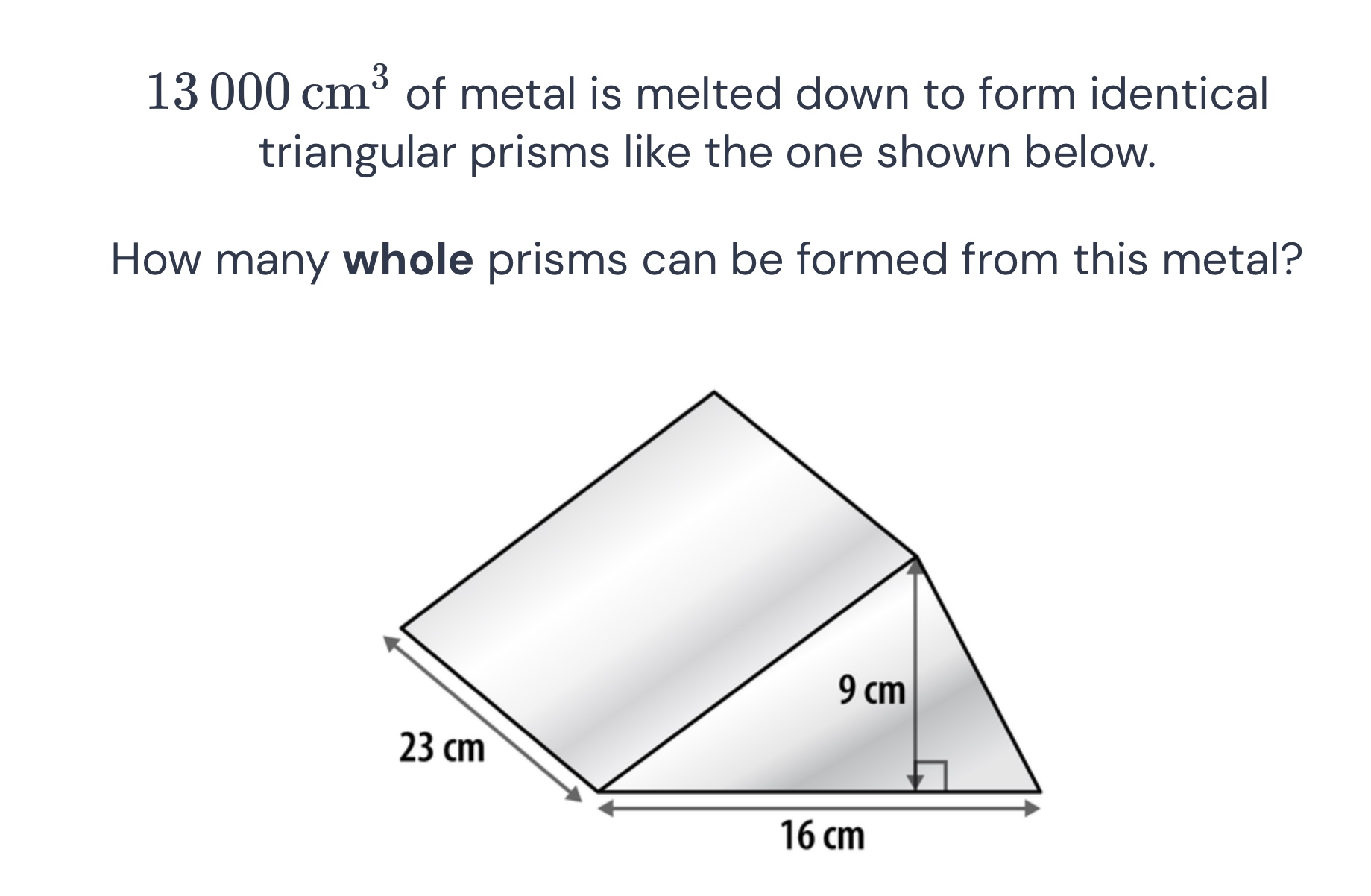
13 000 \text{ cm}^3 of metal is melted down to form identical triangular prisms like the one shown below.
how many whole prisms can be formed from this metal?
⚡ Using what you learned: volume of prisms, pyramids, cylinders, cones, spheres
Step 1: Calculate the area of the triangular base
The base of the prism is a triangle with a base of \( 16\text{ cm} \) and a height of \( 9\text{ cm} \).
$$ \text{Base Area } (B) = \frac{1}{2} \times \text{base} \times \text{height} $$
$$ B = \frac{1}{2} \times 16 \times 9 = 72\text{ cm}^2 $$
Step 2: Calculate the volume of one triangular prism
The length (or height) of the prism is \( 23\text{ cm} \).
$$ \text{Volume } (V) = B \times \text{length} $$
$$ V = 72 \times 23 = 1656\text{ cm}^3 $$
Step 3: Determine the number of whole prisms
Divide the total volume of metal by the volume of one prism and round down to the nearest whole number.
$$ \text{Number of prisms} = \frac{13000}{1656} \approx 7.85 $$
Since only whole prisms can be formed, we round down to \( 7 \).

Snap & solve any problem in the app
Get step-by-step solutions on Sovi AI
Photo-based solutions with guided steps
Explore more problems and detailed explanations
7